




In Shyamnagar, women are turning local knowledge and natural resources into livelihoods while challenging gender discrimination and preserving indigenous traditions.
Women in Bangladesh’s southwestern coastal Shyamnagar upazila are confronting cyclones, storm surges, severe soil salinity and social discrimination while building livelihoods, leading community initiatives and preserving local traditions.
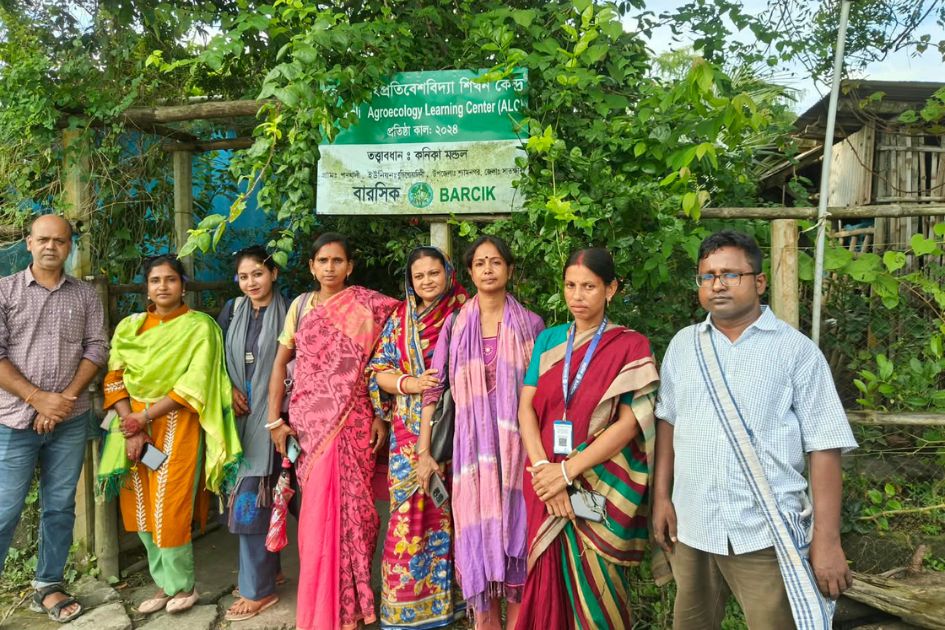
A delegation of development workers from Manikganj, organised by the research and development agency BARCIK, visited several villages in Shyamnagar on Sept 20 to document the lives and struggles of women in the climate-vulnerable area.
In Chok Dhumghat village under Ishwaripur Union, Alpana Rani Misti and her husband, Gangadhar Misti, run an integrated farm focused on environmentally friendly agriculture. Their activities include conserving indigenous seed varieties, cultivating vegetables organically, fish farming and producing vermicompost.
Alpana Rani also leads the Shapla Women’s Development Committee, which works on social issues in the community. The group recently intervened to prevent the child marriage of a local adolescent, Dipika Rani.
Lili Rani Misti, a younger member of the family, has also increased her household’s financial independence while gaining a greater role in family decision-making.
In the same village, Gobinda Mondal’s Agroecology Learning Center demonstrates organic farming practices including growing ginger in sacks and cultivating sweet pineapples and pomelos organically.
In Pankhali village under Burigoalini Union, Konika Mondal’s Agroecology Learning Center serves as a repository of medicinal plants, locally known as the Oshudhi Bari, or House of Medicine. It contains plants including neem, amla and pathorkuchi.
But alongside these efforts toward self-reliance, women in the Sundarbans-adjacent area continue to face gender discrimination and superstition.
When male breadwinners are lost or killed while foraging in the forest, particularly in tiger attacks, women are often left to carry the burden of supporting their families.
Sonomoni, a woman in her 60s who lives in the fishermen’s colony behind Munshiganj market, is one of the area’s so-called “Tiger Widows”.
Her first husband was killed by a tiger in the Sundarbans in 1999. Her in-laws, influenced by local superstitions, described her as “unlucky” and expelled her from the family with her one-month-old infant.
She later married her brother-in-law, but he was also killed by a tiger in 2002. She was subsequently branded a “husband-eater”. Her mother-in-law even physically chained her, believing that seeing her face in the morning would bring bad luck.
Sonomoni raised four children from her two marriages but now lives in isolation without support. She earns a living by sweeping the local market, hauling fishing and crab nets from the river and doing manual labour digging earth in fish enclosures.
She is not covered by formal social safety net programmes and said she had received no support from local elected representatives.
Another woman, 55-year-old Shefali Bibi of Datinakhali village, has built a livelihood using forest resources with technical support from BARCIK.
She produces sweet, sour and spicy pickles, jellies and chocolates from Keora, a mangrove fruit sourced from the Sundarbans. She also makes decorative showpieces and candles using natural beeswax for commercial sale.
She organised forest-dependent women to form the Datinakhali Forest-Dependent Women’s Development Organization, which has provided skills training to more than 100 women.
Part of the profits from their enterprise is used to support destitute Tiger Widows and vulnerable forest-dependent households in the area.
The delegation also observed the traditional Karam Puja in the Munda neighbourhood of Datinakhali.
Anandita Munda, convener of the Indigenous Munda Welfare Association, performed traditional songs in her native language and expressed concern about the gradual erosion of the indigenous language.
She said younger generations were losing fluency as a result of formal Bengali education and called on the government to incorporate indigenous languages into primary education to prevent their extinction.
The women involved in these initiatives are also taking part in local governance and advocacy platforms, including water committees, land rights forums, climate councils and sports associations.
The field delegation included Rasheda Akhtar, Md. Nazrul Islam, Rina Sikdar, Asiya Akhtar, Nitai Chandra Das and Tapan Saha from Manikganj.
The BARCIK Shyamnagar regional team included Regional Coordinator Shahin Islam, Assistant Regional Coordinator Ramkrishna Joardar, Md. Mofijur Rahman, Monika Das and Osman Goni, among others.




