

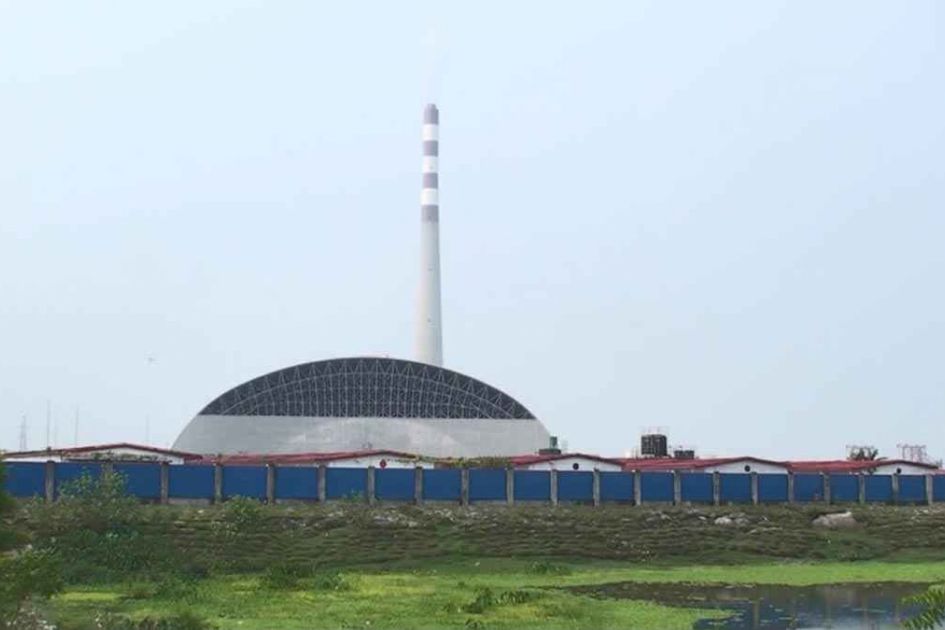



A Chinese-backed coal power plant in Barguna faces mounting allegations of disputed land acquisition, displacement, unpaid compensation and environmental damage, with residents reporting declining fisheries, coastal erosion and health concerns.
Allegations of disputed land acquisition, forced displacement and environmental degradation have intensified around a 307-megawatt coal-fired thermal power plant in Bangladesh’s southern coastal district of Barguna, where residents, officials and environmental groups describe a prolonged conflict over land, livelihoods and ecological damage.
Despite protests, the coal-dependent power plant was built with Chinese investment in Taltali upazila near the confluence of the Payra, Bishkhali and Baleshwar rivers. The facility, which began construction in 2017 and became operational in 2022, is owned 96 percent by China’s Power Construction Corporation (PowerChina) and 4 percent by Bangladesh’s Isotech Electrification Company.
Local residents and affected families allege that at least 142 households were evicted without adequate notice or compensation, while hundreds of acres of land were acquired through disputed procedures, political influence and what they describe as fraudulent documentation. Original landowners say compensation remains unpaid.
In Barguna district, the establishment of the power plant has reportedly led to the displacement of local communities and members of the Rakhine Indigenous group, leaving many residents without livelihoods and increasing economic vulnerability. Civil society actors also warn that the construction of the coal-based plant could significantly damage hilsa production, a key ecological and economic resource for the coastal region.
A local land office source said, “The land originally allotted to 31 Rakhine families was 232.50 acres. Through financial influence and political pressure, the Isotech company took control of this land.”
Disputed Land Ownership and Legal History
The contested land includes areas historically associated with Rakhine Indigenous families under British-era settlement records, later referenced in court proceedings.
Rakhine community leader Chothoyfru Matubbar said the community is preparing legal action.
“We are preparing to file cases in court to recover compensation and the rightful value of our land,” he said.
He added that a 2018 agreement for more than 23 acres of land was never fully executed despite partial payment and continued construction activity on the site.
A local land office official, speaking on condition of anonymity, said, “Court documents support the Rakhine claim. If they go to court, the land will likely be returned to them.”
Allegations of Forced Acquisition and Compensation Gaps
Residents from nearby villages also claim their land was taken without proper compensation during the early stages of development.
One affected resident, Arifur Rahman, said, “They took our ancestral nine acres of land using political influence. We were promised payment, but nothing has been paid so far.”
Another landowner, Sultanshikar from Khottarchar, said company agents used intermediaries to create fraudulent documents.
“Company agents, with local brokers, created fake documents and illegally registered my land in their name,” he said.
Environmental Concerns Over a Fragile Coastal Ecosystem
The plant lies within a sensitive ecological zone near the Tengragiri Wildlife Sanctuary, Sonakata Ecopark, Laldiya mangrove forest and Fatrar Char mangrove ecosystem.
Environmental groups warn that coal combustion, ash disposal and industrial discharge are harming rivers, fisheries and biodiversity.
Waterkeeper Bangladesh local coordinator Arifur Rahman said, “After the power plant was built, coal ships started moving through non-commercial routes in the Payra River, cutting fishermen’s nets and destroying livelihoods.”
Fisheries scientist Dr. Mir Mohammad Ali of Sher-e-Bangla Agricultural University warned of toxic contamination risks in the food chain.
“Hazardous substances are entering the water and accumulating in fish, eventually entering the human food chain,” he said.
Fisheries Decline and Livelihood Risks
Local fishermen report a sharp decline in fish stocks in the Payra and Bishkhali rivers since the plant began operation.
Fisherman Monirul Islam said, “There are no fish left in the river. Coal dust and polluted water are destroying everything. We only catch waste and dead fish now.”
Experts warn that hilsa and other species may permanently disappear from traditional spawning grounds if environmental degradation continues.
Coastal Erosion and Tourism Loss
Residents also link the project to erosion at nearby Shubhash Sandha Beach, once considered a potential tourism destination.
Local environmental activist Mohammad Arifur Rahman said, “We protested and formed human chains, but no action was taken. Sand was extracted during construction and now more than half of the beach has disappeared.”
Health Concerns Among Local Communities
Residents report rising respiratory illnesses since the plant began operation, citing emissions of sulfur dioxide and fine particulate matter.
Dr. Md. Masudur Rahman, a professor at Patuakhali University of Science and Technology, said coal combustion releases hazardous elements.
“Carbon, sulfur, phosphorus and thorium compounds released from coal combustion are polluting air and soil,” he said.
Despite repeated attempts, PowerChina did not respond to requests for comment. The Isotech Group’s Dhaka office was found closed and its managing director is reported to have left the country.
Local authorities and several political figures named in connection with land facilitation could not be reached for comment.
With land disputes unresolved and environmental pressure mounting, residents say the project has reshaped both the landscape and their livelihoods.
As fisherman Monirul Islam put it, “The river no longer gives fish. It only gives us pollution.”




