




“This River is Life. Without It, Everything Fails”: Teesta Drying Threatens Northern Bangladesh
Northern Bangladesh’s Teesta River is drying at an alarming pace, devastating farming, fisheries and local economies. As climate pressures intensify and upstream withdrawals worsen shortages, communities demand urgent action, equitable water-sharing and swift implementation of the long-delayed Teesta Master Plan.
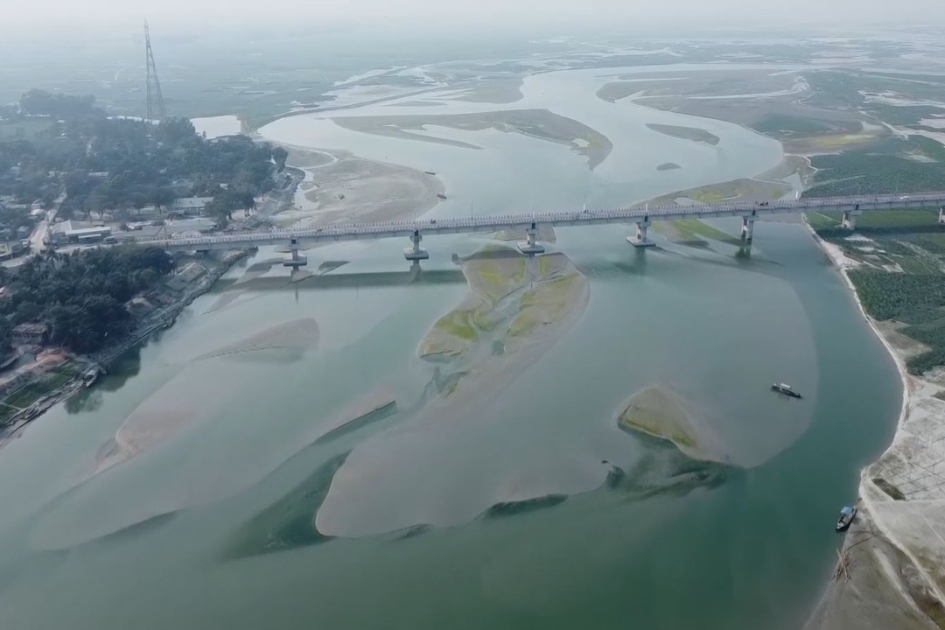
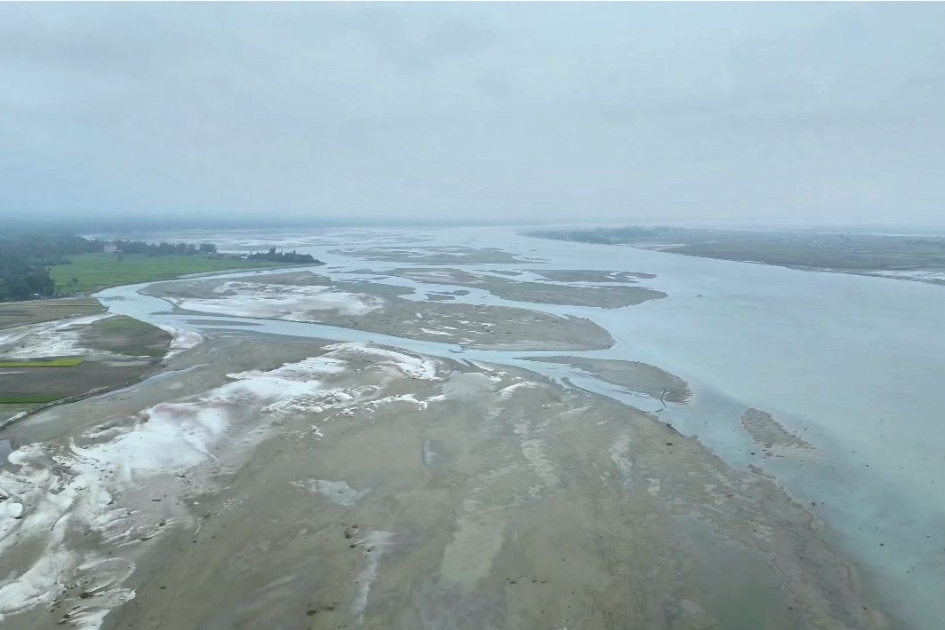
Northern Bangladesh is witnessing a river vanish. In December, the Teesta, a lifeline for millions across Nilphamari, Lalmonirhat, Kurigram, Rangpur, Dinajpur and Gaibandha districts, has fallen to unprecedented lows. Farmers, fishermen and researchers warn the river is disappearing faster than expected, putting livelihoods at risk.
“The river is disappearing before our eyes. If this continues, we cannot grow our crops or even fish for our daily meals,” says Sabuj Mia, a Nilphamari farmer who cultivates maize and mustard along the river’s edge.
According to Bangladesh Water Development Board data, the river is flowing at around 3,000 cusecs, far below the 10,000 cusecs typically expected this season. Sandbars have surfaced along much of the riverbed and in many areas, people now cross on foot where boats once transported goods year-round.
The approaching national election has intensified public scrutiny, with communities demanding immediate action on river protection and the Teesta Master Plan. The Teesta crisis is not only a local problem but also part of a broader climate emergency in South Asia. Rising temperatures, changing monsoon patterns and increased frequency of floods and droughts in the Hindu Kush Himalayan region are creating mounting water stress across the Ganges-Brahmaputra-Meghna basin.
Experts warn that without urgent intervention, rivers like the Teesta may no longer sustain livelihoods or agriculture. Environment, forest and climate change and water resources adviser Syeda Rizwana Hasan, speaking virtually from Dhaka at a sub-regional workshop in Kathmandu, Nepal, stressed water justice, river rights, disaster preparedness and equitable benefit sharing among countries of the region.
Impact on Agriculture and Fisheries
The approaching boro rice season heightens anxiety for farmers. The Teesta basin supports crops ranging from chili and garlic to potatoes, maize, mustard and jute. Yet irrigation may need to be rationed, warns Amalesh Chandra Roy, chief extension officer of BWDB Northern Region. “We will provide water only as long as it is available,” he says. Farmers face mounting costs as they increasingly rely on tube wells, while sand deposits and disrupted riverbeds make crop production uncertain.
Fishing communities are equally affected. “With no water, there are no fish,” says Robiul Islam, a fisherman in Dalia point of Nilphamari. Trade routes that once connected villages are now impassable, forcing residents to take long detours to markets. The slowing of commerce threatens livelihoods and local economies. Experts warn that every dry season without cooperation deepens the crisis, with costs that are financial, human, social and ecological. Holistic, basin-wide, nature-based solutions are essential. Restoration, dredging, controlled reservoirs, cross-border collaboration and civil society engagement can ensure sustainable water management.
Upstream Withdrawals Deepen Teesta River Crisis
Bangladesh is facing a worsening water crisis as the Teesta River experiences unprecedented dry-season lows, with upstream withdrawals in India emerging as a key factor. Under a 1983 interim agreement, Bangladesh was allocated 36% of the river’s flow, while India received 39%, with the remainder reserved for ecological needs. Yet in practice, actual flows to Bangladesh often fall short of this share.
Efforts to finalize a 2011 draft agreement for equal sharing have stalled, amid political opposition from West Bengal Chief Minister Mamata Banerjee. In 2012, she commissioned river expert Kalyan Rudra to assess the prospects of water sharing. While the report remains unpublished, Indian media reports indicate it highlighted the impact of multiple upstream hydro-power projects in Sikkim and West Bengal in reducing river flows. “Rivers do not follow political boundaries.” He adds, The lingering effects of colonial-era planning continue to shape water management and downstream communities bear the consequences.”
Urging equitable and water justice in recent regional workshop in Kathmandu city of Nepal, Bangladesh water resource adviser Rizwana Hasan stressed for a reassessment of outdated infrastructure, warning that embankments and flood-control structures built in the 1960s without ecological consideration have caused lasting harm to the river ecosystem.
Political Transition, Diplomatic Tensions and Public Pressure
The August 5, 2024 uprising that ousted Prime Minister Sheikh Hasina reshaped Bangladesh’s political and diplomatic landscape. The interim government under Professor Muhammad Yunus is reducing heavy dependence on India and seeking stronger ties with China, Pakistan and Western donors. Warm diplomacy with India is expected to resume in 2026 after the national election, but current relations remain tense. Trade disruptions, political distrust and delays in transboundary river negotiations have increased pressure on Bangladesh’s government to act decisively on transboundary river management, particularly the Teesta.
Principal Asadul Habib Dulu, coordinator of the Teesta River Protection Movement and BNP Central Executive Committee Organizing Secretary in Rangpur, emphasizes the urgency. “The Teesta is more than a river. Citizens are demanding action and the election period has brought renewed focus on how political leaders prioritize river conservation,” he says. Communities along the Teesta are calling for immediate government action to start the Teesta Master Plan with domestic funding before the election schedule is announced.
Economic and Social Costs of Non-Cooperation
The International Food Policy Research Institute estimates that annual flooding and dry-season scarcity in the Teesta basin cost around Tk 100,000 crore and reduce paddy production by nearly 1.5 million tons. The broader Ganges-Brahmaputra-Meghna basin, spanning Bangladesh, Bhutan, China, India and Nepal, supports over 670 million people. Rich in rivers and forests, the region is highly water-stressed and climate change exacerbates water, food and energy insecurity.
A study by Ashok Swain and Sajid Karim finds that non-cooperation over shared water governance costs GBM countries over USD 14.2 billion annually. Md Anwar Kadir, member of the Joint Rivers Commission, adds, “Regional cooperation is essential. Without mutual engagement, both countries bear economic and social losses that could be avoided.” He underscored that building resilience will require trust, political will and stronger institutional frameworks, including joint bodies, treaties and agreements that enable effective basin management.
Transboundary Governance and Civil Society Engagement
Bangladesh recently became the 56th party to the UNECE Convention on the Protection and Use of Transboundary Waters, committing to equitable distribution, disaster preparedness and data sharing. Highlighting water justice, Rizwana Hasan asserts that upper-riparian and lower-riparian countries must adhere to international principles on water distribution. Environmental degradation compounds the crisis. Industrial effluents, unplanned development and illegal encroachment threaten the Teesta. Floods, droughts, sedimentation, salinity intrusion, cyclones and river erosion increasingly cross borders. “What happens upstream inevitably affects Bangladesh,” Rizwana Hasan says, highlighting the urgency of integrated river management.
Experts stress that holistic, nature-based solutions are essential. Water and climate change expert of Bangladesh Professor Ainun Nishat emphasizes, “It is a question of equity and fairness. Bangladesh has the right to its equitable share, but enforcement requires trust and cooperation, not just legal documents. Technical solutions alone are not enough.”
Civil society and youth engagement are increasingly crucial. Track 2 diplomacy, bringing together academics, policy experts, and civil society actors, helps maintain dialogue when formal negotiations stall.
Sohanur Rahman, executive coordinator of YouthNet Global, explains, “We need cooperation beyond water-sharing agreements. Some softer issues like water pollution, sedimentation and climate adaptation require joint attention and youth can be catalysts for accountability and change.”
Teesta Mega Project and Master Plan
Experts have long proposed the Teesta Mega Project as a solution. Its aims include restoring river depth and width, dredging the main channel, building controlled reservoirs and strengthening embankments along 115 kilometres of the river in Bangladesh. The plan envisions satellite towns, agro-industrial zones and green corridors. With an estimated cost of Tk 12,000 crore, including Tk 6,700 crore in loans from China, the first phase is expected to begin in 2026.
Successful implementation of the Teesta Master Plan and Mega Project could revitalize livelihoods, preserve biodiversity and create new opportunities for sustainable development.
Professor Dulu says, “Immediate implementation is essential to safeguard communities and the environment. The river’s health is the foundation for northern Bangladesh’s economic and social wellbeing. If the interim government does not start the Teesta Master Plan with its own funding before the election schedule is announced, the people of Teesta’s riverbanks will wage a greater movement.”
Lives and Livelihoods on the Frontline
Communities along the Teesta basin live between hope and uncertainty. Farmers fear crop failures, fishermen struggle with empty nets and trade slows. Sabuj Mia sums it up simply, “This river is life. Without it, everything fails.”
For millions depending on the Teesta, the coming months will test not only agriculture and fisheries but also regional cooperation and Bangladesh’s ability to manage rivers as shared, living resources.




