

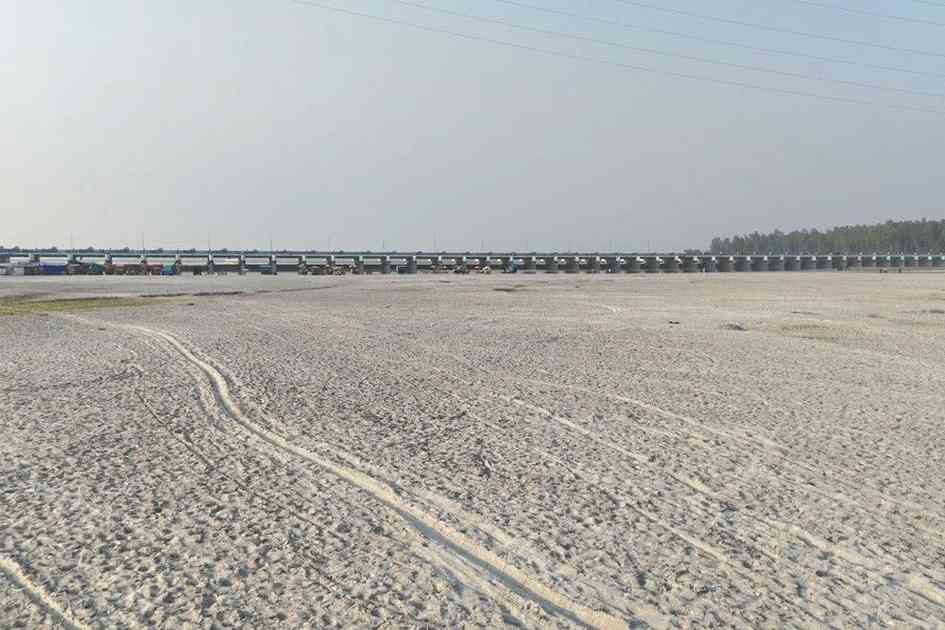



Shrinking dry-season flow in the Teesta River is crippling irrigation in northern Bangladesh, forcing farmers to pay triple for water and exposing gaps in transboundary cooperation and climate-resilient management.
The once-mighty Teesta River, often described as the lifeline of northern Bangladesh, is turning into a near-dry channel during the dry season, raising growing concern over agriculture, food production and rural livelihoods.
Experts say the crisis is being driven by a combination of upstream water withdrawal in India, unresolved transboundary water-sharing issues and changing climate patterns affecting Himalayan-fed rivers.
As water levels decline sharply, Bangladesh’s largest irrigation initiative, the Teesta Barrage Irrigation Project, is facing serious operational challenges. Officials say the project is struggling to meet even half of its irrigation targets, leaving hundreds of thousands of farmers in northern districts without the expected water supply.
According to the Bangladesh Water Development Board, the river carries around 200,000 cusecs of water on average during the monsoon season. However, in the dry months, the flow drops dramatically to about 2,000 cusecs and at times even falls to nearly 500 cusecs, far below what is needed for irrigation.
The declining flow is directly affecting agriculture in northern districts such as Nilphamari, Rangpur and Dinajpur, where farmers depend heavily on irrigation during the dry season.
Farmers forced to pay triple for irrigation
Due to insufficient water in canals, many farmers have been forced to rely on electric and diesel-powered pumps to irrigate their fields, raising production costs significantly.
Local farmer Zakaria Sarkar said irrigation from canal water previously cost between 300 and 500 taka per bigha of land.
“Even though the canal runs beside our fields, we are not getting water. Now we have to use electric pumps, which increases irrigation costs by about 2,000 to 2,500 taka per bigha,” he said.
Another farmer, Nuruzzaman Islam, said the situation has worsened as farming expenses continue to rise.
“The canals were repaired, but there is still no water. Fertilizer, seeds and other costs are already high. When we could use river water, we needed less fertilizer. Every year we are told water will come, but it never arrives,” he said.
Farmer Alauddin also questioned the effectiveness of recent canal repairs.
“Millions of taka were spent fixing canals, but there is still no water in them. We still have to use irrigation pumps. Then what was the benefit of repairing the canals?” he said.
Infrastructure built but water still missing
Over the years, the government has invested heavily in canal rehabilitation and expansion under the Teesta irrigation scheme. The project includes about 766 kilometres of canals covering 12 upazilas across northern Bangladesh.
In 2021, a major initiative titled Rehabilitation and Expansion of the Teesta Irrigation Project Command Area began with an estimated cost of around 14.52 billion taka, approximately 130 million dollars. Authorities say nearly 95 percent of the project work has been completed.
However, field observations indicate that although canals have been constructed or repaired in many locations, Teesta water has yet to reach several of those areas even once. As a result, around 60 to 70 percent of farmers are now dependent on alternative irrigation systems.
Conflicting official statements
The situation has also exposed inconsistencies in official assessments of water availability.
An executive engineer from the Bangladesh Water Development Board in Nilphamari claimed that around 10,000 cusecs of water are available to meet irrigation demands and that water is being supplied wherever required.
However, an official from the Teesta Barrage area reported a different scenario, saying upstream flow currently ranges between 700 and 2,500 cusecs, while downstream sections of the river stretching nearly 110 kilometres below the barrage sometimes receive less than 100 cusecs.
Longstanding irrigation targets still unmet
According to official records, the original irrigation target set in 1990 was 84,378 hectares of farmland. More than three decades later, that goal has still not been achieved.
For the current irrigation season, authorities have set a reduced target of about 57,000 hectares. Yet experts warn that with the current level of water flow, achieving even half of that target may be difficult.
The situation is raising broader concerns about the sustainability of large-scale irrigation investments when river flow remains uncertain. Despite billions spent on infrastructure, the lack of consistent water in the Teesta is increasingly putting the effectiveness of the irrigation project into question.
For farmers across northern Bangladesh, the impact is immediate: higher cultivation costs, uncertainty in crop production and growing pressure on rural livelihoods. The issue also highlights the urgent need for improved regional water cooperation, climate-resilient water management and long-term solutions for transboundary rivers shared between Bangladesh and India.




