

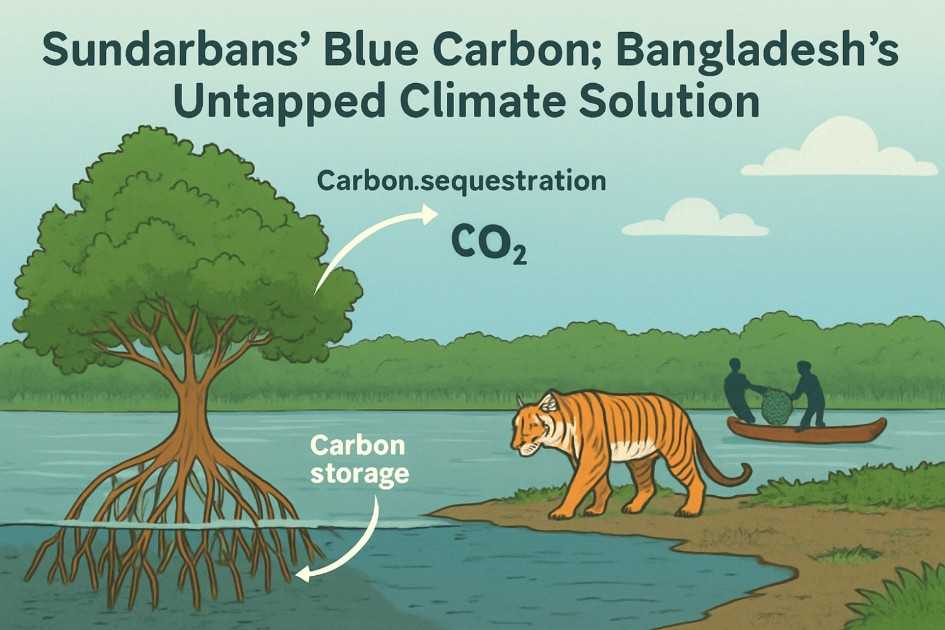

By monetizing mangrove carbon storage through blue carbon markets, Bangladesh could protect ecosystems, boost local livelihoods, and meet climate goals through sustainable, science-backed conservation strategies.
A newly published scientific study underscores the massive climate mitigation potential locked beneath the muddy roots of the Sundarbans. As the world’s largest mangrove forest teeters under ecological strain, researchers say investing in blue carbon, the carbon captured and stored by coastal ecosystems, could offer Bangladesh a dual solution: climate action and sustainable development.
The paper, titled “Blue carbon as a nature‑based climate mitigation strategy for mangrove conservation in Bangladesh”, was published in the Journal for Nature Conservation by Hilmi et al. (2025) published in August 2025 at ScienceDirect. It calls for a transformative shift in how the Sundarbans are protected and funded, emphasizing nature-based solutions that use the forest’s carbon-capturing power as an economic and environmental asset.
“This is not just about protecting a forest. It’s about protecting people, the climate and the future economy,” said lead author Dr. Nathalie Hilmi of the Centre Scientifique de Monaco.
Earlier in another survey of the Forest Department published in 2019 said that there is a reserve of 5.6 crore tonnes of carbon in the Bangladesh part of the Sundarbans. This carbon worth over Tk 188 billion (Tk 18,816 crore) could be extracted without causing any harm to the world’s largest mangrove forest, experts said calling for taking steps to collect the substance. However, Bangladesh has not yet registered at the international carbon stock.
According to the Kyoto Protocol, carbon trading allows nations who are unable to meet their reduction targets to purchase carbon credits under a unified regulatory framework. The carbon credits can be purchased from other member nations who own a GHG quota that they no longer require or alternatively new credits can be created through the financing of projects that reduce GHG emissions.
Forest under threat
Covering more than 10,000 square kilometers across Bangladesh and India, the Sundarbans are home to critical biodiversity, including the endangered Royal Bengal Tiger. The forest supports millions who depend on it for fishing, honey collection and small-scale agriculture.
But this ecosystem faces mounting threats from overexploitation and pollution to rising sea levels and cyclones intensified by climate change. Local dependency has also created pressure on natural resources, endangering both community resilience and ecological integrity.
Why blue carbon matters
The concept of blue carbon focuses on carbon stored in mangroves, tidal marshes and seagrasses. Mangroves, in particular, store up to four times more carbon per hectare than terrestrial forests, much of it locked in deep soil.

Recognizing this potential, Hilmi et al. propose integrating the Sundarbans into global carbon finance mechanisms, where carbon sequestration can be monetized through blue carbon credits or blue bonds.
This could unlock substantial funding for conservation while benefiting frontline communities through job creation, enhanced resilience, and improved resource access.
A regional strategy
The researchers advocate for a multi-level governance model to manage the Sundarbans’ restoration. It includes: National action by Bangladesh, Transboundary coordination with India, Catchment-scale management of the Ganges-Brahmaputra delta.
Such coordination would align conservation with social development and climate policy. According to the study, this approach could generate significant co-benefits, including improved water quality, coastal protection, and food security.
Economic opportunity or ecological emergency?
The authors emphasize that blue carbon finance is not a silver bullet, but a pragmatic path forward. With ethical oversight, it can bridge the funding gap for conservation and development.
“By placing economic value on carbon stored in mangroves, we can shift from exploitative use to long-term stewardship,” said co-author Dr. Jason Hall-Spencer of the University of Plymouth.
Time is running out
As Bangladesh aims for net-zero targets and climate adaptation goals, the Sundarbans stand at a crossroads. Policymakers must decide whether to embrace the innovative, science-based path of blue carbon investment, or risk losing one of the planet’s most vital ecosystems.
The study concludes with a call for immediate integration of blue carbon into national and international climate strategies—before rising seas and shrinking forests take the choice away.




