

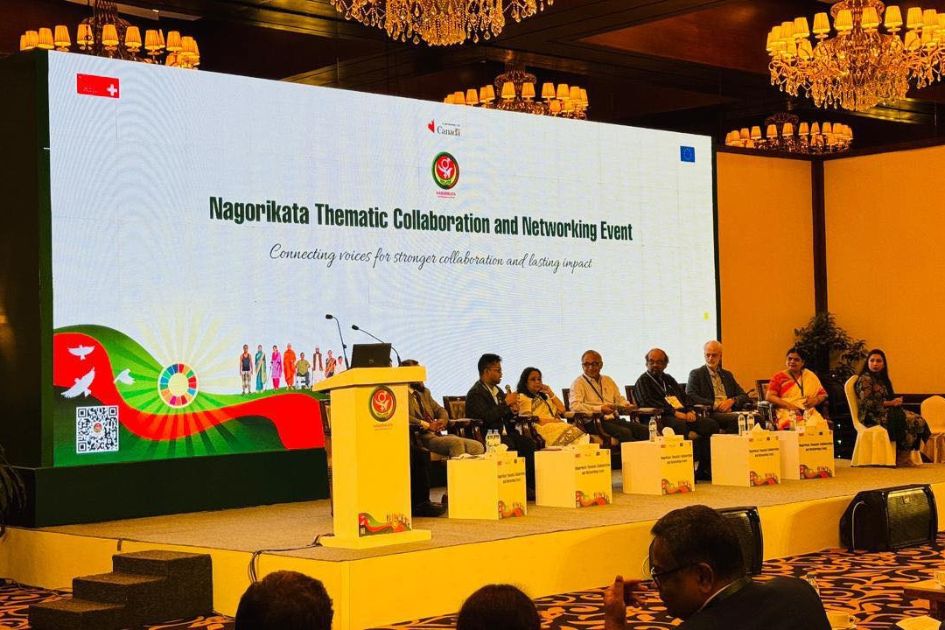

A Dhaka policy dialogue highlighted inclusive governance, civil society collaboration, and youth participation as key drivers of equitable development, urging legal reforms, stronger protections, and greater inclusion in national decision-making.
Inclusive governance, stronger civil society engagement and meaningful youth participation were emphasized as key priorities for advancing inclusive development during a policy dialogue held in Dhaka on Sunday under the “Nagorikata” programme.
The event, titled “Thematic Networking and Collaboration,” was held at Hotel Sonargaon in the capital with support from the European Union, Canada and Switzerland. It brought together government representatives, civil society organizations, development partners and youth leaders to strengthen multi-stakeholder cooperation.
Speaking as chief guest, Special Assistant to the Prime Minister on Environment, Forests and Climate Change Affairs Md Saimum Parvez said collaboration among civil society, government institutions and young people is essential for participatory development.
“We believe in a Bangladesh where every citizen, regardless of religion, ethnicity or background, has equal opportunity and dignity,” he said, adding that constructive criticism from civil society is welcomed as part of improving governance.
Referring to the political and social changes following the July mass uprising, he noted, “We have clearly seen how young people are shaping political discourse and social transformation in Bangladesh today.”
He also stressed that “women and marginalized communities affected by climate change must not remain at the margins of decision-making,” calling for their stronger inclusion in policy processes.
Executive Director of Manusher Jonno Foundation Shaheen Anam highlighted four priority areas: anti-discrimination legislation, protection of human rights defenders, gender equality and youth participation.
“An anti-discrimination law has been under discussion since 2013, but it is still not enacted. We need stronger political will to move this forward,” she said.
She also warned that human rights defenders remain vulnerable. “Those who speak for rights are often exposed to threats. Legal protection for them is urgently needed.”
Shaheen Anam further stressed, “Government and civil society collaboration must be evidence-based if we want sustainable and meaningful development outcomes.”
Head of Cooperation at the Delegation of the European Union Mikael Kreza described the current period in Bangladesh as a “transformational moment.”
“We are developing a Civil Society Roadmap for Bangladesh to strengthen civil society as a key partner in governance and policy processes,” he said, adding that “local knowledge and community voices must be at the centre of national development planning.”
Law officer of the Ministry of Information and Broadcasting Md Masud Parvez called for prioritizing the enactment of anti-discrimination legislation.
“Civil society can even bring forward proposals through private member initiatives in parliament,” he said, adding that “human rights defenders are not adversaries of the state but partners in development.”
He also noted ongoing judicial reforms, stating that “special tribunals and legal aid services are being strengthened to ensure faster justice for women and children.”
Representing Canada, Cooperation Chief Stephen Weaver said Bangladesh has shown strong resilience in its journey of social transformation.
“Despite differences in perspective, we must focus on finding common ground and working toward shared goals,” he said.
Speaking on behalf of the youth, entrepreneur Sohanur Rahman said young people must be seen as rights-holders, not just beneficiaries.
“Youth are not a demographic statistic. We are rights-holders and stakeholders in governance,” he said.
He added, “From tokenism to real inclusion, from beneficiaries to partners, from restriction to enabling civic space, this is the direction we must move in.”
Sohanur further said that platforms like the Nagorikata Civic Engagement Fund are critical in strengthening civil society action. “These platforms enable civil society organisations with funding and capacity support to expand impact across human rights, women’s empowerment, rule of law and democratic governance, contributing directly to SDG 16 and SDG 5,” he said.
He noted that the initiative is supported by the European Union, the Swiss Development Cooperation and Global Affairs Canada.
He warned, “If we fail to harness the demographic dividend, it can turn into a national challenge rather than an opportunity,” adding that youth must be meaningfully included not only as volunteers but as policy actors.
Speakers agreed that stronger alignment between grassroots experiences and national policy frameworks would improve development outcomes and strengthen the effectiveness of interventions.
The day-long dialogue concluded with participation from more than 100 civil society organizations, marking what participants described as an important step toward deepening inclusive governance, dialogue and collaboration in Bangladesh.




