

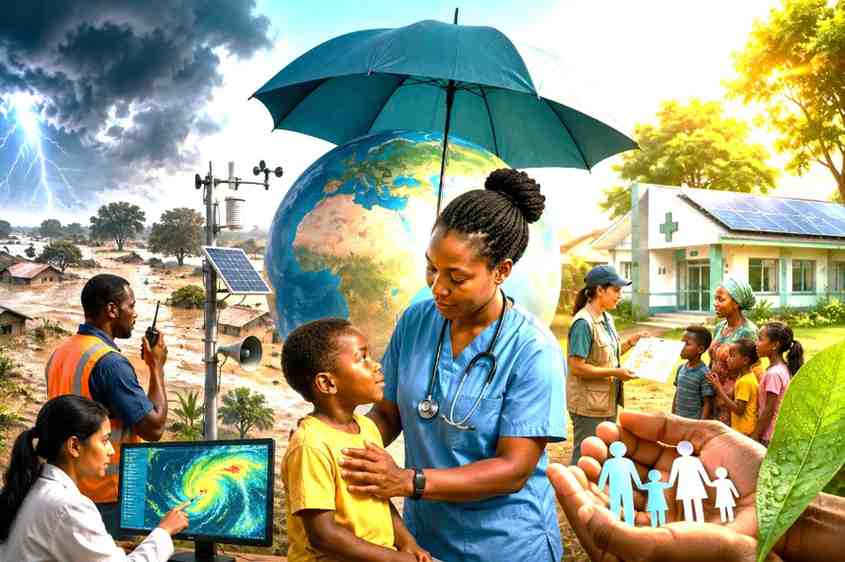



Study says early warning systems and disease surveillance can save lives and cut billions in climate-related losses
Early investment in climate-health solutions in low- and middle-income countries could generate between US$4 and US$68 in benefits for every dollar spent, according to new research released Wednesday by the World Resources Institute with support from The Rockefeller Foundation.
The study examined 46 projects across 40 countries in Sub-Saharan Africa, Asia, Latin America and the Caribbean, and the Middle East and North Africa, assessing the impact of tools such as early warning systems, disease surveillance and public awareness campaigns.
Researchers found that a full package of climate-health services can help governments, hospitals, emergency responders and communities better prepare for and respond to climate-linked health threats, including extreme heat, floods and infectious diseases.
“Climate disasters are becoming more frequent and more destructive, but how severely they affect human health is still within our control,” said Ani Dasgupta.
“Health is the most human face of climate change, it affects everyone, especially children, and disproportionately harms the poorest communities,” he said, adding that investments in climate-health preparedness could save lives while delivering “returns many times over.”
The report warned that climate change is rapidly emerging as a major public health crisis, with rising temperatures intensifying heatwaves and extreme weather events accelerating the spread of diseases such as malaria, dengue, cholera and diarrhoea. Vulnerable populations are expected to face the greatest risks.
Without stronger action, low- and middle-income countries could face nearly 16 million deaths and more than US$20 trillion in economic losses from climate-related health impacts by 2050, according to the study. It also noted that fewer than half of health ministries currently integrate climate data into national health surveillance systems.
The research found that climate-health investments allow earlier and more targeted responses to outbreaks and disasters, reducing illness and deaths while easing long-term pressure on healthcare systems.
“The climate crisis is a health crisis, one that is hurting the people already most vulnerable to the impacts of extreme heat and natural disasters,” said Dr Naveen Rao.
“This study shows how even modest investments can help communities get ahead of climate-driven health threats, strengthening health systems and saving lives,” he added.
WRI estimated that a country of 25 million people could implement a full package of climate-health services for around US$18 million annually, about 72 cents per person. Individual programmes would cost between US$1.4 million and US$5.9 million a year.
Some projects produced even higher returns. Efforts to strengthen climate resilience in health facilities generated returns of US$168 for every dollar invested in Jamaica and US$317 in St Lucia, while urban heatwave warning systems in Indian cities returned around US$50 per dollar invested.
Despite the economic benefits, many countries still struggle to fund climate-health services, while national meteorological agencies often lack resources for cross-agency coordination, the report said.
“If we fail to act, our changing climate will continue to reshape health risks faster than our systems can adapt,” said Celeste Saulo.
“But we are not powerless. We already have the science, data and tools to anticipate and reduce these risks,” she added, calling investment in climate-health services “a life-saving, cost-effective choice.”




