

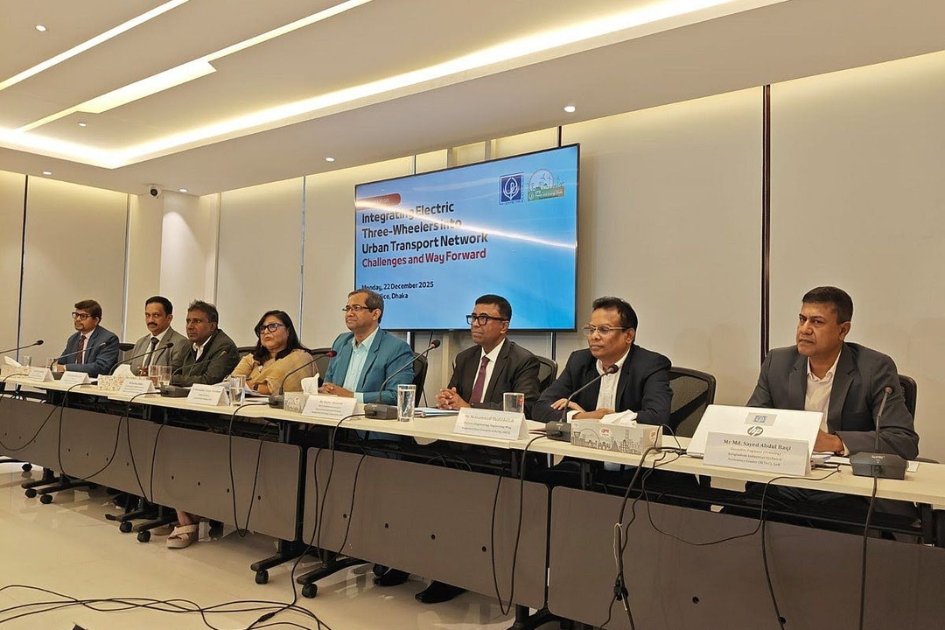

Experts at a Dhaka seminar urged shutting illegal lead battery factories as electric rickshaws drive pollution, soil degradation and child lead exposure amid weak regulation and poor public transport.
Lead acid battery-operated rickshaws are fueling a growing environmental and public health crisis in Bangladesh, experts warned at a seminar in Dhaka on Monday. Around 78 percent of the country’s lead battery market is dominated by electric three-wheelers, with 80 percent of these batteries being recycled illegally. This has led to severe soil contamination, loss of fertility and rising lead pollution.
The seminar, titled Challenges and Solutions for Electric Three-Wheelers in Urban Transport, was organized by the Center for Policy Dialogue at its Dhaka office. CPD Research Director Khandakar Golam Moazzem moderated the session, while speakers included Nilima Akhter, executive director of the Dhaka Transport Coordination Authority and Kabir Ahmad, additional secretary of the Planning Commission. CPD Program Associate Md Khalid Mahmud presented the main findings.
According to the study, Bangladesh now has nearly four million battery-operated rickshaws, 90 percent of which are locally manufactured. In 2023, these rickshaws accounted for 30 percent of total trips in Dhaka, while buses covered only nine percent. The lack of an effective public transport system has left people highly dependent on these rickshaws.
Md Khalid Mahmud raised concerns over vehicle quality, noting that many locally made rickshaws have substandard chassis and braking systems similar to bicycles. Many pedal rickshaws are converted by adding motors, increasing the risk of accidents. Informal garages are also spreading unchecked. He suggested higher import duties on parts and urged a ban on lead batteries, calling for policies to transition to safer lithium alternatives.
Nilima Akhter said, “Road infrastructure has improved, but transport management has not. The overwhelming presence of rickshaws on the streets reflects failures from both the administration and citizens. Proper public transport is essential to ease the situation.”
Kabir Ahmad added, “These rickshaws freely move in front of buses and trucks. The fault lies with us, the authorities, for failing to regulate them. The absence of public transport is being exploited and interventions often face organized resistance from local groups.”
Khalequzzaman Lipon, convener of the Rickshaw, Battery Rickshaw VAT and E-Bike Struggle Forum, challenged the negative image of electric rickshaws. “We will not block highways if proper rules are defined. Registration is already reducing rickshaw numbers naturally. New policies should fall under BRTA. City corporations do not have this authority.”
Khandakar Golam Moazzem stressed the urgent need to control rickshaw expansion and prevent new factories, while simultaneously establishing efficient public transport alternatives. BUET Urban and Regional Planning Professor Asif-uz-Zaman recommended limiting rickshaw speeds to 25 kilometers per hour to reduce accidents.
The seminar also featured remarks from BRTA Director Mohammad Shahidullah, LGED Joint Secretary Khondokar Md Nazmul Huda Shamim and BITA Executive Engineer Md Sayed Abdul Baki.
Bangladesh currently ranks fourth in the world for lead contamination, with nearly 36 million children, around 60 percent of all children, showing elevated blood lead levels.
Experts say lead exposure impairs brain development in children, causes behavioral issues and increases the risk of heart disease in adults. According to the World Health Organization, lead exposure causes around 140,000 deaths every year in Bangladesh and costs the economy about 28.6 billion dollars, equivalent to six to nine percent of the country’s GDP. Unsafe battery recycling is a major source of lead pollution.
Sohanur Rahman, executive coordinator of YouthNet Global, said, “Lead pollution is a silent public health emergency. Children are paying the heaviest price and urgent action is needed to regulate battery recycling, ensure a just transition and protect future generations.”




