

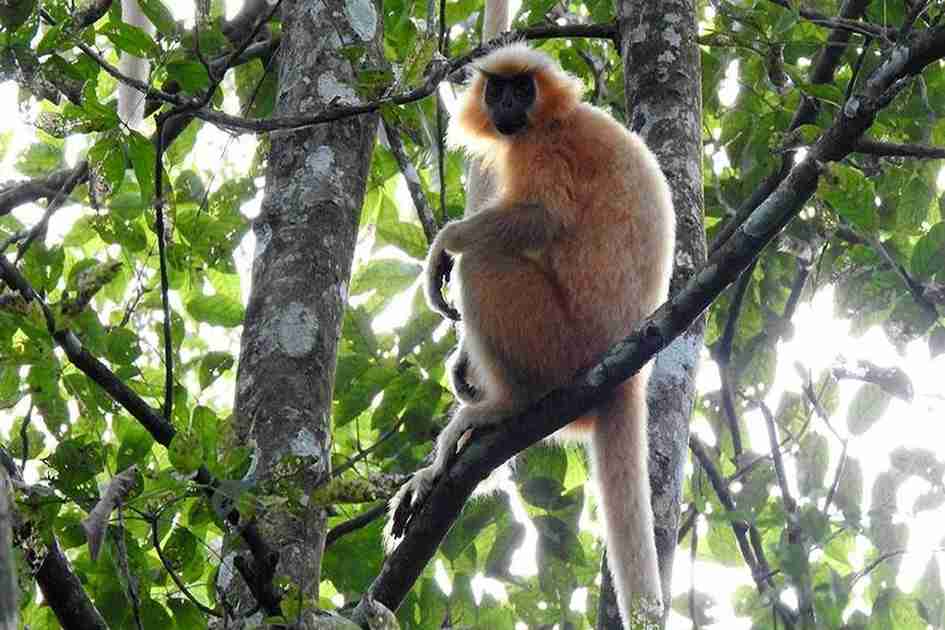

Seven endangered golden langurs rescued from wildlife traffickers were released into Assam’s Sikhna Jwhwlao National Park, highlighting conservation efforts to protect one of the world’s rarest primates.
The primates, rescued on June 19, were released on Thursday, June 25, into the 316-square-kilometre Sikhna Jwhwlao National Park, Assam’s newest national park. The protected area spans Chirang and Kokrajhar districts in the Bodoland Territorial Region (BTR).
Announcing the release, Assam Forest Minister Jayanta Mallabaruah said the langurs underwent a closely monitored rehabilitation process before being returned to their natural habitat.
“Their health and behaviour were also assessed scientifically,” he said, describing the release as a major achievement for wildlife conservation in Assam. He credited the success to coordinated efforts by forest officials, wildlife experts, enforcement agencies and local communities.
The released animals were among eight golden langurs rescued during an operation by the Assam Police Special Task Force, which arrested nine wildlife traffickers, including a Bangladeshi national, in western Assam’s Chirang district.
One of the rescued langurs died despite receiving medical treatment and rehabilitation.
The golden langur (Trachypithecus geei) has one of the world’s most restricted primate ranges. The species is found only within a narrow geographic corridor stretching across western Assam and the foothills of southern Bhutan.
Its estimated 30,000-square-kilometre range is bordered by rivers, including the Brahmaputra, on three sides and by the mountains of Bhutan on the fourth.
The species is protected under Schedule I of the Wildlife (Protection) Act and is recognised as one of the world’s most endangered primates.
Sikhna Jwhwlao National Park forms part of the Manas Biosphere Reserve and provides habitat for several rare and endangered species, including the golden langur.
Other important habitats for the species include Manas National Park and Tiger Reserve, a UNESCO World Heritage Site, Raimona National Park in Kokrajhar district, Chakrashila Wildlife Sanctuary spanning Dhubri and Kokrajhar districts and Kakoijana Reserve Forest in Bongaigaon district.
Source: The Hindu




