

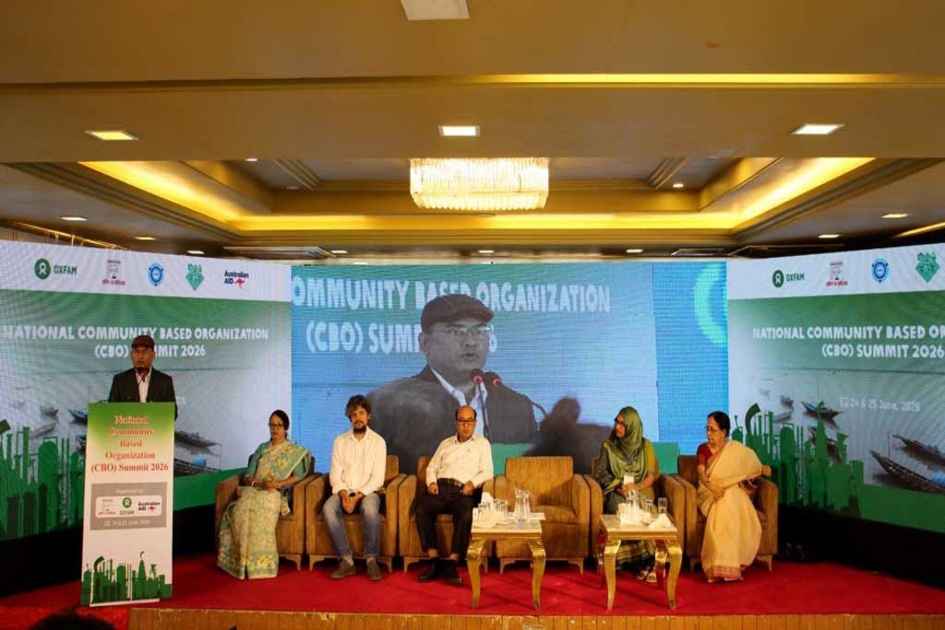

Bangladesh urged grant-based climate finance instead of loans, as speakers at the CBO Summit called for equity, local leadership and stronger community participation in climate adaptation.
Bangladesh has reiterated its demand for grant-based international climate finance, rejecting loan-dependent funding mechanisms and arguing that climate-vulnerable countries should not be pushed into debt to address impacts they contributed little to creating.
Dr Md Saimum Parvez, Special Assistant to the Chief Adviser on Environment, Forest and Climate Change, made the remarks at the opening of the two-day National Community-Based Organisations (CBO) Summit 2026 held on Wednesday at the Krishibid Institution Bangladesh in Dhaka.
The summit, organised by Breaking the Silence in partnership with Oxfam in Bangladesh and funded by Australian Aid, brought together government representatives, researchers, youth networks and grassroots organisations working on climate resilience and justice.
Dr Parvez said Bangladesh’s contribution to global greenhouse gas emissions is negligible, yet it continues to bear some of the worst impacts of climate change. He stressed that financing climate action through loans is fundamentally unjust and urged a shift towards grant-based mechanisms that reflect equity and historical responsibility.
He also said Bangladesh is increasingly asserting its position in global climate negotiations after years of limited visibility. The government, he added, is actively engaging with international mechanisms such as the Green Climate Fund to expand access to climate finance and strengthen locally led ecosystem restoration.
Highlighting adaptation priorities, he announced plans to plant 20 million mangrove trees this year as part of coastal resilience efforts, noting that the initiative will involve local communities with a strong emphasis on women’s participation in protection and restoration activities.
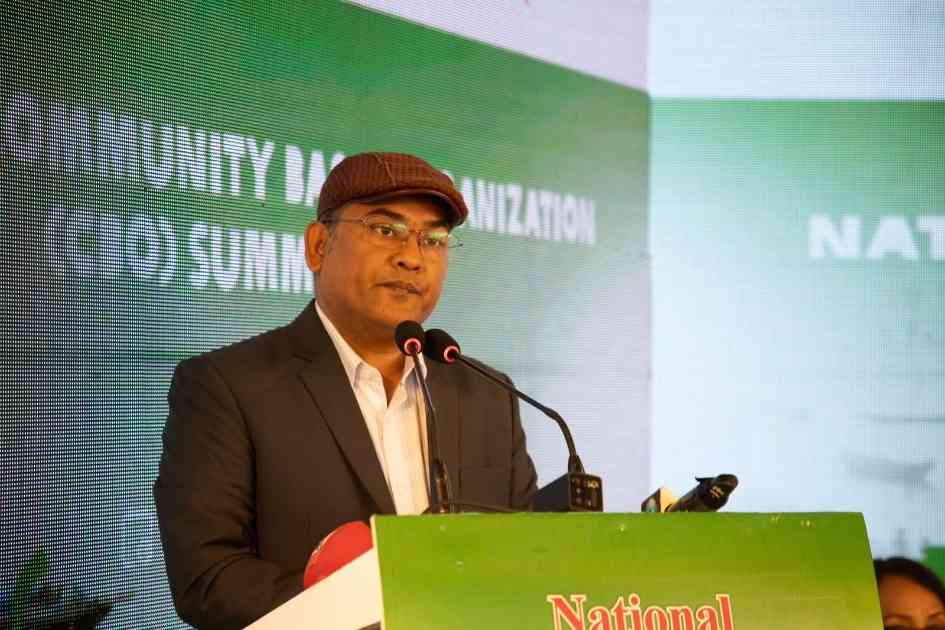
Speakers at the summit echoed concerns over equity, participation and local ownership of climate solutions, with discussions broadly reflecting three perspectives: government policy direction, academic insight and civil society advocacy.
From the academic perspective, Professor Mahbuba Nasreen of the Institute of Disaster Management and Vulnerability Studies at the University of Dhaka stressed the need to embed local and indigenous knowledge into climate adaptation strategies. She said adaptation learning should move beyond short-term project training and become intergenerational knowledge that strengthens biodiversity conservation and reflects local ecological realities. She also called for greater youth engagement in research and planning processes.
From the civil society perspective, Dr Mohammad Emran Hasan, Head of Climate Justice and Natural Resources Rights at Oxfam in Bangladesh, said Bangladesh is widely recognised as a global “adaptation champion” because of its community-led resilience practices, where local knowledge and grassroots action remain central.
Roksana Sultana, Executive Director of Breaking the Silence, warned that climate change is increasingly undermining development gains. She noted that community-based organisations and youth-led initiatives, despite being on the frontline of climate impacts, remain underrepresented in climate finance allocation and national policymaking.
Gobinda Ray, Project Director of the Forest Department’s SuFAL project, highlighted that adaptation has clear limits and stressed the importance of coordinated action among community organisations, youth groups and development partners to ensure long-term resilience.
Farzana Faruk Jhumu, President of Kathpencil, called for stronger and more meaningful youth participation in national climate policymaking, particularly in shaping adaptation priorities.
The first day of the summit focused on “Climate Leadership, Research and Policy Dialogue”, featuring presentations on feminist climate leadership, youth engagement in climate action and locally led adaptation strategies.
In the research competition, Farha Fatima and Sanjida Alam Sifat jointly secured first place, followed by Apurbo Dey in second place and Shamima Yasmin in third.
The summit also featured a photo exhibition highlighting climate impacts and community responses alongside displays of climate-resilient and eco-friendly products developed by 12 coastal community-based organisations.
As discussions concluded for the day, speakers underscored a common message: Bangladesh’s climate resilience depends not only on reforming international climate finance but also on recognising and empowering the communities already leading adaptation on the ground.




