

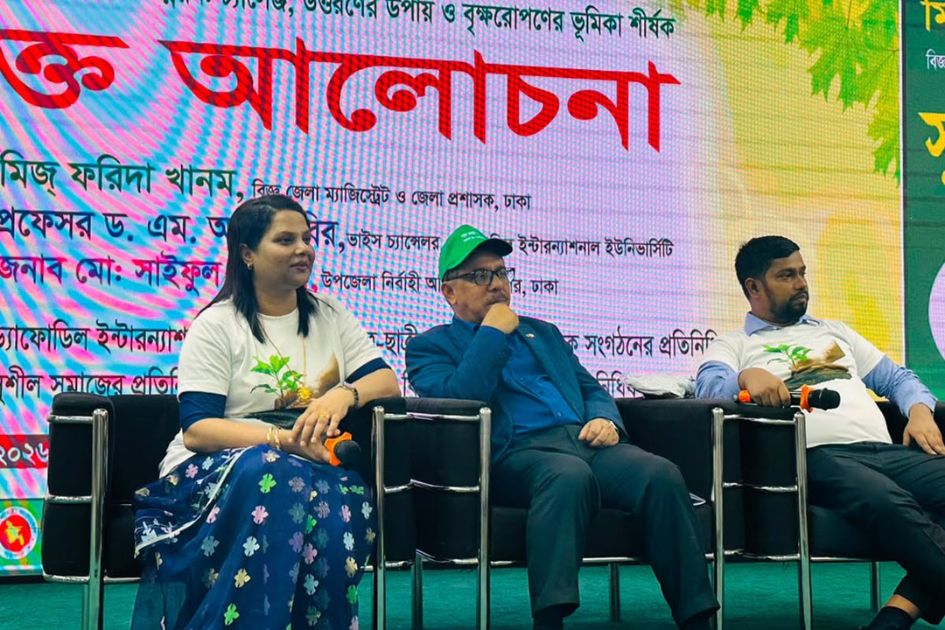



Savar has launched a six-month campaign to plant 150,000 trees under Bangladesh’s National Green Mission, aiming to improve climate resilience, restore ecosystems, and expand urban green cover.
The Upazila administration in Savar, a subdistrict of Dhaka district in central Bangladesh, has launched a large-scale tree plantation campaign under a national environmental restoration programme aimed at strengthening climate resilience and addressing rising environmental pressures in the Dhaka region.
The initiative, held under the slogan “Green Dhaka’s Commitment, Today’s Trees, Tomorrow’s Breath,” was inaugurated on Tuesday afternoon on the campus of Daffodil International University in Birulia by Dhaka District Commissioner Farida Khanom.
Officials said the programme targets the planting of 150,000 trees in Savar within the next six months and 100,000 trees in Keraniganj within the next five months as part of coordinated local implementation under the broader national initiative to expand afforestation and ecological restoration across the country.
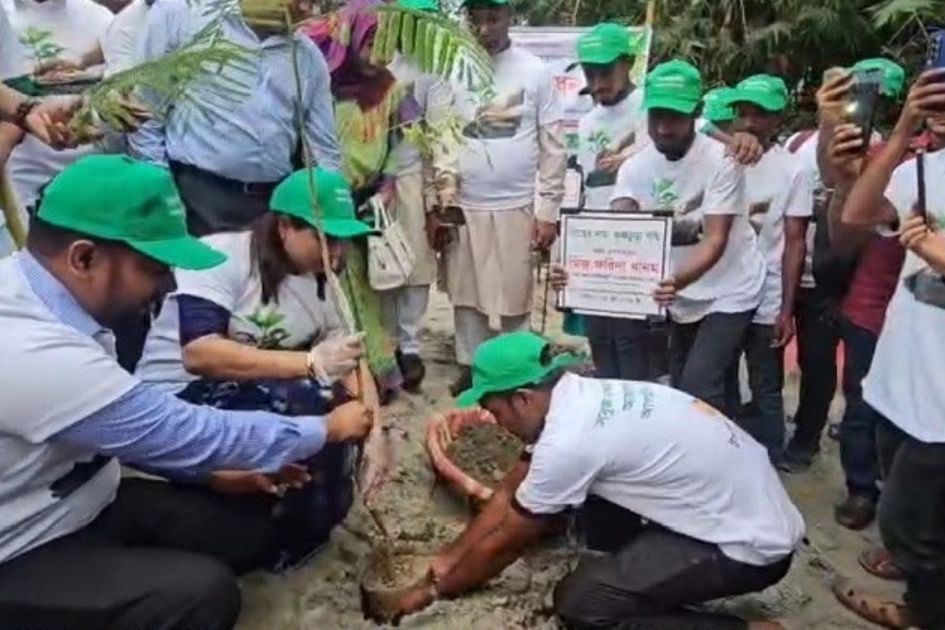
The campaign is aligned with the National Green Mission, a large-scale environmental initiative by the Bangladesh Nationalist Party (BNP) government to plant 250 million (25 crore) trees across Bangladesh over a five-year period. Officially launched in June 2026 by Prime Minister Tarique Rahman, the programme aims to combat climate change, increase national tree cover and foster a sustainable green economy.
Speaking at the inauguration, Farida Khanom said rising temperatures, worsening air pollution and rapid urbanisation are intensifying climate-related risks, making large-scale tree plantation essential for protecting urban and peri-urban ecosystems.
“Dhaka must be made more liveable, environmentally balanced and climate-resilient. There is no alternative to large-scale tree plantation to safeguard the city’s future,” she said.
She stressed that environmental protection must go beyond government initiatives and become a shared social responsibility.
“Planting trees alone is not enough. Every tree planted must be properly nurtured and protected. Saving a tree means saving a life, a family and a healthier environment,” she added.
The District Commissioner called for planned afforestation across educational institutions, government and private offices, industrial areas, residential zones and available open spaces, urging collective action from all sectors of society.
Referring to environmental research cited by officials during the event, she noted that an adult requires approximately 550 litres of oxygen per day, amounting to nearly 1.4 million litres over an average lifespan of 70 years. A mature tree produces around 82,600 litres of oxygen annually, meaning roughly 17 fully grown trees are needed to meet one person’s lifetime oxygen requirement.
However, she cautioned that not all planted saplings survive to maturity, urging individuals to adopt a long-term approach to tree plantation. “If we want meaningful impact, each person should aim to plant at least 100 trees in their lifetime so that a sufficient number reach maturity and contribute to the environment,” she said.
She also highlighted the economic contrast between natural and medical oxygen, noting that treatment in an ICU bed in Bangladesh can cost between BDT 10,000 and BDT 50,000 per day, while the oxygen and ecological services provided by trees remain freely available.
“Medical oxygen can be purchased, but the ecological services provided by a mature tree, including oxygen production, shade, cooling, biodiversity support and environmental protection, cannot be replaced by money,” she said.
The event was attended by the Vice Chancellor of Daffodil International University, Prof. Dr. S. R. Kabir, Savar Upazila Nirbahi Officer Saiful Islam and local union parishad representatives, among others.
Officials said the initiative forms part of a broader national programme to transform the Dhaka region into a greener and more climate-resilient urban landscape amid escalating environmental challenges linked to climate change and rapid urban expansion.




