

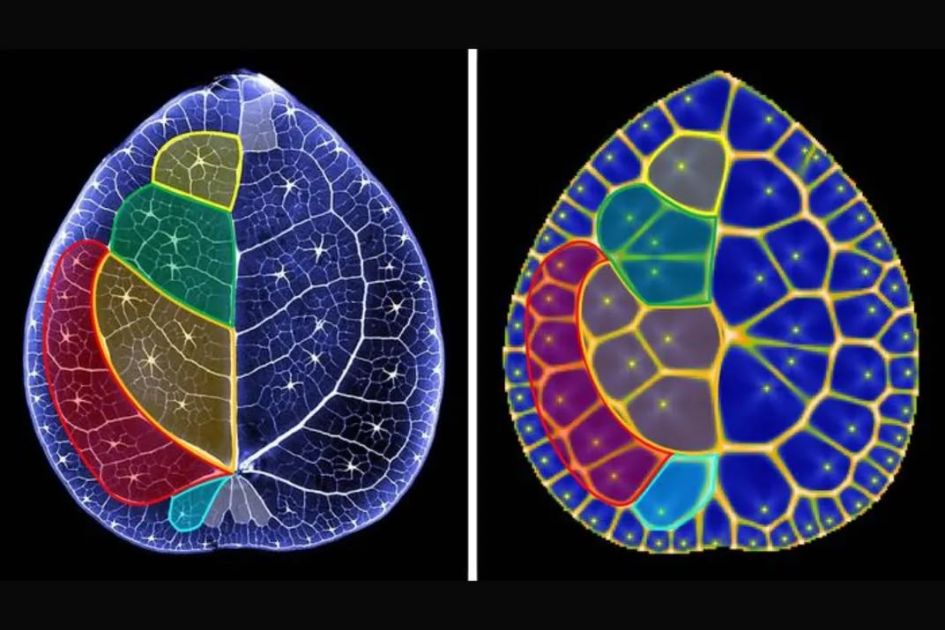

Researchers discovered the Chinese Money Plant develops Voronoi-like leaf vein patterns through self-organization, offering new insights into mathematical growth, plant development, and nature’s efficient spatial design principles.
A familiar houseplant, widely known for its round, coin-shaped leaves, has become the focus of a scientific study exploring how complex patterns emerge in nature. Researchers studying Pilea peperomioides, commonly known as the Chinese Money Plant, report that its leaf vein architecture closely resembles a mathematical structure known as a Voronoi diagram, a spatial partitioning system widely used in engineering, logistics and urban infrastructure planning.
The findings, published in Nature Communications, suggest that natural growth processes can independently generate efficient spatial organization patterns that also appear in human-designed systems. However, researchers emphasize that the similarity should be understood as a shared mathematical principle rather than a direct biological blueprint for city design.
From Houseplant to Spatial Mathematics
A Voronoi diagram divides space into regions based on proximity to defined points. In human applications, it is used to optimize the placement of services such as hospitals, schools and emergency response facilities so that access distances are minimized. The same mathematical framework is also used in telecommunications network planning, robotics navigation and environmental modeling.
The study was prompted by a visual observation from Eliza Bloom, a researcher at Cold Spring Harbor Laboratory, who noticed that the plant’s vein patterns resembled computational diagrams used in computer science. Together with computational biologist Saket Navlakha, she investigated whether this resemblance reflected a deeper organizing principle in plant development.

A Model-Based Mechanism, Not a Fully Mapped Pathway
To explore the phenomenon, the researchers used computational simulations supported by biological observations. Their work proposes a mechanism that may explain how Voronoi-like patterns arise during leaf development.
Central to this process are hydathodes, microscopic pores on leaf surfaces that release excess water, and auxin, a plant hormone that regulates growth and pattern formation.
In the proposed model, auxin disperses outward from multiple hydathode points, forming overlapping diffusion fields. Where these fields intersect, boundaries emerge that gradually stabilize into the leaf’s vascular network. The resulting structure is not directed by a central biological controller but instead emerges through local interactions governed by chemical gradients and physical constraints.
Researchers stress that this explanation is a computational and conceptual model supported by imaging and simulation rather than a fully experimentally mapped step-by-step biological pathway. Certain aspects of the mechanism remain under investigation.
Efficiency Without Central Control
The study contributes to a broader understanding of how plants develop highly organized internal structures without centralized coordination. Instead, they rely on self-organizing processes in which simple local rules generate complex global patterns.
Scientists caution against interpreting this as nature designing systems in the human sense. Rather, it reflects how physical and biochemical processes can naturally converge toward efficient spatial arrangements.
Implications for Engineering and Design
While the findings do not suggest that plant biology directly informs urban planning or design, they reinforce a broader principle that similar mathematical solutions can appear across very different systems.
Researchers note that understanding these natural optimization processes may still offer indirect inspiration for engineering fields. Plant vascular networks have already informed improvements in microchip layout, material distribution systems and solar energy design. More broadly, biomimetic research continues to explore how biological systems solve spatial and structural challenges through simple governing rules.

A Case Study in Emergent Order
Rather than functioning as a literal blueprint for human cities or infrastructure, the Chinese Money Plant provides insight into how complexity can arise from simplicity. Its structure demonstrates how repeated local interactions over time can produce highly organized and efficient forms without centralized planning.
Native to the Yunnan and Sichuan regions of southern China, the plant has become a popular ornamental species worldwide. Beyond its aesthetic appeal, it now serves as a useful model for studying how mathematical patterns can emerge in living systems, bridging botany, computational modeling and theoretical design science.
As research continues, scientists hope that studying such systems will deepen understanding of plant development and contribute to broader advances in modeling complex, self-organizing systems in nature and technology.




