

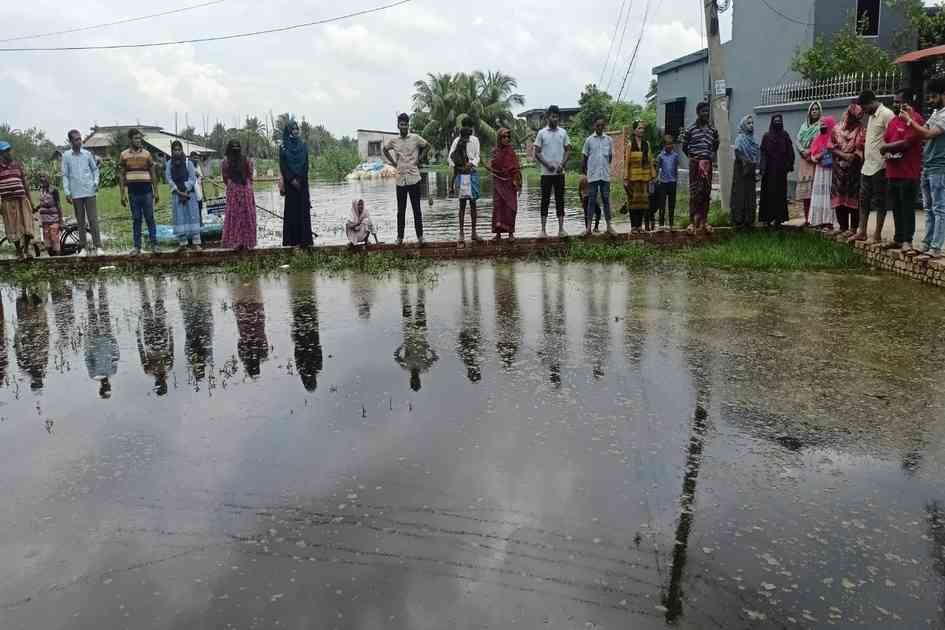

Organisers linked Itagachha’s prolonged flooding to poor drainage and filled water bodies, as residents reported household inundation, sanitation disruption and growing waterborne disease concerns.
Residents in the southwestern Bangladeshi district of Satkhira formed a human chain on Wednesday demanding action to monitor the impact of climate change and address severe waterlogging, placing five demands to ease suffering in low-lying neighbourhoods.
The programme, titled “Climate Education Exchange Visit Series 2026”, was held in a waterlogged area of West Itagachha in Satkhira town.
It was organised by the non-governmental development organisation HEAD under the Community Action for Climate Justice and Networking Project, with support from Sampriti Aid Foundation and the Climate Justice Resilience Fund.
The human chain was chaired by Ferdousi Ara Moyna, an elderly local resident.
Speaking at the event, Ali Noor Khan Babul, joint member secretary of the Satkhira District Citizens’ Committee, said a lack of planned drainage and the filling of natural water bodies had left Itagachha and surrounding areas submerged.
He presented five demands for quickly addressing the waterlogging.
The demands included ensuring planned fish farming based on scientific methods, providing appropriate compensation to people affected by climate-related and human-made disasters, building sustainable drainage systems in West Itagachha and all low-lying areas, restoring natural water bodies and freeing them from illegal occupation and ensuring local people’s participation in community-based climate adaptation activities.
Local residents Sharifa Khatun and Rowshan Ara said years of waterlogging had pushed water into homes, disrupted sanitation and led to the spread of waterborne diseases.
Earlier in the morning, an exchange meeting was held at HEAD’s head office in the Katia area of Satkhira town.
HEAD Executive Director Luis Rana Gain said the organisation’s main goal was to develop sustainable adaptation strategies to address the climate crisis by involving the younger generation and local communities.
Journalist Sharifullah Kaiser Sumon, local media workers and members of the organisation’s youth team attended the meeting.




