

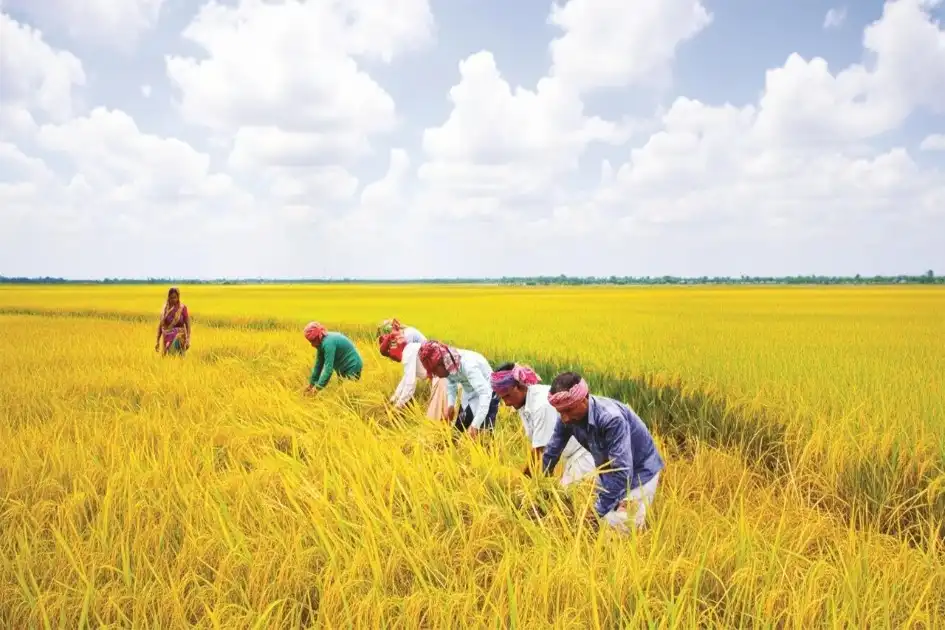



A bumper harvest of the salt-tolerant Rajasail rice in Sandwip’s tidal charlands has brought renewed optimism to coastal farmers battling rising salinity. The rare variety’s success is reviving abandoned lands and offering a model for climate-resilient rice cultivation in Bangladesh.
A rare salt-tolerant local rice variety has yielded a bumper harvest on Sandwip’s tidal charlands this season, offering new hope for farmers battling rising salinity along Bangladesh’s coast.
Farmers say Rajasail, a traditional rice variety long cultivated in Sandwip, thrives in conditions where modern varieties fail, even in fields that flood twice a day with tidal water. In the unprotected char areas outside the embankment, where saltwater intrusion makes conventional farming nearly impossible, Rajasail grows submerged.
“If it doesn’t go under the tide twice a day, it won’t produce well,” said Nizam Uddin, a farmer from Sabuj Char.
Newly emerged chars about 10 kilometres northwest of Sandwip town have created a stretch of fertile agricultural land as sediment continues to accumulate. Many former residents who had migrated due to erosion have now returned, rebuilding homes and restarting cultivation. Watching his wife bundle freshly cut rice, Abbas Mia of Dighapara said the tidal water brings nutrient-rich silt that makes the land “incredibly fertile.”
According to the Upazila Agriculture Office, Rajasail was cultivated on at least 20,000 hectares this season. If siltation continues, farmers expect the chars to become even more productive in coming years. Upazila Agriculture Officer Maruf Hossain said favourable weather and fertile silt soils played a major role in boosting yields, adding that seed samples have been sent for further research.
Beyond the new chars, roughly 2,000 kani of land on the eastern edge of Sandwip, outside the embankment, were also planted with Rajasail. But fungal infections and pest attacks cut yields sharply there. Azizur Rahman of Mogdhara, who cultivated 10 kani, said he harvested barely half of last year’s output. With silt buildup raising land levels, he said tidal water no longer enters fields on time, worsening pest pressure. Applying pesticides across such vast land is costly, he added, and farmers receive little government support.
Farmers in Mogdhara, Bauria and Gasua unions said better and timely guidance from agriculture officials could have prevented the pest outbreaks.
Despite the setbacks in some areas, the Upazila Agriculture Office reports that Rajasail’s average yield reached 2.80 metric tonnes, exceeding the season’s target. Experts say that with scientific seed improvement, proper preservation, and stronger state support for coastal agriculture, Sandwip and much of Bangladesh’s coastline could rapidly emerge as one of Asia’s major grain-producing belts.
Salt-tolerant rice varieties bring new hope to Bangladesh’s coastal belt
Bangladesh’s coastal districts, which produce 25% of the country’s rice, are increasingly threatened by salinity intrusion. Thousands of hectares have become barren as seawater pushes inland, leaving farmers searching for alternatives.
This crisis is not new. In the 1970s, Satkhira farmer Nandi Dulal, now 70, noticed his once-productive fields turning sterile. “Seven to eight months a year, the land was barren,” he recalled. Many farmers shifted to shrimp and fish farming as rice cultivation collapsed.
With salinity rising due to climate change, Bangladesh urgently needed rice that could survive in salt-prone soils. The breakthrough came in 2006, when the Bangladesh Rice Research Institute (BRRI), with support from IRRI, released BRRI-47, the country’s first salt-tolerant variety. It can withstand salinity levels of 10–12 dS/m-1, compared with just 0.7 dS/m-1 for most traditional varieties.
The innovation transformed farming across 19 coastal districts. In Satkhira, the most climate-affected district, cultivation of BRRI-67 expanded from 119 hectares in 2018 to 5,216 hectares by 2022. Other varieties such as Binadhan-10 also spread rapidly, reviving once-abandoned lands.
Bangladesh has 2.86 million hectares of coastal and offshore arable land, but more than 500,000 hectares remain uncultivated due to high salinity. Soil studies show that large parts of Khulna, Satkhira, Bagerhat, Patuakhali and Barguna now experience salinity between 8.1–16 dS/m-1, far above the tolerance of most rice.
Scientists say salt-tolerant varieties could increase production by 11.75% by 2050 if widely disseminated. BRRI has since developed around 16 salt-tolerant variants, including the newest BRRI Dhan-97 and BRRI Dhan-99, which can withstand up to 14 dS/m-1 during seedling stages.
“Salt-tolerant rice has changed the fortunes of coastal farmers,” said BRRI Chief Scientific Officer Mohammad Khalequzzaman. “But rising salinity means we must innovate even faster.”




