


Project pivots to door and window wood market as traditional buyers disappear
Once planted to meet Nepal’s growing demand for fuelwood, eucalyptus trees in the Sagarnath Forest Project now face an uncertain future. With declining demand and unsold stock piling up, the state-run project has turned to a new strategy—treating and marketing eucalyptus timber for use in doors and windows, offering it at one-third the cost of sal wood.
Demand for eucalyptus timber collapses
Launched in 1977 with a $13.2 million loan from the Asian Development Bank, the Sagarnath Forest Project aimed to replace degraded natural forests in Sarlahi and Mahottari districts with fast-growing species like eucalyptus. Imported from Australia, these trees were chosen to produce fuelwood for Kathmandu and the Terai. But with changing technology and energy sources, demand for eucalyptus has all but disappeared.
“Previously, eucalyptus timber was used for electric utility poles,” said Project Chief Khem Bishwakarma. “Now, cement and aluminum poles have replaced it, and eucalyptus is no longer in demand—even as fuel, especially after the closure of the Janakpur Cigarette Factory.”
New plan: treated timber for construction
In response, the project has started marketing eucalyptus for furniture and construction. With support from the World Bank and the REDD Implementation Center in Kathmandu, a timber treatment plant was installed, sawmill upgraded, and staff trained.
“Eucalyptus timber can now be used to make doors and windows,” said Bishwakarma. “It is three times cheaper than sal wood. Some housing companies in Kathmandu are already using it without complaints.”
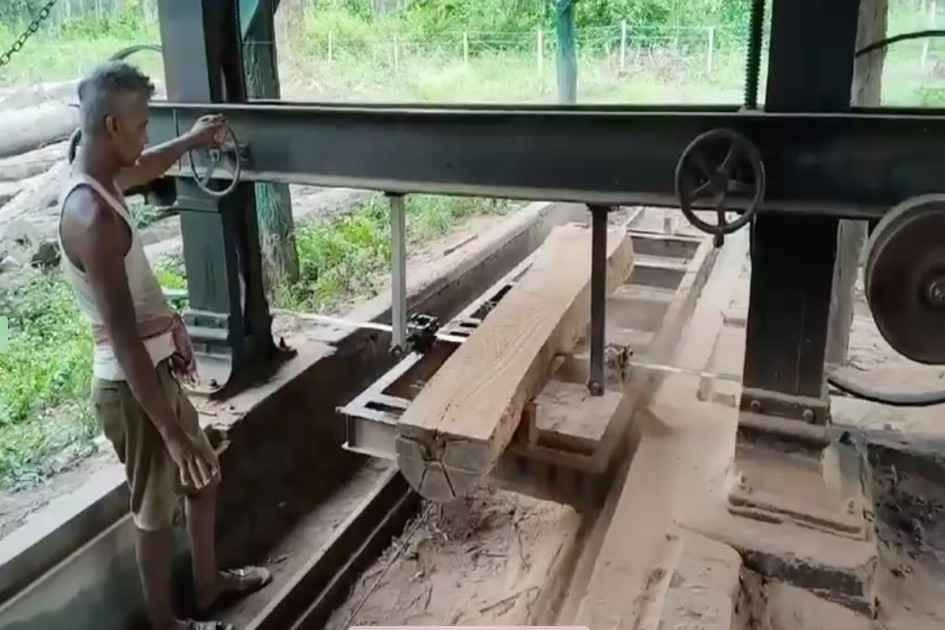
The treated wood is being tested for durability against weather, and project officials hope it could eventually rival aluminum as a low-cost alternative.
Price sap spurs hope and challenges
Currently, quality sal timber sells for around Rs. 2,200 per log, while eucalyptus fetches only Rs. 700. This low value has discouraged private farmers in the Terai, who once planted eucalyptus widely, from continuing its cultivation. Many are now removing the trees due to lack of market.
REDD Implementation Center Deputy Secretary Nawaraj Pudasaini sees potential in the project’s revival. “We aim to reduce dependence on imported timber and aluminum,” he said. “Treated softwood from the Terai can meet domestic demand for furniture and interior construction.”
A new project operating committee involving community forests and the Division Forest Office has been formed to boost eucalyptus sales and support farmers.
From fuelwood to forestry failure
The eucalyptus strategy dates back nearly five decades. Following Nepal’s 1957 Forest Nationalization Act, deforestation increased as landowners cleared trees to avoid government seizure. In response, Nepal invited Australian forestry experts in the 1960s. One, Kevin Joseph White, recommended fast-growing eucalyptus and various pines as suitable alternatives.
Sagarnath planted 60% of its 10,000 hectares with eucalyptus, 10% with teak (another imported species), and the remainder with native sissoo. Local opposition prevented complete conversion to eucalyptus.
Despite early success—the first harvest was in 1989—the project has since struggled. Without timber sales, revenue dried up, affecting salary payments and regular operations.
A test for domestic timber markets
Now, the project’s future hinges on its ability to reposition eucalyptus as affordable construction timber. Officials hope this new model will support local economies, reduce imports, and revive one of Nepal’s largest forest initiatives.




