




Rising LNG costs and global decarbonisation demands are pushing Bangladesh’s garment sector toward solar power, but financing and policy barriers remain major hurdles.
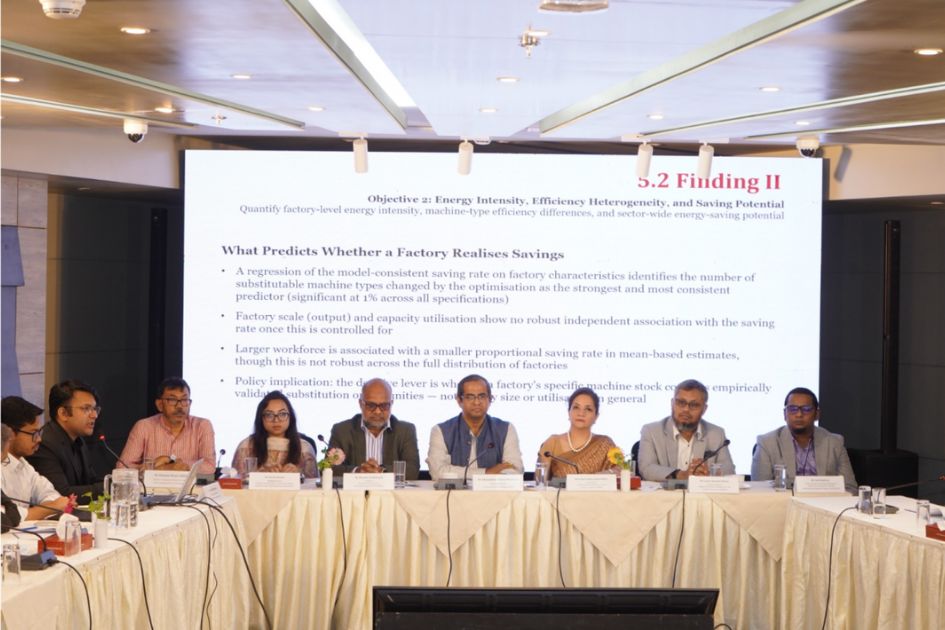
Bangladesh’s garment industry could reduce its average monthly energy costs by 15.7 percent if renewable energy meets 30 percent of its electricity demand, according to a new study by the Centre for Policy Dialogue (CPD) released on Sunday.
The study, based on data from 350 ready-made garment (RMG) factories, says the sector needs to accelerate its transition to renewable energy as growing dependence on imported liquefied natural gas (LNG) exposes manufacturers to higher costs, supply risks and increasing pressure from global buyers.
The CPD said renewable energy should increasingly be considered a matter of energy security, cost stability and global competitiveness for Bangladesh’s export-oriented RMG industry, rather than solely an environmental initiative.
Greater reliance on imported LNG exposes factories to international fuel-price volatility, pressure on foreign exchange and potential supply disruptions. Solar power, by contrast, offers a more predictable cost structure because it does not require continuous fuel purchases from international markets.
Dr Khondaker Golam Moazzem, research director of the CPD, said the ongoing gas crisis was likely to intensify and put further pressure on the RMG sector and the wider economy.
“Relying solely on imported LNG will not be sustainable in the long run,” he said.
He noted that the Bangladesh Garment Manufacturers and Exporters Association (BGMEA) was already encouraging its members to explore renewable energy, but said more comprehensive information on financing and technological options was needed to help manufacturers understand the transition.
CPD modelling shows that meeting 30 percent of a factory’s electricity demand through solar power could reduce average monthly energy costs from Tk 998,190 to Tk 846,435, a saving of 15.7 percent.
Even a 10 percent solar offset could reduce average monthly energy costs by 5.5 percent, the study found.
A Monte Carlo simulation involving 1,000 possible scenarios for each factory also found that renewable-energy adoption could reduce monthly energy-cost volatility. Costs became less volatile in 96 percent of the factories in the model.
The CPD therefore recommends combining renewable electrification with technological innovation and research into lower-energy production methods and alternatives for industrial thermal processes.
Industry leaders say Bangladesh has little time to make the transition as major export markets introduce stricter environmental and decarbonisation requirements.
Vidiya Amrit Khan, vice president of BGMEA and deputy managing director of Desh Garments Ltd, said the shift from traditional energy to renewable energy had become a global requirement for the RMG industry.
“There are multiple EU and UK directives and regulations coming into enforcement in the coming years that require energy transition, so we have very little time in hand,” she said.
Khan said BGMEA wanted renewable-energy investments to be free of tax and additional VAT.
“We want 0% tax, without an additional 15% VAT on RE. If the government is going for 0% tax, then why is the NBR not aligning with this?” she said.
Mostafa Al Mahmud, president of the Bangladesh Sustainable and Renewable Energy Association (BSREA), said although the government had set a 10,000MW renewable-energy target, policy bottlenecks remained, particularly regarding taxation of solar technologies.
“The NBR’s SRO is still a bottleneck, where more than 50% VAT remains on solar technologies,” he said.
“Without taking out-of-the-box decisions by the government and clearing these bottlenecks, we are heading towards a bigger energy disaster,” he warned.
Fazlee Shamim Ehsan, executive president of the Bangladesh Knitwear Manufacturers and Exporters Association (BKMEA), said Bangladesh was lagging behind global competitors in renewable-energy adoption.
“There are many EU regulations. We have many funds but those are not accessible. We must explore those pathways to access those funds,” he added.
The CPD study also found substantial differences in energy efficiency among factories of different sizes.
The smallest factories had an estimated energy-saving gap of 57.3 percent compared with the efficiency frontier, while the gap for the largest factories was only 8.9 percent.
The disparity was attributed partly to older machinery and tighter financing constraints among smaller factories.
Machine-level efficiency also varied significantly. A band-knife cutting machine was found to be roughly 300 times more energy-intensive per unit of output than a laser-cutting machine. A buttonhole machine was about 140 times more energy-intensive than the most efficient sewing-machine types.
Optimising or replacing machinery across the 350 factories could produce an average factory-level energy-saving rate of 10.17 percent, according to the study.
Under the model, annual energy consumption could fall from about 1.54 million MWh under the existing machinery mix to around 1.28 million MWh under an optimal mix. After accounting for actual factory capacity utilisation, however, the expected real saving falls to around 25,330 MWh a year.
The required investment would be substantial: Tk 6,604 crore for 50 percent adoption and Tk 13,209 crore for full adoption.
The CPD said machinery replacement alone could not deliver deep decarbonisation, as capital and energy function as complements rather than substitutes in the RMG sector. Sewing accounts for 85.2 percent of installed machinery, much of which is technically essential and difficult to replace.
Mohammed Zahidullah, chief sustainability officer of DBL Group, said solar energy would be central to Bangladesh’s decarbonisation efforts.
“The code of decarbonisation is nothing but solar renewable energy for Bangladesh,” he said.
He said Bangladesh risked losing orders to competitors such as India, Pakistan and Vietnam because they were advancing faster in integrating renewable energy into production.
“The macro level change will come when we, as a country, move forward in renewable energy; in our case, it is solar and public-private partnership for setting up large-scale solar power plants. For acquiring land for large-scale power plants, the government can support the land, while the private sector can come collectively to invest in the technology,” he said.
The CPD identified high upfront investment, limited information about alternative technologies, long payback periods and risk aversion as major barriers to renewable-energy and energy-efficiency investments, particularly for smaller factories.
It recommends expanding blended finance combining private investment, concessional lending and government-backed credit.
The study also calls for financial institutions to develop standardised appraisal frameworks for renewable-energy and energy-efficiency projects, making it easier for factories to access financing.
With global brands increasingly imposing supply-chain decarbonisation requirements and carbon-sensitive trade measures emerging, the CPD warns that continued investment in fossil-fuel infrastructure could create stranded or underutilised assets.
It recommends expanding rooftop solar, promoting renewable electrification, incentivising energy-efficient machinery, developing alternatives for energy-intensive thermal processes, conducting regular energy audits and streamlining approval procedures for renewable-energy projects.
Moazzem called for a coordinated initiative involving BGMEA, BKMEA, BSREA, Petrobangla and all other relevant stakeholders to address the current energy crisis and remove existing bottlenecks. He said the organisations should come together under a joint committee to find solutions to the crisis and take concerted steps to remove the barriers to the transition towards renewable energy.




