

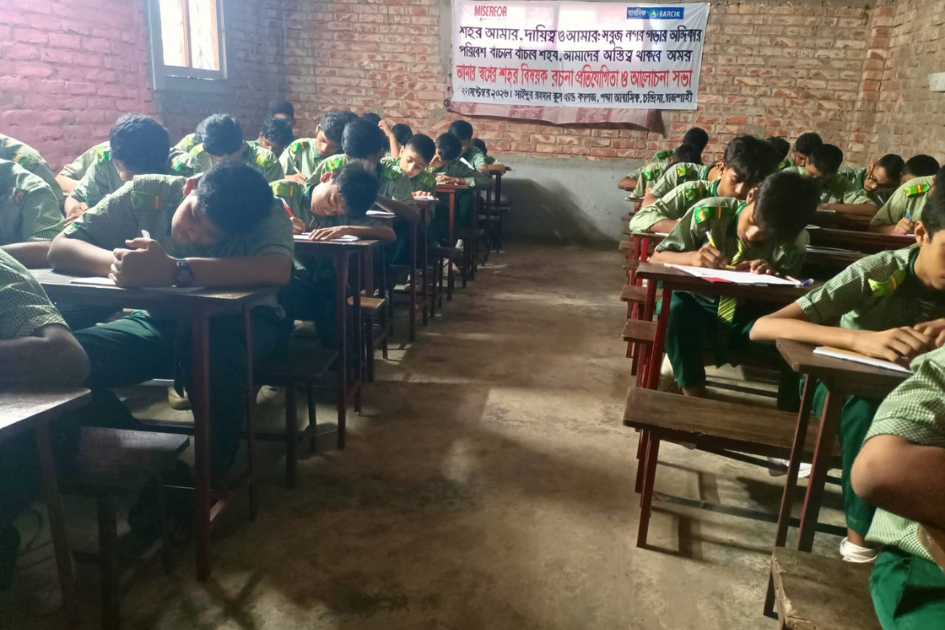



Students’ essays explored greener neighbourhoods, safer public spaces, better education and stronger environmental awareness as they imagined Rajshahi’s future.
Nearly 100 students in Rajshahi took part in an essay competition on Tuesday to share their experiences of the city and their visions for a greener, safer and climate-resilient urban future.
The competition, titled “Understanding the climate crisis, dreaming of a resilient city: The city I see, the city I imagine”, was organised by Bangladesh Resource Centre for Indigenous Knowledge (BARCIK) at Saidur Rahman School and College in the Padma Residential Area of Rajshahi.
Students from grades seven to 10 took part in the competition, writing about their experiences of the city, the impacts of climate change, the environment, education, gender equality and their ideas for a beautiful and safe urban environment.
The essays reflected not only the students’ visions of an ideal city but also problems they encounter in their daily lives and how they want their city to develop in the future.
Some students imagined a city surrounded by greenery, while others focused on creating an education-friendly urban environment. Some called for a city where women could move around safely and with dignity.
At the end of the competition, first, second and third-place winners were selected from each grade. The winners received educational materials, including geometry boxes, as prizes.
Saidur Rahman, the school’s director and head teacher, said activities of this kind encourage students to think beyond conventional classroom studies.
“When they learn to think about their own city, environment and future, it develops their creativity and sense of responsibility,” he said.
He said such activities also give students an opportunity to understand the environment and society around them, rather than relying only on knowledge from books. Giving importance to students’ opinions could help them play a more positive role in developing their communities and cities in the future, he said.
Assistant teacher Md Mehedi Hasan said such activities could increase students’ interest in their studies.
“Through essay writing, they get an opportunity to organise and express their own thoughts,” he said. “At the same time, they are developing the habit of thinking about an issue in their own way and expressing those thoughts in writing, which will be useful in their studies and future lives.”
Eighth-grade student Nusrat Jahan Nupur won first place in her grade. Describing her vision of a future city, she said: “I want my dream city to be green, where there will be trees and more trees. Outside tourists will also be able to enjoy the beauty of the city through its trees. This will reduce environmental pollution and make the city more beautiful and comfortable for people to live in.”
Seventh-grade student Tasnia Tabassum Takia won second place. “I want an education-friendly city where no one has to suffer for education,” she said. “There will be good educational opportunities for everyone and students will be able to study in a safe and beautiful environment.”
Eighth-grade student Samiul Al Mahdi won third place. “I want a city where everyone respects women,” he said. “Women should be able to move around safely and everyone should give importance to their opinions and rights.”
The students’ views showed that their idea of a good city extends beyond large buildings, roads and improved infrastructure. Their visions include trees and a clean environment, access to education, safety, respect and conditions suitable for people to live in.
BARCIK Associate Programme Officer Amit Sarkar said the competition aimed to raise awareness among the next generation about the impacts of climate change and urban challenges and to encourage them to imagine a safe, green and climate-resilient city.
“Today’s children will build tomorrow’s cities. Therefore, they need to be involved in building climate-resilient cities by giving importance to their thoughts, dreams and opinions,” he said.
BARCIK Associate Programme Officer Tahura Khatun Lily told the students: “Today’s thoughts are the bright stars of tomorrow. Together, we have to move these beautiful thoughts towards implementation. Today, we have learned about your thoughts through your essays. We want to move forward with your dreams and ideas.”
She said children and adolescents should not only be told about climate change or urban challenges but should also be given opportunities to express their own experiences and ideas. Problems they see around them can often lead to ideas for important solutions for the future, she said.
The organisers said building a beautiful and resilient city requires more than plans made by adults and that children’s thoughts and aspirations should also be incorporated into such planning.
Through the competition, students were able to reflect on problems in the city they see around them and present their visions for a future urban environment. Their essays included expectations for green cities, pollution-free urban areas, education-friendly environments, cities free of traffic congestion, and safety and respect for women.
The organisers said the activity also created an opportunity to promote environmental and climate awareness among students while developing their creative thinking, ability to express opinions and sense of civic responsibility.
The cities imagined by the students remain on paper for now, but the competition brought their ideas and expectations into view as they considered what future urban environments should look like.




