

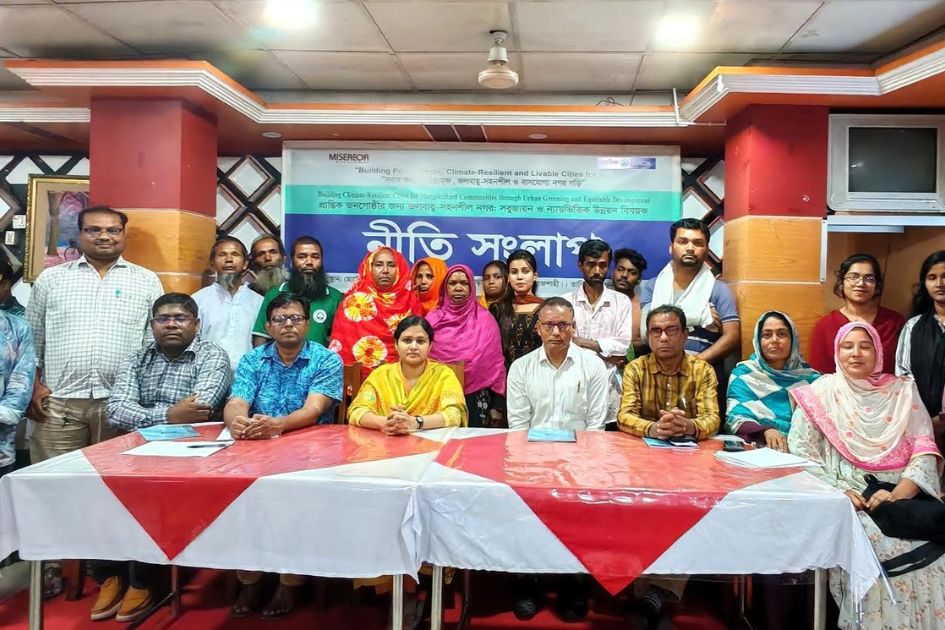

A policy paper launched in Rajshahi calls for urban agriculture, greening initiatives and rights-based planning to strengthen climate resilience, food security and basic services for marginalized urban communities.
A policy paper unveiled in Rajshahi on Sunday called for integrating urban agriculture, greening initiatives and rights-based development into city planning to improve the lives of slum dwellers and other marginalized communities while strengthening resilience to climate change.
Rajshahi city, located in northwestern Bangladesh, is facing growing challenges related to climate change, food security and access to basic services among its low-income urban population. Against this backdrop, the policy paper titled “Climate-Resilient Cities for Marginalized Communities: Building Inclusive Urban Areas Through Greening, Urban Agriculture and Equitable Development” was published during a dialogue held at SK Seminar Hall in Ranibazar under the initiative of the Bangladesh Resource Center for Indigenous Knowledge (BARCIK).
The paper was developed under BARCIK’s Poverty Reduction and Urban Resilience Programme based on field investigations, case studies and household interviews conducted in 14 slums across the city.
According to the findings, expanding urban agriculture, increasing green spaces and improving access to basic civic services could significantly enhance food and nutrition security, boost household incomes, strengthen women’s empowerment, promote social cohesion and improve communities’ capacity to adapt to climate change.
The policy paper recommends incorporating urban agriculture into Rajshahi City Corporation’s development plans and recognizing it as a key component of urban food and nutrition security. It also proposes establishing community nutrition gardens and climate-resilient urban agriculture programmes in every slum to improve access to nutritious food for low-income families.
Other recommendations include ensuring access to safe water, electricity and sanitation services for slum residents through coordinated efforts by the Water Supply and Sewerage Authority (WASA), Northern Electricity Supply Company (NESCO) and the city corporation.
The paper further calls for providing seeds, saplings, technical training and financial support to urban poor communities, particularly women, and establishing women-led urban agriculture and greening funds. It also recommends expanding green corridors, public green spaces and tree-planting programmes in every ward to reduce urban heat island effects and maintain environmental balance.
Among its key proposals are the creation of a dedicated climate adaptation fund for urban poor communities, guaranteed allocations for them in climate budgets and the formulation of participatory urban plans that ensure representation of slum residents and reflect their needs and opinions.
The recommendations also include establishing seed banks, compost production facilities, technical support services and incentive funds to support sustainable expansion of urban agriculture. The paper urges authorities to implement safe and climate-resilient housing programmes for slum residents and ensure their land and housing security.
In addition, it calls for expanding social protection programmes for the urban poor and ensuring effective implementation of the principles of “Right to City” and “Right to Basic Services” as part of efforts to achieve Sustainable Development Goal 11. It also emphasizes the need for community-based climate awareness and capacity-building programmes to help residents better prepare for climate-related risks.
The policy paper states that transforming Rajshahi and other cities in Bangladesh into greener, more inclusive and climate-resilient urban centres will require placing marginalized communities at the centre of development planning while ensuring their rights and participation.
The dialogue was moderated by Tahura Khatun Lili, associate programme officer of BARCIK Rajshahi. Opening remarks were delivered by Shahidul Islam, regional coordinator of BARCIK Rajshahi, while the policy paper was presented by Amit Sarkar, associate programme officer of the organization.
Slum residents and representatives of marginalized urban communities shared their experiences and concerns during the discussion. Speakers included Nilufa Ismat Ara, member secretary of the Urban Poor Rights Implementation Committee and a resident of Jamalpur Slum; Latifa Begum and Omar Ali from Budhpara Slum; Papiya Begum from Chouddapai Slum; Bacchu Mia from Namobhadra Slum; Mati Mia from Baharampur Slum; youth educator Md Rocky Ali, who runs a school for underprivileged children; and Fatematuz Johora, among others.
Participants in the dialogue also included Farzana Haque, metropolitan agriculture officer in Rajshahi; Azizur Rahman, community development officer of Rajshahi City Corporation; Faruk Ahmed, assistant engineer of Rajshahi WASA; Mahbub Siddiqui, president of Green Coalition Rajshahi and a river and environment researcher; Jahangir Alam, project coordinator of BARCIK; Dr Ainal Haque, special correspondent of Bangladesh Sangbad Sangstha (BSS) in Rajshahi; and Md Atikur Rahman, president of Barendra Youth Forum, among others.




