




Farmers in Pakistan are adopting traffic-light soil moisture sensors to cut irrigation, save energy and protect crops as climate change intensifies water scarcity across Punjab and Khyber Pakhtunkhwa districts today.
Farmers in parts of Pakistan are adopting a simple but innovative tool that is reshaping how they irrigate their fields as water scarcity and climate stress intensify across South Asia.
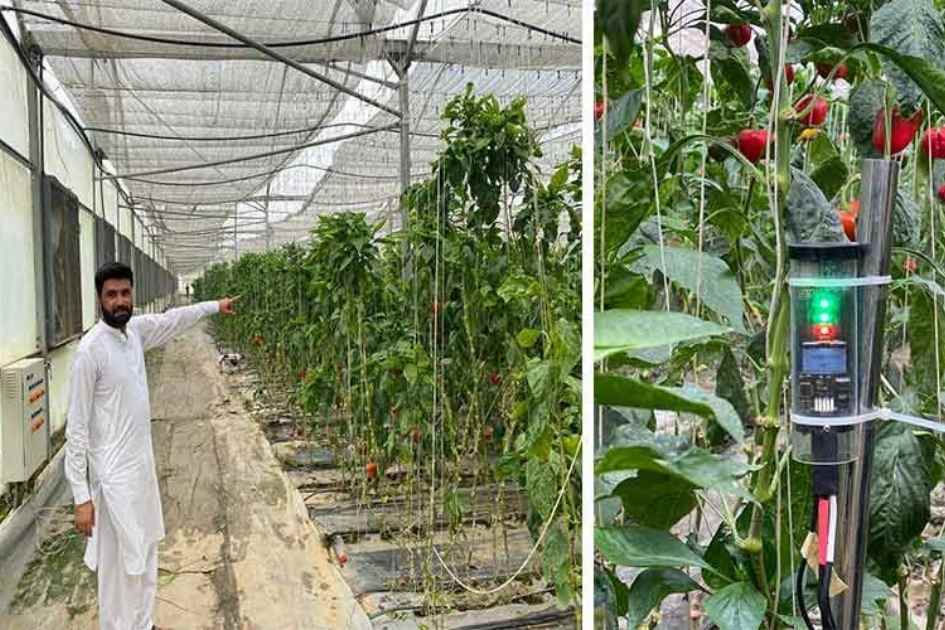
In Kallar Kahar, a rain-fed area of Chakwal district in Punjab, Tauseef Ahmad, manager of a coloured bell pepper farm, says soil moisture sensors have helped him cut water use by nearly half.
“Earlier we were using 12,000 to 14,000 litres of water per day,” Ahmad says. “Now 8,000 litres is enough. It saves water, energy and improves soil health.”
The technology is being introduced by the International Water Management Institute (IWMI) under its Water Resource Accountability in Pakistan (WRAP) programme, funded by the UK’s Foreign Commonwealth and Development Office. The initiative was launched in Punjab in 2021 and expanded to Khyber Pakhtunkhwa in 2024.
Installed in farmers’ fields, the sensors measure moisture at different depths across the crop’s root zone and relay the information through a simple colour-coded light system. Green indicates sufficient moisture, blue signals declining but adequate moisture and red warns that irrigation is required.
According to Abubakar, IWMI’s district officer in Chakwal, 44 sensors have been installed across the district to help farmers optimize irrigation practices.
The impact has been significant. For wheat, irrigations have dropped from five to three per season, saving farmers around Rs 10,000 per acre. Vegetable growers have reduced irrigations from ten to seven, cutting water use as well as electricity and fuel costs.
Chakwal relies heavily on rainfall, with farmers using tube-wells during dry periods. Reduced pumping, farmers say, also means lower energy consumption and operating costs.
Similar benefits are being reported in Khyber Pakhtunkhwa. In Mansehra district, IWMI began installing sensors in 2024 as part of its water governance and climate adaptation work.
Dr Attique Rehman, a farmer from Baffa tehsil in Mansehra, is using the sensors on his six-kanal farm to grow kiwi fruit, a crop that is highly sensitive to over-irrigation.
“These fruits need a precise amount of water,” he says. “Too much irrigation can cause rot. The sensor’s green, blue and red lights help me understand exactly when watering is needed.”
IWMI describes water security as one of the most pressing development challenges facing Pakistan, where climate change is driving erratic rainfall, longer dry spells and rising pressure on groundwater resources. Rural communities and small farmers are among the most vulnerable.
Under the WRAP project, IWMI aims to strengthen water governance at national and provincial levels while promoting climate-resilient farming practices. So far, 299 soil moisture sensors have been installed across Chakwal and Okara districts in Punjab and Mansehra and Charsadda districts in Khyber Pakhtunkhwa.
IWMI officials say the sensors are relatively low-cost, durable and battery-powered, with data accessible directly from the device or through digital connections. They add that scaling up such technologies will require stronger government support and training for farmers.
Experts say that simple, easy-to-use innovations like soil moisture sensors could play a critical role in safeguarding food production in water-stressed countries, where agriculture remains central to both livelihoods and the economy.
For farmers already using the technology, the change is tangible. “It removes the guesswork,” Ahmad says. “We can see what the soil needs and act at the right time.”




