

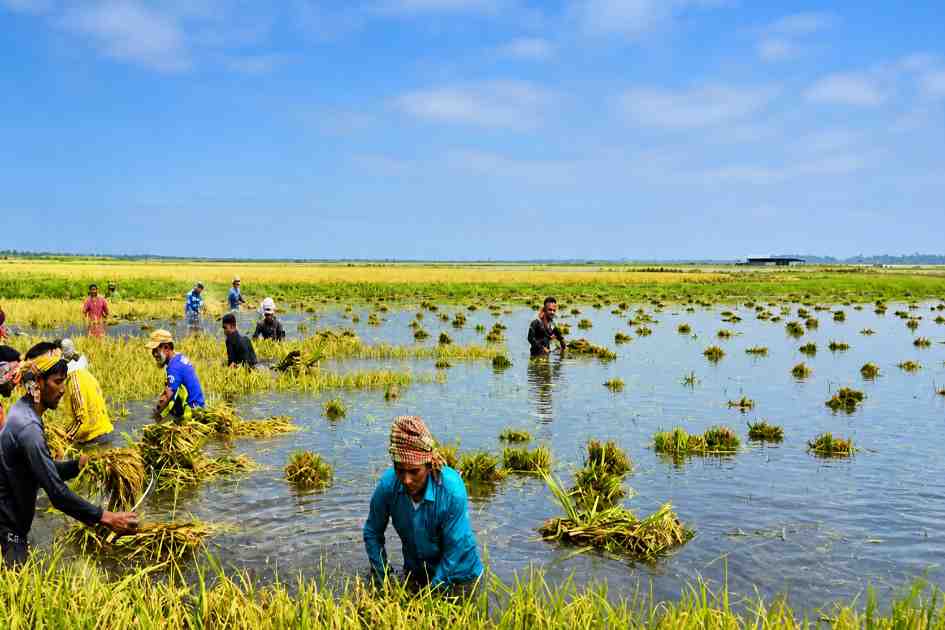



A farmer’s death after watching his flooded crop rot has ignited anger over alleged corruption, river mismanagement and lack of support, exposing deep cracks in Bangladesh’s rural safety net and raising urgent questions about accountability.
Ahad Mia’s death was not a mere heart attack. It was a calculated killing by our corrupt state machinery and river-grabbing syndicates. When six bighas of ripe paddy rot beneath floodwater, that loss is not just of crops; it is the loss of a father’s ability to feed his children and free his family from debt. When that last hope drowns, it is no surprise the farmer’s heart gives out.
We celebrate the illusion of “development” yet cannot offer a farmer security or even the simple act of dredging a river, a testament to the incompetence of our administration. From Kishoreganj to Nasirnagar, the air reeks of despair, debt and death. Where have the millions meant for river dredging gone? Into the pockets of the powerful while farmers drown year after year in upstream deluges.
The much-talked-about “climate justice” ends at luxury seminars. Meanwhile in the fields there is no crop insurance, no emergency relief. With soaring fertilizer and pesticide prices and rising labor costs, farmers are forced to sell their golden rice at throwaway prices, making our boast of “self-sufficiency in food” nothing but a cruel joke.
The time has come to turn this simmering rage into real power. Expressions of sympathy on editorial pages no longer suffice. Unless river grabbers are tried, corrupt officials held accountable and farmers’ debts written off, this volcano of injustice will one day erupt and destroy everything in its path.
History teaches us that no civilization has survived by starving its workers. Ahad Mia’s blood-stained paddy and the curse of the starving farmer are enough to shake even the strongest throne. When a farmer sows seeds, he is wagering his family’s future. Yet skyrocketing production costs force him to borrow from moneylenders or predatory NGOs. When floodwaters take his crop, it is not just rice that sinks, it is his last hope of survival.
Ahad Mia of Nasirnagar was the father of three. As he watched his six bighas vanish underwater, the images haunting him were not of grains but of creditors and his children’s hungry faces. That crushing psychological blow, abandoned by the state, is itself a social crime.
When men like Iqbal Hossain or Hazarat Ali from Kishoreganj wade waist-deep through water to harvest decaying rice, there is no heroism in that sight, only humiliation. We call them “food warriors” yet they stand unarmed, clutching only sheaves of debt papers. While we spend words in comforted rooms, this article is for the farmer whose stove remains cold and against the predators who have stolen the rivers and redirected the waters.
How many more bodies like Ahad Mia’s must surface before the nation awakens? To call his death an “accident” is an obscenity. It is the product of a ruthless system that protects capital but abandons labor. Funds for river dredging are looted without consequence but fertilizer subsidies for farmers come wrapped in endless bureaucracy.
Demands must no longer remain on paper: expose the river grabbers publicly, publish a white paper on corruption in dredging projects and immediately cancel all debts of flood-affected farmers. The long-promised agricultural and crop insurance schemes remain trapped in files. The state owes an answer.
The day the Bangladeshi farmer truly collapses, even the rice on our golden plates will reek of decay, not harvests. No civilization that tramples its working class has ever endured. Ahad Mia’s lifeless body is the mirror of a rotting system, one that glorifies “development” while letting its farmers die.
This explosive anger will subside only when the state guarantees real security and dignity to the people who feed the nation. Otherwise the coming eruption will consume us all, for the tears of working people have always had the power to shake even the mightiest thrones.




