




Bangladesh is advancing a major solar energy partnership with China that could be finalized during the Prime Minister’s ongoing visit, as the government pushes to expand renewable energy use from urban rooftops to rural irrigation systems and reduce dependence on costly fuel imports.
Bangladesh is actively pursuing a major solar energy agreement with China and there is a strong possibility that the deal will be finalized during Prime Minister Sheikh Hasina’s current visit to the country, Chief Whip Noor-E-Alam Chowdhury Moni said on Tuesday.
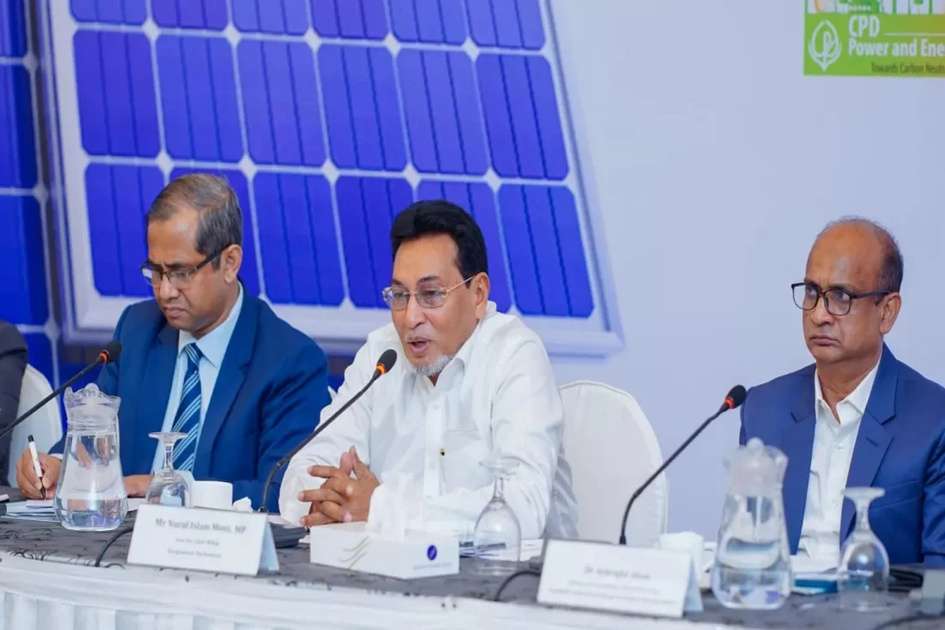
Speaking at a dialogue organized by the Centre for Policy Dialogue (CPD) in Dhaka, Moni said the government was moving ahead with plans to accelerate renewable energy deployment across the country, ranging from rooftop solar installations in urban areas to solar-powered agricultural irrigation systems in rural communities.
“The government is seriously pursuing a solar-related deal with China and there is a strong possibility it will be concluded during the Prime Minister’s current visit,” he told participants at the event titled “Solar Revolution in Pakistan in the Eyes of Country’s Leading CSO: Lesson for Bangladesh from National Budget Perspective” held at a hotel in the capital.
Moni said the government was considering bringing agricultural water pumps under solar power to reduce the substantial fuel subsidies currently provided to farmers for irrigation.
“There are plans to bring agricultural water pumps in villages under solar energy. This will significantly reduce the large fuel subsidies currently given to farmers for irrigation,” he said.
Acknowledging the challenges involved in expanding renewable energy nationwide, the Chief Whip said the government was focused on making an immediate start rather than expecting rapid results.
“We may not reach our desired goal in three months, perhaps not even in three years. But we want to start now,” he said.
Moni also highlighted the government’s fiscal support for the sector, saying the current national budget provides significant tax incentives for renewable energy investments.
He urged banks, financial institutions and private businesses to increase investment in renewable energy projects, arguing that the sector offers strong financial returns.
“A renewable energy plant recovers its cost within three to four years and operates for around 15 years. Investment in this sector is unquestionably profitable,” he said.
The dialogue featured a presentation by Muhammad Basit Ghauri, Manager of Special Initiatives and China Programme at Renewables First in Pakistan, who shared lessons from Pakistan’s rapid expansion of solar power and their relevance for Bangladesh.
According to Ghauri’s analysis, Bangladesh is structurally approaching conditions similar to those that triggered Pakistan’s solar boom. In Pakistan, solar panel imports increased eightfold within a year and reached 17.9 gigawatts in fiscal year 2025, while distributed solar energy now accounts for 46 percent of net grid electricity sales.
The study found that Pakistan’s solar expansion helped avoid an estimated 35 million tonnes of carbon dioxide emissions, generated around 500,000 direct and indirect jobs and attracted approximately US$15 billion in private investment over the past nine years.
The analysis also noted that Bangladesh faces challenges similar to Pakistan’s, including power-sector overcapacity and a heavy dependence on imported fossil fuels.
However, import duties ranging from 11 percent to 58 percent on solar panels, inverters and batteries are keeping solar system costs in Bangladesh 40 percent to 50 percent higher than in Pakistan, the study found.
The report argued that removing these duties could substantially lower costs and unlock wider adoption of solar technology across the country.




