

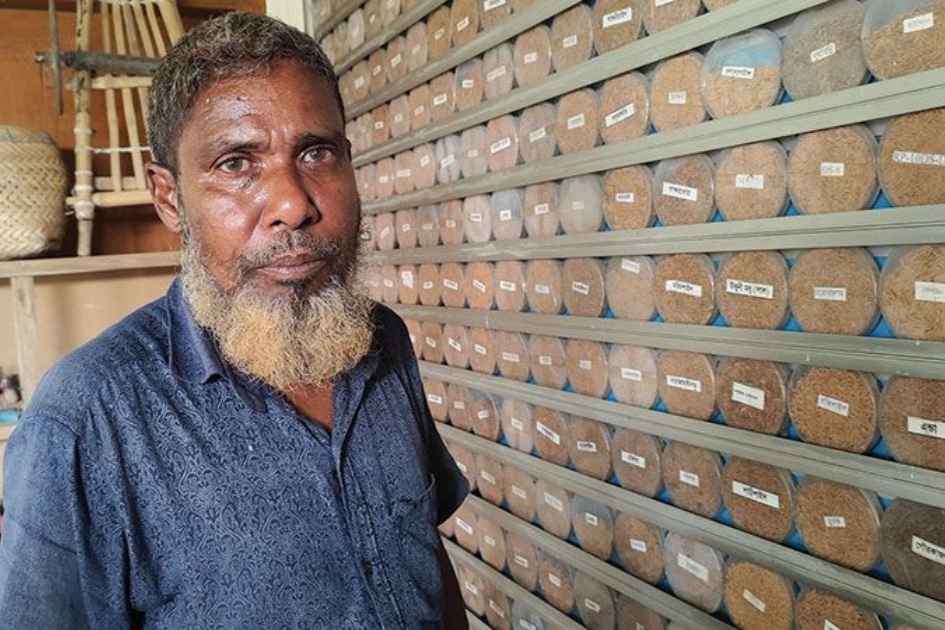



In rural Netrokona, a 66-year-old farmer conserves hundreds of rare rice and crop varieties, protecting Bangladesh’s agricultural heritage and promoting community-based seed sharing for food security and biodiversity.
In the quiet village of Rameshwarpur in Atpara Upazila, far from the noise of the city, 66-year-old farmer Sayed Ahmed Khan Bacchu has quietly become a guardian of Bangladesh’s agricultural heritage. Known locally as the “Seed Collector,” Bacchu has spent more than a decade preserving traditional rice, vegetable and fruit seeds that are disappearing from farms across the country.
His journey began with a single unusual Bathua plant in his own field. Instead of discarding it, he nurtured it, collected its seeds and shared them with neighboring farmers. Today, his personal collection includes 540 rice varieties along with 42 types of vegetables and 19 rare indigenous fruits. Beyond collecting, he has developed 16 new rice varieties through cross-breeding, nine of which are his own innovations. These seeds are freely shared with farmers on the condition that an equal amount is returned after harvest, ensuring the preservation cycle continues.
Bacchu’s mission comes at a time of global and national change. The spread of hybrid and commercial seeds, climate change and shifting farming practices have led to the loss of countless local crop varieties. Studies show that more than 75 percent of crop varieties disappeared in the 20th century. As a result, farmers increasingly rely on imported seeds and Bangladesh’s biodiversity continues to decline.
Many indigenous varieties offer unique taste, nutrition and resilience. If they disappear, future generations will lose not only food diversity but also a vital part of agricultural heritage, Bacchu said.
Bacchu’s home now resembles a small seed museum, with jars of rice, vegetable and fruit seeds carefully labeled and stored. A separate display at the Tushaipara Farmers Association office allows villagers to observe, discuss and exchange seeds. He cultivates dozens of rice varieties on his own land and hosts field days where farmers can see the crops, choose seeds and learn cultivation methods firsthand.
Although not a formal researcher, Bacchu collaborates with institutions such as the Bangladesh Rice Research Institute, the Bangladesh Agricultural Research Institute and the research organization BARCIK for technical guidance and experimental support. He has also traveled to India, Thailand and the Philippines to learn advanced rice cultivation techniques and apply them at home.
His efforts extend beyond rice. Bacchu grows indigenous vegetables, fruits and spices using minimal chemical fertilizers or pesticides. His integrated farming system includes fish, poultry and livestock, ensuring food self-sufficiency for his household.
Experts say his work has a meaningful impact on food security, biodiversity and sustainable agriculture. Ohidur Rahman, regional coordinator at BARCIK, said Bacchu has preserved hundreds of rice varieties and shared his knowledge with local farmers. His work strengthens agricultural diversity and inspires community-based seed conservation.
At a time when crop diversity faces growing threats, Sayed Ahmed Khan Bacchu stands as a reminder that individual dedication can safeguard heritage, strengthen food security and protect the environment for future generations.




