




The disaster has prompted rescue efforts across Nepal and neighbouring India, while officials warn of further flooding from blocked waterways and rising Himalayan risks.
At least 95 people have been killed and nearly 400 remain missing after massive flash floods swept through northern Nepal on Wednesday, destroying homes, roads and hydropower projects and disrupting travel in parts of the Himalayan country.
The floods surged through the Bhote Koshi River at around 9 a.m. local time, affecting Rasuwa and Dhading districts bordering Tibet as well as Nuwakot district southwest of Kathmandu, officials said.
At least 384 travellers were reported missing from the region, including 105 Indians, 93 Nepalis, three U.S. citizens and 12 British nationals, Nepal’s tourism authority said.
Nepal police spokesperson Abi Narayan Kafle said at least 28 police officials were also among those missing.
Officials warned residents in several districts to stay away from the banks of the Bhote Koshi, Trishuli and Narayani rivers. The Bhote Koshi flooded around 9 a.m. Wednesday, destroying several villages, roads and hydropower projects, officials said.
A sudden wall of mud and rock appeared to collapse into a river on the Himalayan border between Nepal and China’s Tibet, triggering catastrophic flooding on the Nepali side.
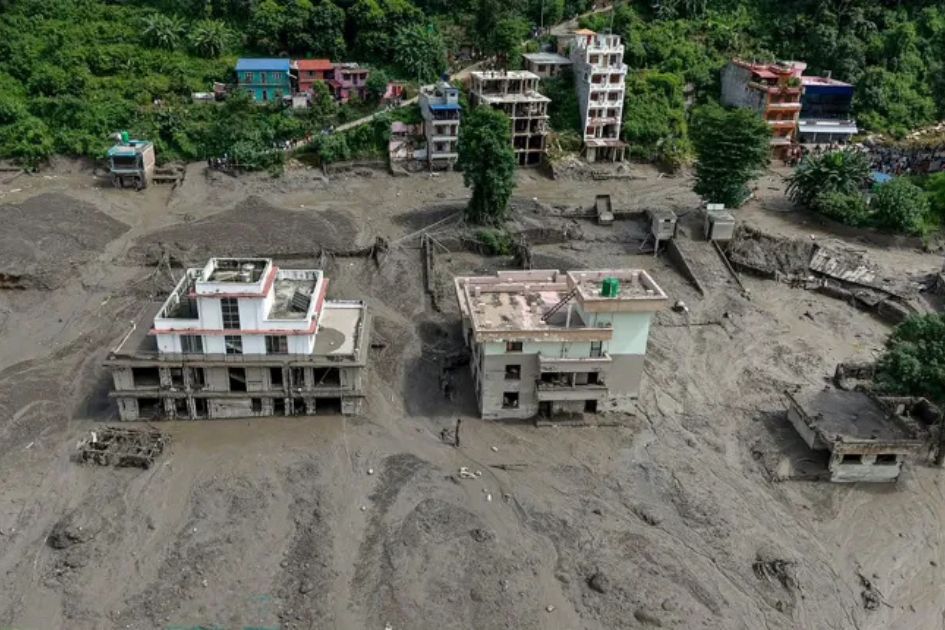
Houses, roads and power projects were swept away in Nepal. Images showed what appeared to be the second floors of buildings in hard-hit Nuwakot district covered in mud after the torrent passed. Debris hung from tree branches and wires, vehicles were buried and survivors were covered in mud.
Officials in Tibet said they feared major casualties, with some people missing in the county of Gyirong after a mudslide hit a border land crossing. Chinese authorities were conducting large-scale search and rescue operations in the Tibetan border area, according to state broadcaster CCTV. Chinese President Xi Jinping ordered authorities to step up the efforts, state news agency Xinhua reported. No death toll was immediately reported from the Chinese side.
Nepal’s government spokesperson Sasmit Pokharel said the country had asked both India and China to assist with rescue efforts.
India has pledged humanitarian assistance. Prime Minister Narendra Modi spoke with Nepal’s Prime Minister Balendra Shah and conveyed condolences over the loss of lives.
“The people of India stand in solidarity with their sisters and brothers in Nepal at this difficult time. India is ready to provide all possible humanitarian assistance to Nepal. Our teams are coordinating closely on rescue and relief efforts,” Modi said in a post on X.
India is sending relief material to Nepal on Indian Air Force planes, officials said.
The Indian Embassy in Nepal said it remained engaged with Nepalese authorities in efforts to rescue and provide relief to Indian nationals affected by the floods.
“For assistance and information related to Indian nationals that have been affected by the flash floods in Nepal today, the following emergency numbers may be contacted: +977 985 131 6807 +977 970 910 7500,” the embassy said in a post on X.
India’s National Disaster Response Force has also deployed nine teams across Bihar amid a flood threat following heavy rainfall and the flash floods in Nepal. Additional teams were sent to vulnerable areas as authorities prepared for a possible rise in water levels downstream.
NDRF Commandant Hitender Pal Singh Kandari said teams had already been pre-positioned in flood-prone areas of Bihar as part of the force’s monsoon preparedness. Additional teams were sent after the situation in Nepal indicated a possibility of increased water flow into the state.
Union Home Minister Amit Shah spoke by phone with Bihar Chief Minister Samrat Choudhary over the flood threat and assured the Bihar government of all possible assistance from the central government. He also directed that necessary preparedness measures be taken and said the NDRF was being mobilised to respond to any emergency.
The Sashastra Seema Bal, which guards the India-Nepal border, alerted its formations following the flash floods. Its 11 rescue and relief teams were placed on standby for immediate deployment, while seven additional teams were kept ready to respond to any emerging situation.
Authorities warned that a second flood could occur because a blockage remained upstream on the Lhende Khola river. Flood alerts were also issued in the Indian states of Bihar and Uttar Pradesh, which border Nepal, as several rivers flow from the Himalayas into the plains.
The European Union said it had activated its Copernicus satellite surveillance system to help map affected areas and support recovery efforts.
“Copernicus has been activated to help map the affected areas in Nepal and support the response on the ground,” EU chief Ursula von der Leyen wrote online.
“We stand ready to mobilise further European assistance.”
South Korean government officials said citizens working on a hydropower plant in Nepal were among those reported missing. Malaysia’s foreign ministry said its embassy in Kathmandu had received reports from travel agencies that they had lost contact with 11 Malaysians believed to be in Rasuwa district, which was also badly hit by the floods.
Tourism board officials said most of the missing travellers were likely from India and the Indian diaspora travelling on pilgrimage to Mount Kailash in Tibet, a sacred site for Hindus.
Nepal’s steep valleys serve as economic lifelines and travel corridors but can become highly vulnerable when disasters strike. The Trishuli River roughly parallels a highway north of Kathmandu that is used to reach the Langtang area, one of Nepal’s most popular trekking destinations.
The U.S. Geological Survey reported a magnitude 4.4 earthquake early Wednesday, about 100 kilometres (60 miles) north of Kathmandu, near the border with China’s autonomous region of Tibet.
Nepal’s Foreign Minister Shisir Khanal told parliament on Wednesday that initial reports suggested the earthquake could have triggered an avalanche and caused the floods, local media reported.
Climate experts at the Kathmandu-based International Centre for Integrated Mountain Development said an avalanche from a glacier likely caused Wednesday’s flash flood.
The Lhende Khola River, a tributary of the Bhotekoshi, had maximum flooding Wednesday, they said.
“The Lhende Khola has flooded twice in 14 months, this time triggered by an ice rock avalanche from a glacier on the Nepal side that blocked the river and released a sudden surge downstream,” said Saswata Sanyal, a disaster risk reduction specialist at the climate research group.
He noted the importance of early warnings in “a warming Himalaya.”
The same region experienced similar flash floods in August last year, when a glacial lake in Tibet overflowed because of high temperatures. Nine people were killed and critical infrastructure, including a bridge connecting Nepal and China, was damaged.
The Himalayan region, which spans several countries including India, is especially vulnerable to heavy rains, floods and landslides because it is warming faster than the rest of the world due to human-caused climate change. Research shows that extreme weather events, including heat waves, rains and melting glaciers, have become more frequent.
Researchers in Kathmandu found earlier this year that glaciers across the Hindu Kush Himalaya region are melting at an accelerating rate, with ice loss rates doubling since 2000, primarily due to rising global temperatures and climate change.
In a joint statement, Australia, Britain, the European Union, Finland, France, Norway and Switzerland expressed solidarity with people affected in Nepal.
“We encourage all those in affected areas to follow the guidance of local authorities and official safety advisories as the situation continues to evolve.”




