




Bangladeshi climate experts warn COP30 delivered political promises but little real action, citing weak commitments on fossil fuel phaseout and finance. Civil society groups argue the Belem Political Package lacks implementation pathways, urging stronger preparedness, coordinated advocacy and accountability ahead of COP31.
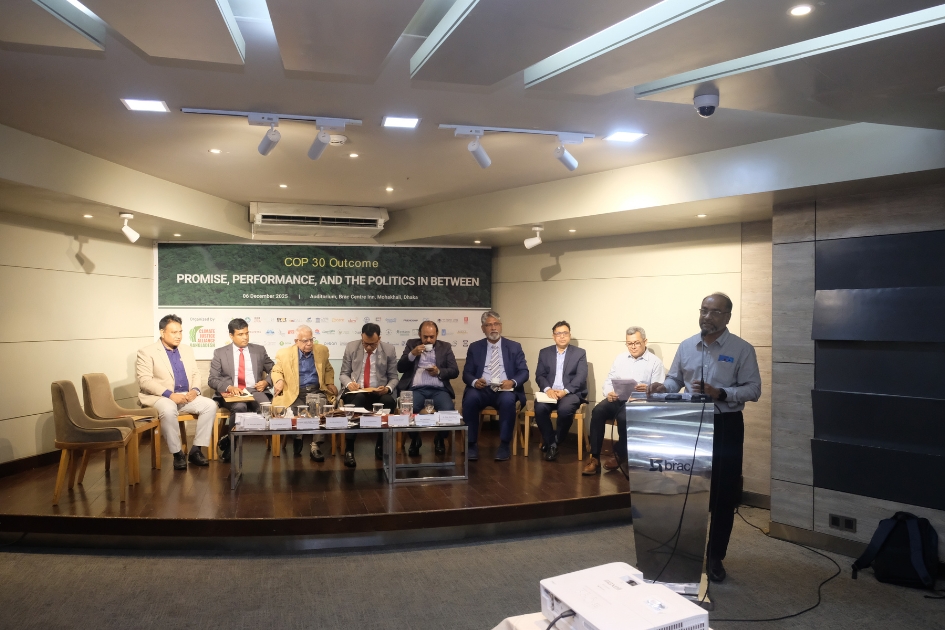
Climate justice advocates in Bangladesh have sharply criticized the outcomes of COP30, warning that the global climate summit failed to deliver decisive action on fossil fuel phaseout and finance commitments. The concerns were raised at a national event titled COP30 Outcomes: Promise, Performance and the Politics In Between, hosted by the Climate Justice Alliance Bangladesh (CJA-B) and led by the Center for Participatory Research and Development (CPRD) at BRAC Center Inn on December 6, 2025.
The forum brought together more than 50 national and international organizations, offering what organizers described as a comprehensive and critical analysis of the Belem Political Package. According to participants, the package is filled with political promises but lacks real implementation pathways. The event aimed to equip policymakers, civil society groups and media representatives with a deeper understanding of the technical and political complexities shaping COP negotiations.
Md Shamsuddoha, Chief Executive of CPRD and National Coordinator of CJA-B, facilitated the discussion, while Sheikh Nur Ataya Rabbi, Assistant Manager for Research and Advocacy at CPRD, presented the key COP30 outcomes on behalf of the alliance. Senior government officials, academics and climate experts delivered remarks, including Adv. Hafijul Islam Khan of CCJ-B, Prof Md Hafizur Rahman of Independent University Bangladesh, Sharif Jamil of Waterkeeper Alliance, Dr Shah Abdul Saadi of the Economic Relations Division, Mr Md Ziaul Haque of the Department of Environment, Additional Secretary A K M Sohel, Dr Fazle Rabbi Sadek Ahmed of PKSF and Dr M Asaduzzaman of the Bangladesh Institute of Development Studies. Representatives from alliance member organizations and civil society also offered reflections.
In his keynote, Sheikh Nur Ataya Rabbi outlined COP30’s mixed results, noting progress such as the adoption of the Global Goal on Adaptation indicator framework, approval of the first tranche of the FRLD, inclusion of trade policies in central negotiations, a follow up mechanism on Article 9 and an agreement to triple adaptation finance targets. He said major gaps overshadow these steps, including the sidestepping of roadmaps for fossil fuel phaseout and halting deforestation, compromises on means of implementation linkages and the absence of enforceable finance decisions.
Shamsuddoha provided a political assessment of COP30, stating that while the Loss and Damage Report marks progress, the summit fell short of encouraging developed countries to adequately fund the FRLD. He also commented on climate related trade policies, noting that although institutionalizing dialogue is positive, Bangladesh needs stronger media engagement and coordinated civil society advocacy ahead of COP31.
He added that COP30 failed to reinforce the Global Stocktake’s call for transitioning away from fossil fuels, omitting explicit phaseout language that many negotiators had expected to strengthen. He further said the summit did not operationalize GST-1’s message on aligning global finance flows with low emission pathways, instead issuing general statements without concrete mechanisms.
Dr Shah Abdul Saadi emphasized the need to align COP efforts with other UN conventions, including the UNCBD and UNCCD. He also highlighted the importance of capacity building for developing countries to use Article 6 mechanisms in their NDC implementation.
Additional Secretary A K M Sohel criticized what he called the overwhelming presence of fossil fuel lobbyists, numbering more than 1,600, describing them as a major factor behind the sidelining of the fossil fuel phaseout roadmap.
Dr M Asaduzzaman warned that multilateralism continues to struggle to bring parties to consensus but remains essential for long term global cooperation. He reiterated the urgency of reaching net zero emissions as quickly as possible for the sake of future generations.
Dr Fazle Rabbi Sadek Ahmed stressed that developed countries must be pushed to take domestic mitigation actions in line with their historical responsibility.
Shamsuddin Illius, Bureau Chief, Chittagong at The Business Standard, Mohammad Shahjahan Director YPSA, Ms. Rabeya Begum, Executive Director, SDS-Shariatpur & Resilience Society, Saqib Huq, Managing director ICCCAD, Kazi Amdadul Haque, director Friendship also spoke in the programme.
The event concluded with calls for stronger national preparedness, coordinated advocacy and enhanced global accountability as Bangladesh looks ahead to negotiations at COP31.




