

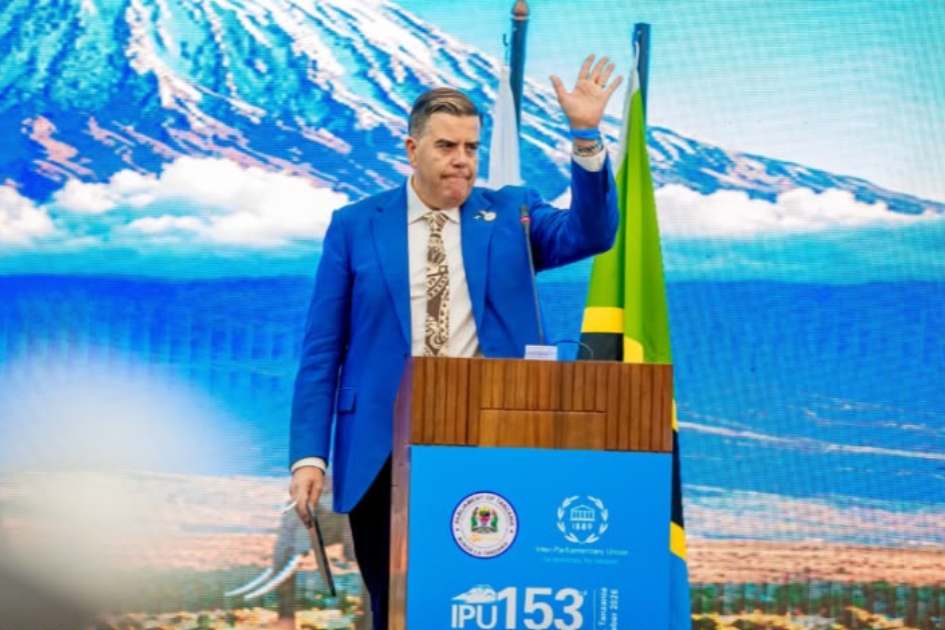



The Australian parliamentary leader takes charge until 2029 as the Arusha Assembly highlights climate resilience, inclusive governance and stronger representation for vulnerable communities.
Australian House Speaker secures 56 percent of votes at Arusha Assembly, pledges greater inclusion of young people, civil society and underrepresented nations.
Australian House of Representatives Speaker Milton Dick has been elected president of the Inter-Parliamentary Union (IPU), pledging to strengthen youth participation, advance climate action and give underrepresented nations a greater voice in global parliamentary decision-making.
Dick, 54, was elected the organisation’s 32nd president on Friday during its 153rd Assembly in Arusha, Tanzania, securing 56 percent of the votes in a secret ballot. He defeated candidates from Azerbaijan and Chile to become the first Australian to lead the world’s oldest multilateral political organisation.
He succeeds Tanzania’s Dr Tulia Ackson, whose three-year presidency concluded at the assembly. Dick will serve until 2029, leading the organisation at a time when democratic institutions face growing pressure to respond to climate change, inequality and declining public trust.
Speaking to Tanzania’s Daily News following his election, Dick called for stronger engagement with young people, civil society organisations and countries that have historically had limited participation in international parliamentary affairs.
“I want the IPU to be their voice as well, engaging with civil society, engaging with all the youth groups to make sure young people are empowered, because they’re the future and they will protect and enhance democracy,” he said.
Highlighting Africa’s large youth population, Dick stressed that empowering young people and creating opportunities for meaningful participation in parliamentary processes would be essential to strengthening democratic institutions.
He also pledged to broaden engagement with smaller and less influential nations, arguing that every member parliament deserves an equal opportunity to contribute to international discussions, regardless of its country’s size, economic strength or political influence.
Climate change will be another central priority of his presidency, particularly the disproportionate challenges facing small island developing states, African countries and other environmentally vulnerable regions.
Dick acknowledged that countries face different environmental, economic and development circumstances, underscoring the need for international parliamentary cooperation that recognises these differences.
For climate-vulnerable countries, including small island states and nations across Africa and South Asia, stronger parliamentary engagement could help translate international climate commitments into domestic legislation, financing priorities and measures to protect communities facing increasingly severe environmental risks.
His priorities come amid growing demands for national parliaments to strengthen oversight of climate policies, ensure accountability for public spending and translate international agreements into practical measures that address the needs of affected populations.
The significance of parliamentary action on climate change was also reflected in the Arusha Assembly, where Nepal secured the inclusion of an emergency agenda item calling for urgent measures to address climate-related disasters and strengthen resilience in the Himalayan region and other vulnerable areas. (Press Information Bureau)
The assembly also presented the Arusha Communiqué, which emphasised people-centred governance, equal opportunities and the importance of ensuring that parliamentary decisions reflect the realities of communities.
The document called for legislation, policies and national budgets to be informed not only by scientific evidence and official statistics but also by local knowledge and people’s lived experiences.
It further stressed that parliamentarians must remain accessible and accountable to the communities they represent, particularly those living in remote areas or affected by crises. (Inter-Parliamentary Union)
Calling for unity following his election, Dick urged member parliaments to overcome political differences and strengthen cooperation on shared global challenges.
“We will work together. We will listen to one another. We will seek common ground,” he said in remarks published by the IPU.
The 153rd IPU Assembly, held from October 5 to 9, brought together nearly 700 parliamentarians from more than 130 countries, including 50 parliamentary speakers and 45 deputy speakers.
Women accounted for 39.4 percent of participating parliamentarians, the highest proportion recorded at an IPU Assembly.
Discussions addressed democratic governance, human rights, disability inclusion, climate resilience, emerging technologies and international security, with particular attention to strengthening parliamentary responses to challenges affecting vulnerable communities.
Founded in 1889, the IPU brings together national parliaments to promote peace, democracy, human rights and sustainable development. Its president serves as the organisation’s political head, chairs key governing bodies and represents the global parliamentary community at major international forums.
Dick now faces the challenge of turning his commitments into practical initiatives that strengthen youth representation, support climate-vulnerable countries and ensure that smaller nations have a meaningful role in global parliamentary cooperation.




