

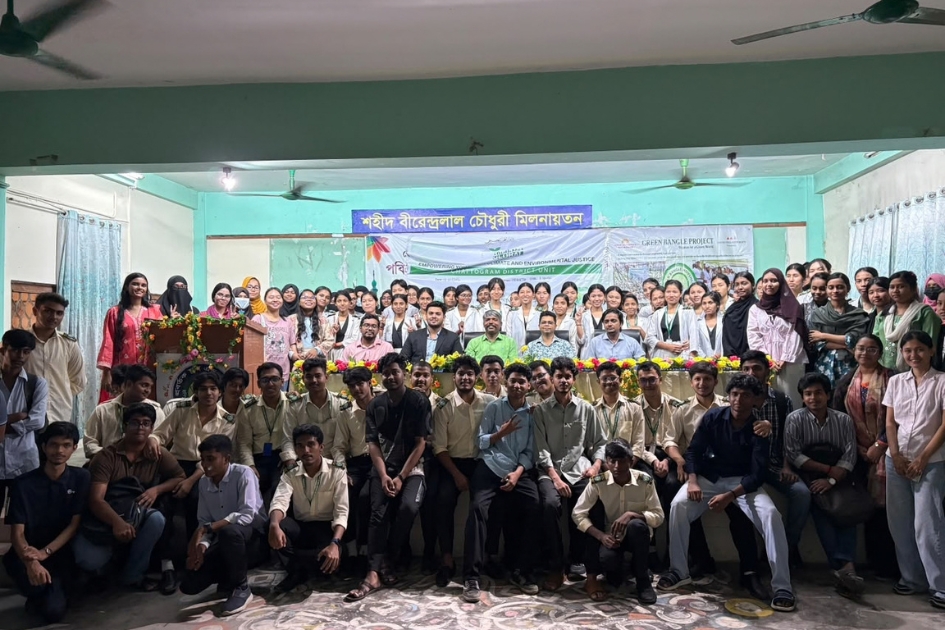



Students and teachers learned practical steps to address rising temperatures as organisers highlighted native tree species, biodiversity and women’s role in environmental protection.
The AUW Green Bangle Project joined YouthNet Global as a supporting partner for a climate awareness and tree plantation programme at Prabartak School and College in Chattogram, Bangladesh, on October 8, 2026.
The programme brought together students, teachers, climate advocates and youth leaders to promote environmental awareness and practical action within the school community.
Dr. Mosae SelvaKumar Paulraj, director of the Environmental Sciences and Biological Sciences programme and principal investigator of the Green Bangle Project at Asian University for Women (AUW), addressed the students at the start of the programme.
He said the Green Bangle Movement works to create climate awareness and that the world is facing rising temperatures. Warmer conditions affect every community, he said, adding that addressing the challenge requires action from people of all ages, including students.
Dr. SelvaKumar outlined four key actions: reducing consumption by being more mindful of daily use and waste, conserving natural resources including water, energy and forests, adopting green and eco-friendly technology, and enriching natural resources through measures such as tree plantation.
He also explained the meaning of the movement’s name, saying “Green Bangle” stands for women for the environment and reflects the role women can play as leaders, educators and caretakers in protecting nature and building sustainable communities.
The YouthNet Global divisional coordinator and Dr. Ahmedul Kabir, director of the M.S. in Apparel Sciences Programme at Asian University for Women, also addressed the gathering. They stressed the importance of building climate awareness among young people and encouraged students and teachers to take an active role in climate action.
Following the speeches, students and teachers joined the guests in planting trees across the school campus. The Green Bangle Project provided Palmyra and Khejur (date palm) saplings, as well as Palmyra seeds, for the plantation.
Both Palmyra and Khejur are native to the region and suited to its soil and climate. Palmyra is drought resistant and has deep roots that help bind soil and reduce erosion. Its fruit, sap and leaves have long been used in Bengal. Khejur is also valued for its resilience and the food and livelihood benefits it provides.
The programme organisers said the use of native species would help the trees grow with minimal upkeep while strengthening local biodiversity.
Shucitra Chowdhury, acting principal, and Mahbubul Hasan, lecturer in accounting, represented Prabartak School and College. District and divisional coordinators of YouthNet Global for Chattogram also attended.
The trees planted during the programme are intended to remain on the school campus as a lasting part of its environment.
The Green Bangle Project is an initiative of Asian University for Women focused on climate awareness, sustainability and community engagement through education, plantation drives and partnerships, with a special focus on the role of women in environmental protection. Its guiding motto is: “Together, we grow greener, stronger, and more connected to our roots.”
Nuching Marma and Tasfiya Asad Toya, research assistants of the Green Bangle Project, Saika Sultana, volunteer, GBM, and Purna Sen, YouthNet Global district coordinator for Chattogram, coordinated the event.




