

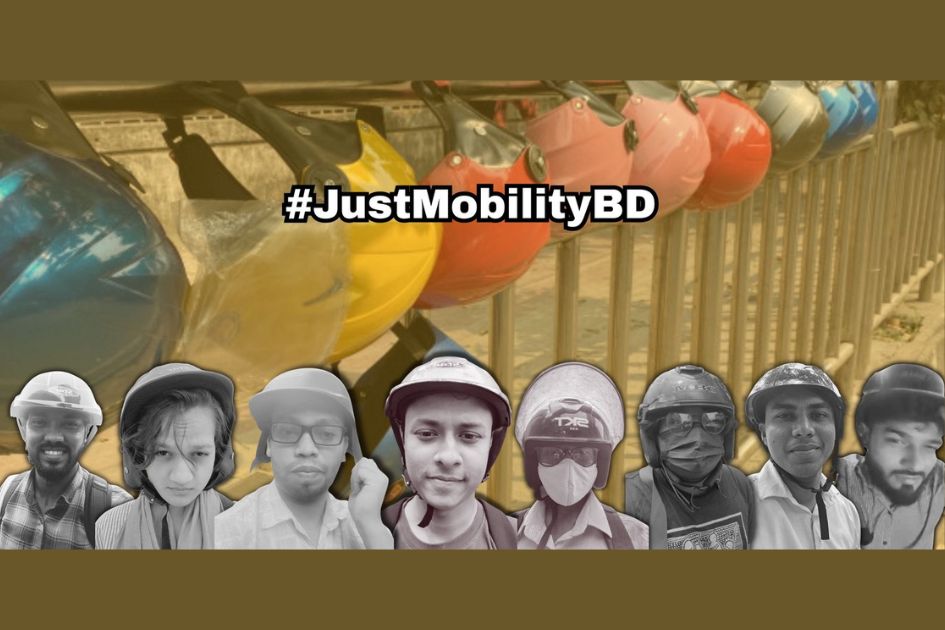



Dhaka’s helmet selfie trend is turning into a quiet urban protest, exposing unsafe ride-sharing helmets and demanding safer, fairer mobility for commuters, gig workers and young city residents.
On the vibrant streets of Dhaka, from the calm surroundings of Rabindra Sarobar to the constant motion of Hatirjheel, a new ritual among young people has become part of the urban landscape. As a motorcycle taxi comes to a stop, a young commuter instinctively reaches for a smartphone. Still wearing the ride-sharing provider’s helmet, they take a quick photo before continuing their journey.
These helmet selfies, now widely circulating on social media, initially appeared to be a fleeting digital trend. However, beneath these aesthetic snapshots lies a deeper urban story, a silent protest by a generation demanding safer and more equitable mobility in one of the world’s fastest-growing megacities.
Beyond the Lens: The #JustMobilityBD Movement
What began as an informal social habit has evolved into a symbol of civic discourse. Young climate activists and urban observers are using these images to anchor a broader conversation under the hashtag #JustMobilityBD. Youth climate activist Sohanur Rahman, who started the trend that is now gaining popularity among young commuters in Dhaka, said it represents a demand for a just transition in urban transport.
“Dhaka’s transit is not merely about roads and flyovers. It is a matter of public health, climate justice and social dignity,” Sohanur said.
He also highlighted the plight of gig workers and app-based riders, saying their occupational safety, particularly during the city’s increasingly severe heatwaves, remains a neglected priority.
Echoing this sentiment, Stamford University student Mohaiminul Islam Zipat said, “Our streets have become a testing ground for inequality. When a passenger is handed a cheap plastic bowl as safety gear, it sends a message that their life has a lower value. These selfies aren’t just for social media. They document a systemic failure that we refuse to ignore.”
The Bowl-Helmet Crisis: A Death Trap
The movement highlights a grim reality: the widespread use of substandard half-shell helmets, locally known as bowl helmets. These plastic shells, often purchased for as little as Tk 300, offer minimal impact resistance. Safety experts warn that they provide virtually no protection in the event of a collision.
The crisis is compounded by the practical challenges faced by gig workers.
Speaking on condition of anonymity, one ride-sharing driver explained the trade-offs.
“Two good-quality helmets cost Tk 4,000 to Tk 5,000 and are heavy to carry. If we leave them on the bike, they get stolen within minutes. It is not practical to carry two heavy helmets all the time. That is why many riders buy at least one good helmet for themselves and cheap helmets for passengers simply to avoid police fines.”
Economic Distortions and Customs Irregularities
The supply chain is also riddled with fiscal irregularities. Reports indicate that helmets are often declared at import values as low as US$3, about Tk 370, yet retail for as much as Tk 4,500 in local markets. Customs officials acknowledge that under-invoicing, or declaring artificially low values to evade taxes, remains a persistent problem.
This distorts the market, penalises compliant importers and floods the streets with substandard uncertified gear. In 2025 alone, despite the import of more than 875,000 helmets, the market remained dominated by low-grade plastic products as the tax framework failed to create a level playing field for safer certified equipment.
A Regulatory Loophole
Law enforcement agencies, including the Dhaka Metropolitan Police (DMP), acknowledge a significant legal loophole. While the law requires both drivers and passengers to wear helmets, it does not explicitly define the safety standards those helmets must meet.
“We face a significant legal gap,” a senior police official said.
“If someone wears a plastic bowl on their head, our ability to take effective action is limited because the law does not clearly define what qualifies as an approved protective helmet.”
A Call for an Inclusive Future
Providing an expert perspective, Dr. Adil Mohammed Khan, an urban planner, professor at Jahangirnagar University and Executive Director of the Institute for Planning and Development (IPD), said, “Ride-sharing has opened doors to employment for many unemployed young people. However, I want to see only skilled drivers engaged in this profession, drivers who will not compromise on providing high-quality standard helmets for their passengers. Only then will safety risks for commuters be significantly reduced.”
Urban planners say the helmet selfie culture reflects the accumulated frustrations of a generation living in a city that is expanding rapidly but struggling to keep its residents safe.
As Dhaka continues to grow, the message from its youth is clear. Progress cannot be measured only by the number of electric vehicles, flyovers or the speed of transit. It must also be measured by safety, inclusivity and the assurance that every commuter, regardless of economic status, can travel without fear.
These selfies are more than a social media trend. They are a visual demand for a city that values human life above the convenience of the daily commute.




