

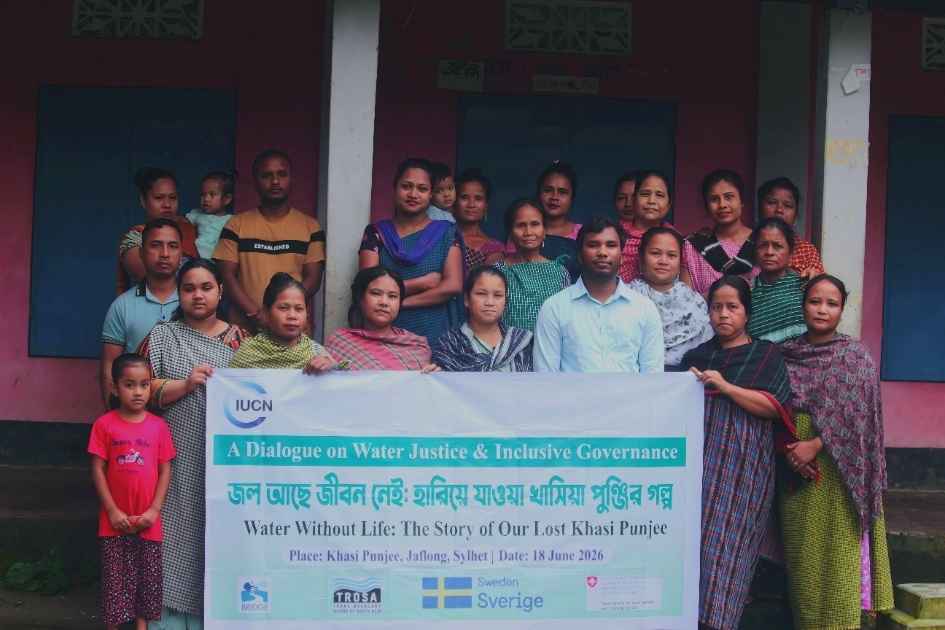



A Khasi community workshop in Jaflong highlighted water justice, falling water tables and threats to betel leaf farming, calling for indigenous voices in transboundary water governance.
A community dialogue and workshop on transboundary water rights, inclusive governance and the mounting socio-ecological pressures on indigenous communities was held at the Khasi Punjee in Jaflong, Sylhet, on June 18, 2026.
Titled “Water Without Life: The Story of Our Lost Khasi Punjees”, the event brought together Khasi women, youth and men to discuss the growing threats to their land, water and traditional livelihoods.
The workshop focused on the impacts of upstream resource extraction on local water systems and examined how falling water tables are endangering the community’s traditional Pan Jhum, or betel leaf, cultivation. It also underlined the importance of localised Nature-Based Solutions (NbS) for ecological survival.
The event was facilitated by Sagor Shil, Storyteller Fellow at the International Union for Conservation of Nature (IUCN).
Speaking at the workshop, Seema Rimba, Acting Head Teacher of Nokshiyarpunjee Government Primary School, said the Khasi people have historically served as natural guardians of the forest.
She warned that the drying up of hill streams caused by unregulated and unplanned extraction now poses an existential threat to Khasi livelihoods and called for immediate protective steps and policy intervention.
The grassroots initiative sought to connect indigenous knowledge from the ground with higher-level climate policy discussions, with organisers saying communities in the transboundary Barak-Meghna basin must be recognised as central and proactive voices in future water governance and resilience planning.




