

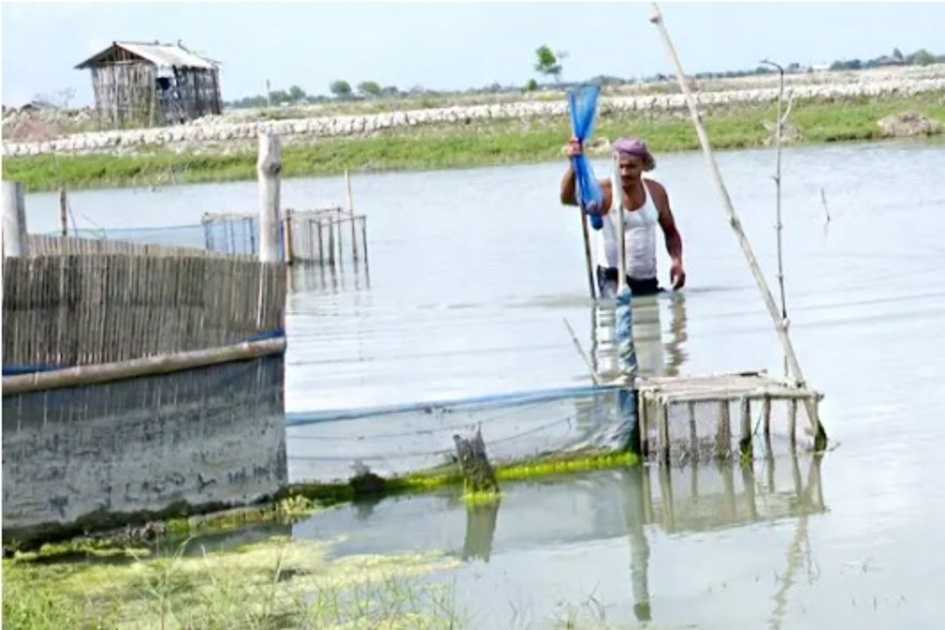



Extreme heat is killing shrimp in Satkhira’s coastal farms, exposing how climate change, shallow ponds and falling oxygen levels are threatening farmers’ livelihoods and Bangladesh’s export earnings.
Shrimp farmer Shahidul Islam has spent the past two decades cultivating black tiger shrimp in the coastal district of Satkhira, but in recent years a new threat has pushed his business into crisis: extreme heat.
Islam owns a 30-bigha saline water enclosure in Sriula area of Assasuni upazila, where he once earned good returns from shrimp farming. Now, during the hottest weeks of May and June, fish and shrimp in his ponds are dying as water temperatures soar. This year has been no different. Within just a few days, a significant number of shrimp in his enclosure died.
“It used to get hot before, but not as intensely as it does now,” Islam said. “Now when the sun comes out, the water temperature rises sharply. Fish come floating to the surface after dying. Some become weak and then die gradually. It has been the same for the last several years. Forget profit, now it is difficult even to protect the capital.”
Islam is far from alone. Nearly 55,000 fish farmers in Satkhira district are involved in producing black tiger shrimp in saline water enclosures, and farmers across the coastal upazilas of Shyamnagar, Assasuni, Kaliganj, Debhata and Sadar report much the same experience. Their complaint is consistent: every year the heat grows more intense and so does the death rate of fish and shrimp.
The problem is especially severe in the shallow saline water farms that dominate the coastal belt. Water depth in most of these enclosures is only about two to three feet. Most also lack large trees or any meaningful shade along the embankments, leaving the water exposed to direct sunlight for most of the day. As a result, intense heat raises water temperature quickly and reduces dissolved oxygen levels.
The impact falls most heavily on black tiger shrimp. Rising temperatures and oxygen shortages weaken the shrimp, make them vulnerable to disease and in many cases trigger mass mortality. Each summer, a large number of farmers are suffering production losses and financial damage.
Abdul Kader, a farmer from Gabura in Shyamnagar, said the water in his enclosure becomes hot by midday and shrimp rise to the surface. “Many times I come in the morning and see dead shrimp floating,” he said. “This problem has increased a lot over the last three to four years.”
Nityananda Mondal, a farmer in Assasuni, said rainfall used to bring relief from the heat. “Now there is no rain for a long time. The water dries up and the temperature rises. That is also increasing disease in shrimp,” he said.
Data and expert observations suggest the warming trend in Satkhira is becoming increasingly clear. According to information from various international weather databases, summer maximum temperatures have risen and long-lasting heatwaves have become more frequent. In the past, maximum temperatures in April and May generally remained between 33 and 35 degrees Celsius. In recent years, they have often reached 35 to 38 degrees Celsius or even higher. Both the duration and intensity of heatwaves have increased, directly affecting shrimp and fish farming in coastal areas.
The district weather office says the tendency toward higher temperatures in Satkhira has become evident in recent years.
District weather officer Zulfikar Ali Ripon said rising summer temperatures had been observed over the past several years as a result of climate change. “At different times, maximum temperatures have risen significantly compared with the past,” he said. “Prolonged heatwaves are also now more common.”
He said rainfall patterns in coastal areas were also changing. Long dry spells, higher temperatures and variations in humidity were affecting both agriculture and fisheries, he added.
Climate expert and convenor of the district climate council Principal Asheq-i-Elahi said climate change was no longer a future concern but a present-day reality. Excess carbon emissions by industrialised countries were raising the Earth’s average temperature, with coastal regions bearing the heaviest consequences, he said.
“Satkhira is one of the districts most vulnerable to climate change,” he said. “This is not only a fisheries sector crisis, it is a direct blow to the coastal economy caused by climate change. If adaptation measures are not strengthened now, shrimp production will face even greater risk in the future.”
Any decline in black tiger shrimp production has direct consequences for Bangladesh’s export earnings because black tiger shrimp make up the largest share of the country’s exportable shrimp. According to the Fish Inspection and Quality Control Department in the Khulna region, about 13,963 tonnes of black tiger shrimp were exported in the 2024-25 fiscal year, generating around 16.92 billion taka. That accounted for the lion’s share of the region’s total shrimp export income.
Against that backdrop, sector insiders say the future risks are becoming harder to ignore. In recent years, heatwaves, rising water temperature, disease outbreaks and increasing production costs have reduced output in many enclosures. If fish and shrimp deaths continue to rise during the summer season, production could fall further, hurting the country’s foreign currency earnings. Industry-related estimates suggest that the production crisis and disease outbreaks are putting several billion taka in potential export earnings at risk each year.
Signs of pressure are also visible in Bangladesh’s frozen shrimp export sector. According to the Export Promotion Bureau, export earnings from shrimp stood at about $266.01 million from May 2025 to May 2026, down around 2.62% from $273.16 million during the same period a year earlier.
Analysts say rising temperatures, the effects of climate change, disease and production instability in coastal farms, especially in Khulna and Satkhira, are undermining continuity in the sector.
Fisheries officials are advising farmers to retain adequate water depth in their enclosures to protect shrimp from heat stress. They say deeper water helps prevent temperatures from rising too quickly and supports a more suitable environment for shrimp. Where possible, fresh tidal water should be allowed in and aerators or water circulation systems should be run at night to maintain normal dissolved oxygen levels. Officials are also stressing the importance of regularly monitoring water temperature, salinity, pH and dissolved oxygen.
According to fisheries officials, preserving some natural aquatic vegetation or algae in the enclosures can also help regulate water temperature and support a healthier environment for shrimp.
Officials say that although temperatures are rising, much of the damage can still be reduced by following scientific farming methods.
Dr Muha. Shafiqul Islam, senior scientific officer at the Satkhira Shrimp Farming Demonstration Farm, said black tiger shrimp are an environmentally sensitive species. During extreme heat, if water temperature in the enclosures rises above normal levels, dissolved oxygen falls. Shrimp then experience heat stress, reduce feed intake and suffer weakened immunity.
If high temperatures persist for a long time, shrimp become more vulnerable to bacterial and viral diseases, he said. In many cases, sudden large-scale deaths can occur because of oxygen shortages and deteriorating water quality.
He said climate change had increased both the intensity and duration of heatwaves, creating a new challenge for shrimp farming in coastal areas. Farmers now need to move toward more modern, science-based farming systems, he said.
“If proper management is adopted, losses during heatwaves can be reduced significantly,” he said. “But in the long term, it is essential to expand climate-resilient shrimp farming technologies and increase training for farmers.”
Satkhira district fisheries officer G M Selim said heatwaves driven by climate change had become a major challenge for the coastal fisheries sector. The fisheries department was working to provide technical support to shrimp farmers to cope with the situation, he said. Field-level officials were regularly visiting enclosures in different parts of the district and advising farmers as needed.
He said the department also had facilities to test water quality. Farmers facing difficulties can contact the upazila fisheries office or relevant officials for assistance. Water temperature, salinity, pH and dissolved oxygen levels are being tested and recommendations are being provided accordingly.
He added that any unusual changes in the enclosures during periods of intense heat should be addressed quickly. To raise awareness, the department is regularly organising courtyard meetings, training sessions and advisory activities. All forms of technical support will continue so that farmers can reduce losses and maintain normal production, he said.
People linked to the sector say the shrimp industry is one of Bangladesh’s largest agriculture-based foreign currency earning sectors after the top export categories. Satkhira is one of the country’s main black tiger shrimp-producing regions. As a result, falling production would hurt not only farmers but also the national economy.
Climate experts say that preserving the coastal fisheries sector will require more than farmer awareness alone. Climate-resilient fisheries management, stronger research, early warning systems and increased government support will be necessary. Otherwise, rising heat will continue to deepen the threat.
This article is republished from the Jagonews24




