

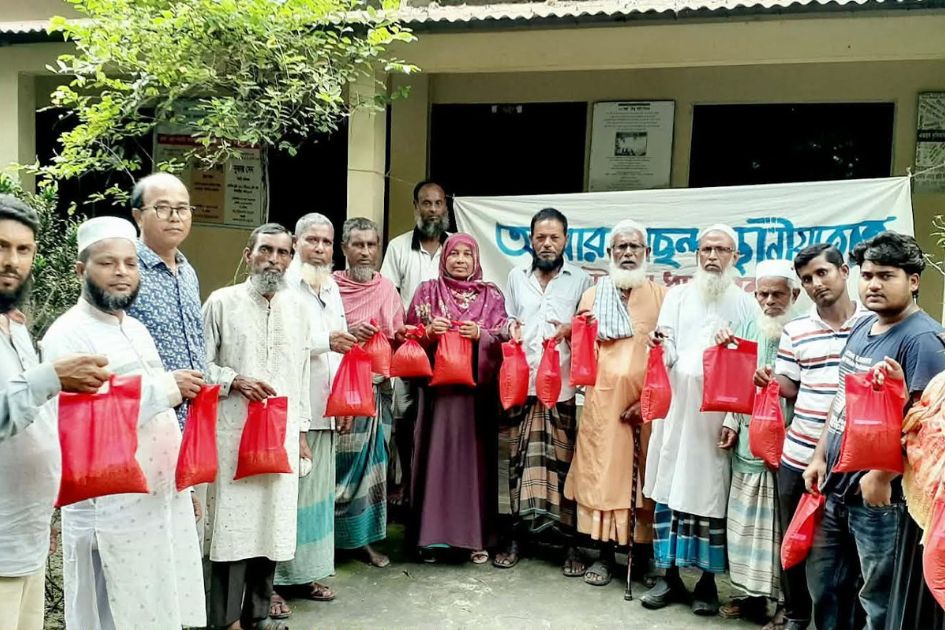



Farmers in Netrakona received 22 indigenous climate-resilient rice varieties through a seed exchange initiative aimed at strengthening sustainable agriculture, conserving biodiversity, improving food security and reducing dependence on commercial seed companies.
Farmers and agricultural researchers in Atpara Upazila of Netrakona, a district of Mymensingh Division in north-eastern Bangladesh, have launched an initiative to promote climate-resilient indigenous rice varieties, describing locally adapted seeds as a key solution to addressing climate change while strengthening sustainable agriculture and ensuring sustainable and safe food sovereignty.
A farmer exchange meeting and indigenous seed distribution programme was held in Rameshwarpur village of Atpara Upazila with the aim of promoting climate-resilient farming practices and ensuring long-term food security. The event was jointly organised by the private research organisation BARCIK and the Tushaipara Farmers’ Organisation.
Twenty-three farmers from three upazilas collected their preferred indigenous rice varieties during the programme. A total of 22 climate-resilient local rice varieties, selected during field evaluations based on farmers’ own observations, research and experiences from the 2025 Aman season, were formally distributed among the participating farmers.
Those attending the programme included farmer researcher Syed Ahmed Khan Bacchu, farmer organiser Abdul Wadud Khan, Regional Coordinator Md. Ohidur Rahman, Associate Coordinator Shankar Mrong, agriculturist Juton Pal and local farmers.
The rice varieties distributed were Kabundulan, Benapul, Hekim, Biroi, Tulsimala, Bhutta Aijong, Narikelmoti, Jesmin, Subash, Malshira, Ritu Faizam, Bishali Binni, Yorchal, Rajmahal, Porabinni, Boro Abji, Jalkumri, Chinisagar, Khaki Biroin, Bashful Balam, Gandharaj and Madhuraj.
Organisers said these traditional rice varieties have adapted naturally to local soil conditions and weather over many years but have gradually disappeared from cultivation. Through the initiative, the varieties are now returning to farmers’ fields.
During the exchange meeting, farmers said that as weather patterns continue to change because of the climate crisis, traditional local rice varieties have proven to be more resilient than hybrid varieties. They stressed that conserving and expanding indigenous rice varieties that are well suited to local environments has become one of the most urgent priorities for sustainable agriculture.
The farmers said selecting rice varieties based on their own experiences and observations in their respective areas would help preserve indigenous seeds while protecting soil, water and biodiversity and ensuring safe food production.
Speakers also expressed hope that the initiative would create opportunities to expand cultivation of the selected indigenous rice varieties across farmers’ fields. They said farmers would be able to conserve, produce and exchange their own seeds, helping protect local agricultural biodiversity while advancing Bangladesh’s food sovereignty.
According to the organisers, the initiative in Rameshwarpur village could serve as a model for other parts of the country by reducing farmers’ harmful dependence on multinational seed companies and promoting a more self-reliant agricultural system.




