

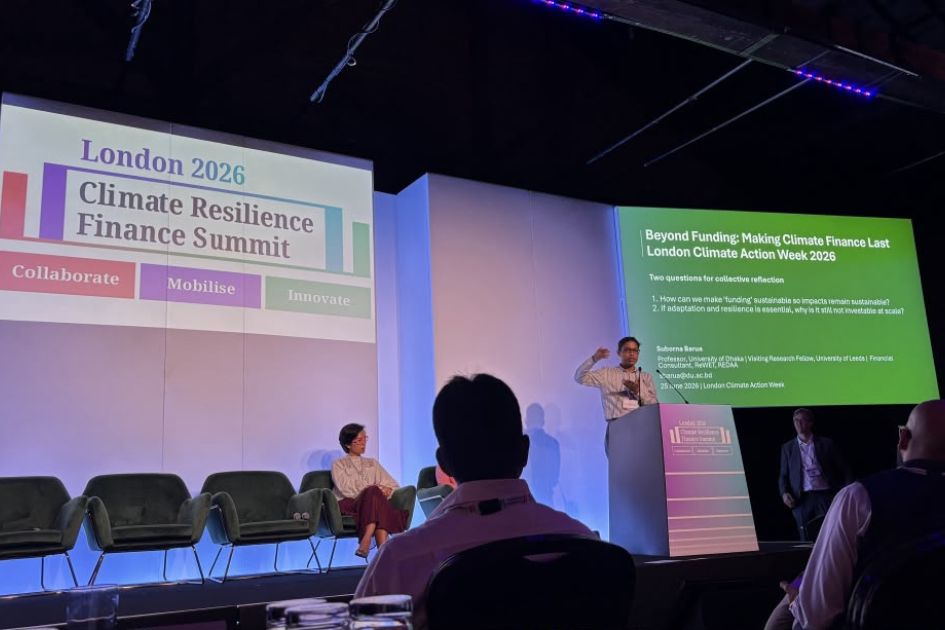



A finance expert urged governments and investors to adopt regenerative financing models that make climate adaptation bankable, community-owned, and financially sustainable, helping close persistent global resilience funding gaps.
A leading development finance expert has called for a fundamental redesign of global climate adaptation funding, arguing that the prevailing project-based model is too short-term to build lasting resilience in vulnerable communities.
Speaking at the London Climate Resilience Finance Summit during London Climate Action Week, Dr. Suborna Barua urged governments, international financiers and development actors to rethink how adaptation is structured, financed and measured, particularly the assumption that such interventions are not inherently revenue-generating.
He said the global system continues to underestimate the “bankability” of adaptation and resilience projects, limiting the scale of private and blended finance flows needed for climate action.
“There are many adaptation and resilience activities that could be transformed into bankable projects,” Dr. Barua said. “The real gap is not a lack of opportunity but how climate adaptation is structured, valued and financed.”
Beyond the limits of linear climate finance
Dr. Barua criticized the dominant “linear” model of climate funding, where projects are financed, implemented and then often fade once donor support ends.
He described this as a “project lifetime trap,” arguing that it prevents long-term resilience from taking root in communities most exposed to climate risks.
Under this model, funding cycles are typically disconnected from sustained outcomes, meaning infrastructure, services or ecosystem restoration efforts can deteriorate once initial grants expire.
Regenerative financing as an alternative
To address this gap, Dr. Barua proposed “regenerative financing” approaches designed to create self-sustaining value streams from adaptation investments.
These models aim to use initial grant or concessional funding to unlock longer-term market-based mechanisms that continuously reinvest in resilience-building activities.
He pointed to emerging tools such as impact credit markets and tokenized impact assets, digital or tradable representations of verified climate and ecosystem benefits, as potential mechanisms to generate recurring finance for adaptation work.
“The idea is to move from one-time funding to systems that regenerate value and reinvest it in resilience over time,” he said.
Community ownership at the centre
Dr. Barua emphasized that financial innovation alone would not be enough without strong community ownership of climate interventions.
He argued that sustainability depends on ensuring local communities have both agency and tangible economic incentives to maintain and benefit from resilience systems.
“To ensure that these impacts last beyond the project lifetime, it is important that communities continue to own them,” he said. “Communities will only sustain them when they have clear economic incentives.”
ReWET project exploring new models
The discussion builds on ongoing work under the Reversing Environmental Degradation in Africa and Asia (REDAA) programme, where regenerative finance approaches are being explored through the ReWET project.
The initiative is testing community-led models in which ecosystem restoration activities generate recurring value streams that can be reinvested in local climate resilience and stewardship.
Dr. Barua, who is both a professor at the University of Dhaka and a consultant on the ReWET project, said such pilots could help demonstrate how adaptation can move beyond aid dependency toward more durable financial ecosystems.
Rethinking the future of climate finance
The summit highlighted growing pressure on policymakers and investors to move beyond rhetorical commitments and address the structural barriers limiting adaptation finance.
As climate-related disasters intensify globally, experts at the event stressed that the key question is no longer whether to fund adaptation but how to design financing systems that are scalable, sustainable and capable of delivering long-term impact for frontline communities.




