

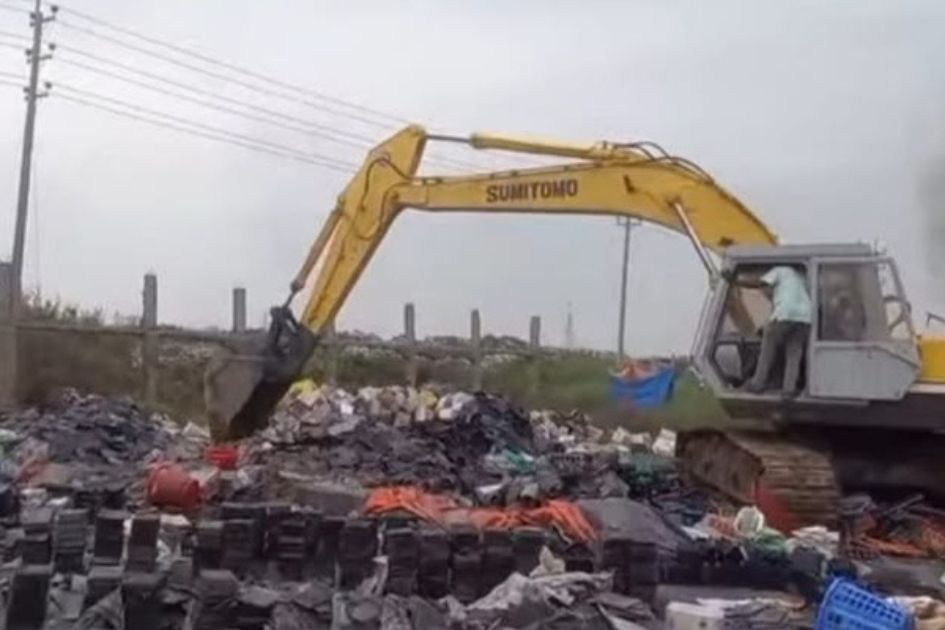

Bangladesh’s Department of Environment demolished illegal lead smelting furnaces in Savar, halting hazardous battery recycling while intensifying efforts to identify operators and curb toxic pollution threatening public health.
The Department of Environment (DoE) of Bangladesh has dismantled a clandestine facility involved in illegal lead extraction from discarded batteries during a targeted enforcement drive in the Bhakurta area of Savar, a subdistrict in Dhaka District in central Bangladesh.
A joint mobile court operation conducted on Wednesday, July 1, demolished six furnaces and three open-air kilns used for the unregulated smelting of hazardous lead in a remote location. The drive followed reports of serious environmental and public health threats linked to the illegal activity.
Toxic Operation in a Secluded Area
According to officials, unidentified groups had been burning used batteries in open conditions to extract lead, releasing toxic fumes and heavy metal contaminants into the surrounding air, soil and water.
Environmental and health experts warn that such primitive smelting practices pose severe risks, particularly for children and vulnerable communities, including irreversible neurological damage and long-term organ complications due to lead exposure.
Reacting to the incident, Sohanur Rahman highlighted the broader public health risks linked to informal lead-acid battery recycling.
“Lead poisoning from unsafe recycling of used lead-acid batteries is a silent but devastating crisis. It contaminates soil and water and the impacts on children’s cognitive development are often irreversible,” he said, calling for stricter enforcement and safer circular economy systems for hazardous waste management.
Enforcement Challenges on the Ground
The operation was led by Executive Magistrate Md. Sajjad Zahid Ratul with support from the DoE Monitoring and Enforcement Wing, the DoE Dhaka District Office and Savar Police.
Officials said no individuals were found at the site during the raid, preventing arrests or immediate fines.
“Our biggest challenge is the culture of fear in the area,” said Md. Habibur Rahman, an inspector at the DoE Dhaka District Office. “Locals are often unwilling to provide information about those behind such illegal operations.”
Commitment to Stronger Monitoring
The DoE has reaffirmed its zero-tolerance stance on illegal hazardous waste processing and announced strengthened surveillance in the region to prevent a recurrence.
Officials said while the site has been fully neutralized, efforts are ongoing to identify and bring the operators to justice.
“We have demolished the kilns to stop immediate pollution,” Habibur Rahman added. “Our next priority is to trace the masterminds and ensure strict legal action.”
The operation highlights the continuing challenge facing environmental authorities in curbing illegal industrial practices that pose serious risks to public health and ecosystems.




