

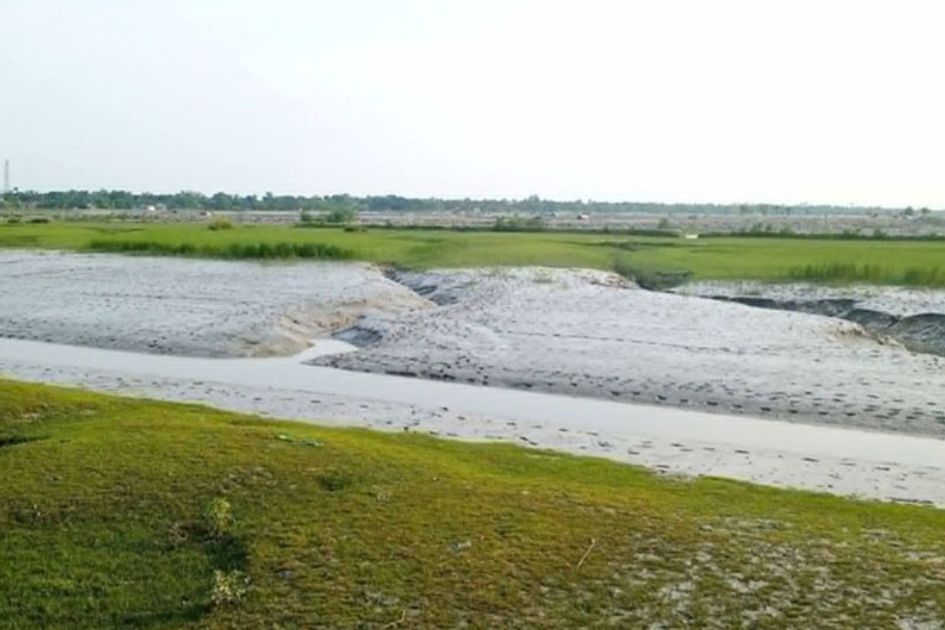



Despite billions spent on dredging and restoration, the Kobadak River continues to lose navigability as siltation, encroachment and weak water management fuel worsening waterlogging, erosion and environmental decline.
Once a lifeline for livelihoods across southwestern Bangladesh, the Kobadak River is now fighting for survival as silt accumulation, encroachment and decades of poor water management continue to choke its flow despite repeated dredging projects costing more than Tk 8.17 billion ($97 million).
Stretching through the districts of Jhenaidah, Jashore, Satkhira and the upazila of Koyra in Khulna, the river once sustained agriculture, fisheries, trade and settlement across the region. Today, large sections have turned into shallow channels and dead waterways, raising concerns among residents, environmentalists and water experts about the future of one of the area’s most important rivers.
According to the Bangladesh Water Development Board (BWDB), multiple projects have been undertaken to restore the river. The first phase of the Kobadak River Waterlogging Mitigation Project began in 2011 at a cost of about Tk 2.86 billion and was completed in 2017. However, authorities acknowledged that the expected results were not achieved.
A second phase launched in 2020 with an allocation of Tk 5.31 billion, bringing the combined expenditure to Tk 8.17 billion. The ongoing works include dredging, riverbank protection and embankment rehabilitation from Taherpur to Monirampur in Jashore and from Paikgachha to Amadi in Koyra, Khulna. The project is scheduled to conclude on June 30 this year.
Local residents say they initially welcomed the dredging works but quickly became disillusioned as the river began filling with sediment again within a short period.
“Projects keep coming and money keeps being spent, but the benefits do not last,” residents complained.
Environmental groups say communities in areas such as Kapilmuni, Chandkhali, Koyra, Shyamnagar, Keshabpur and Tala historically depended on the river system. However, the loss of navigability in the Kobadak and other regional rivers has contributed to chronic waterlogging, riverbank erosion and the displacement of hundreds of families every year. They argue that the absence of a sustainable development strategy has allowed the crisis to worsen steadily.
Researchers from the environmental and climate-focused civic groups Sundarbans and Bangladesh Coastal Protection Movement said local farmers once managed water resources using indigenous knowledge. Temporary embankments lasting six to eight months were used to block saline water while maintaining natural river flow.
That system collapsed after the construction of permanent embankments under the former East Pakistan Water and Power Development Authority’s Coastal Embankment Project in the 1960s. Since tidal water could no longer enter surrounding floodplains, sediment began accumulating within the river channels. Riverbeds gradually rose, navigability declined and encroachment accelerated.
Advocate Babul Howlader, divisional coordinator of the Bangladesh Environmental Movement (BAPA) in Khulna, said rivers are legally recognised as “living entities” under a High Court order but continue to face severe degradation.
“We want the dead and dying rivers and canals of the Khulna region, including the Kobadak, Shibsa and Sholmari rivers, to be dredged in a planned and transparent manner,” he said. “At the same time, they should be freed from illegal occupation and reopened for use by farmers and fishers.”
BWDB data show the Kobadak River extends about 367 kilometres through four districts before flowing through Koyra into the Sundarbans and eventually reaching the Malancha estuary of the Bay of Bengal via the Arpangasia River.
In reality, much of that downstream section now contains more submerged sandbars than navigable water. In some places, the river’s width has shrunk from 750 metres to only 150 metres.
A recent field visit found extensive sandbars and widespread signs of encroachment along both banks. The river’s decline has severely affected local agriculture, fisheries, transportation and the environment.
In Amadi Union of Koyra, the riverbed has become so heavily silted that large vessels can no longer operate. During low tide, water depth falls to between one and one-and-a-half feet. Although dredging marks are visible between Paikgachha and Mosjidkur in Amadi, the river resembles a narrow canal rather than a major waterway. Newly emerged land on both banks has been occupied for housing, brick kilns and shrimp farms.
At Kathmarchar in Koyra, vast sandbanks emerge during low tide where fish once thrived. Similar conditions can be seen in Khutighata, Gobra, Madinabad, Loka and Dashalia, where newly formed chars are obstructing the river’s natural flow.
Mozam Gazi, a resident of Gobra village in Koyra, said sediment accumulation has dramatically increased flooding risks.
“Previously, even high tides would not reach the embankment. Now the riverbed has risen so much that water overtops the embankments,” he said. “Every year saline water enters farmland and destroys crops. As a result, the number of landless people is increasing.”
He added that the river became clogged again within a year of dredging.
“Dredging alone will not solve the problem. Water flow must be ensured. Otherwise, what is the benefit of dredging?” he asked.
In areas including Deyara, Rahimpur, Salua, Habibnagar, Ramchandranagar, Malopara of Boalia, Hitampur and Banka Malopara along the riverbanks in Paikgachha, residents reported continuing riverbank erosion.
Sushanta Biswas of Malopara in Boalia said longstanding fishing communities are on the verge of disappearing because of relentless erosion.
Mohammad Firoz Hossain, assistant sub-divisional engineer of BWDB in Jashore and an official involved with the waterlogging mitigation project, said that despite completion of dredging under seven separate packages between Paikgachha and Koyra, nearly 7.5 million cubic metres of sediment had refilled between 70 and 78 percent of the excavated sections.
“It is not possible to keep rivers in this region functional through dredging alone,” he said. “Where Tidal River Management, or TRM, has been implemented, rivers remain active. Without TRM, sediment rapidly accumulates and rivers die. Long-term scientific research is essential for sustaining southern Bangladesh’s rivers.”
Local elders describe TRM as an indigenous water management system developed by farmers generations ago. Under the method, one selected floodplain connected to the main river is partially opened to tidal flows while other sides remain protected by embankments.
Historically, farmers constructed temporary embankments during the Ashari full moon period for eight months to prevent saline tidal water from entering cropland. During the Maghi full moon period, those embankments were removed. This system, known locally as the “eight-month embankment”, allowed sediment brought by tidal flows to accumulate in designated floodplains while cleaner water returned to the sea during ebb tides. The process naturally maintained river depth and prevented waterlogging.
On the issue of encroachment, Firoz said dredged soil had been placed 30 feet away from the riverbanks, but many sections of the river had previously been leased out. Some leases were cancelled through administrative intervention, though new encroachment attempts have emerged after dredging.
He said permanent cancellation of such leases is necessary to protect the river.
Mashiul Abedin, assistant sub-divisional engineer of BWDB in Khulna, identified reduced upstream flow and poor sediment management as the primary causes of the Kobadak’s navigability crisis.
“Ensuring upstream flow through the Padma-Gorai system is essential,” he said. “Otherwise sediment will continue accumulating in the river instead of reaching the sea.”
Abedin said TRM could offer a sustainable solution but noted that large-scale implementation would be costly and require significant land acquisition.
Once a powerful river that shaped the economy and culture of southwestern Bangladesh, the Kobadak today survives amid expanding sandbars, shrinking channels and mounting pressure from both nature and human activity, raising urgent questions about the effectiveness of current restoration efforts.
This post is republished from Daily Bonik Barta.




