

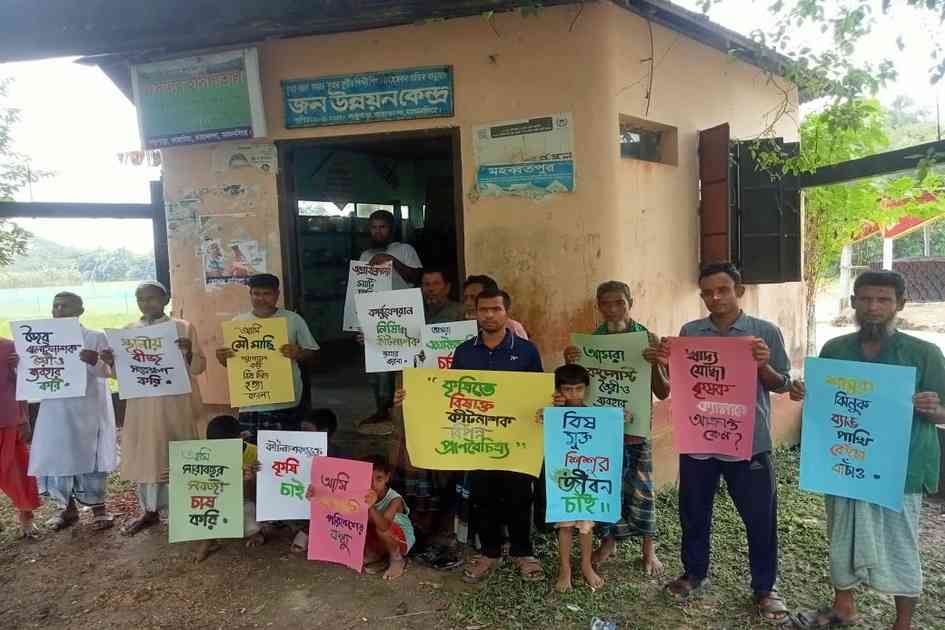



Farmers, researchers and green activists in Mymensingh called for pesticide-free villages, warning that banned toxic inputs are polluting soil, water and air while threatening biodiversity, health and agriculture.
A farmers’ workshop in Mymensingh called for stronger action to curb the use of banned pesticides and harmful materials, warning that soil, water and air are under growing threat and that unchecked chemical use is putting biodiversity, public health and the future of agriculture at risk.
The workshop, titled Soil, Water and Air Endangered by Banned Pesticides and Materials, was held at the public development centre in Sadhupura under Kamaria union of Tarakanda upazila in Mymensingh district. It was organised by private research organisation BARCIK and the Green Coalition Committee with representatives from Shatobari and the Agroecology Learning Centre taking part in a campaign to help build a pesticide-free village.

Opening the event, BARCIK regional coordinator Md Ahidur Rahman spoke about the environmental crisis and the threat to biodiversity caused by the use of banned pesticides and materials.
“The environment, public health and biodiversity are all under threat from pesticides and banned materials,” he said. “We have to reduce the use of pesticides, chemicals and pest control substances in farming and increase the preparation and use of organic pest control. We need to practise family farming. Local seeds should be preserved. Our natural resources, soil, water and air, are now polluted. We all have to take initiative together.”
Farmer Abul Kashem said growers in the area were gradually reducing their dependence on chemicals but stressed that wider community involvement was essential.
“We are gradually reducing the use of chemicals ourselves,” he said. “At the same time, all the people of the village must be involved in this work. One person taking the initiative will not be enough. We want to make an entire village free from pesticides together.”
Participants shared their own environmentally friendly initiatives and pledged to advance agroecological practices further. They said excessive pesticide use was exposing the entire animal world to grave danger and killing beneficial insects that are essential for pollination, even though there is no alternative to pollination in crop production.
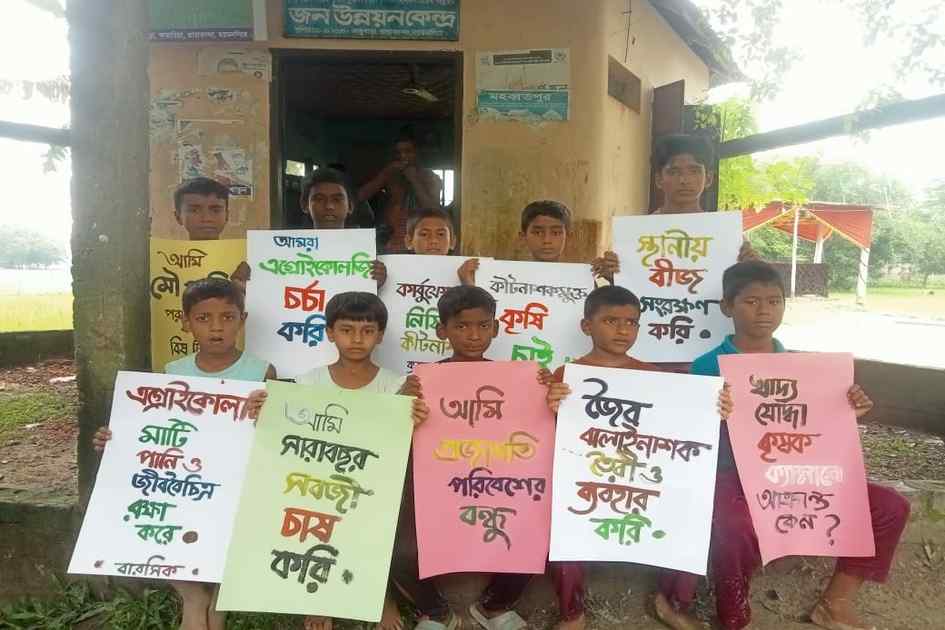
Speakers noted that pesticide use kills the eggs of beneficial insects and that excessive application is placing all living creatures at serious risk. They also said air guns and poisoned bait are used to kill birds while the use of fine-mesh nets in wetlands is driving aquatic biodiversity toward destruction.
According to the discussion, toxic substances used as poisoned bait to catch birds include aluminium phosphide, gas tablets, rotenone, cyhalothrin and glyphosate.
Participants warned that if the situation continues, crop production will eventually be seriously disrupted and the entire agricultural system will face a severe crisis. They called for strict monitoring to control the trade and use of pesticides and said it was urgent to develop safe alternative methods.
They also stressed the need to encourage farmers to apply fertiliser in moderation and avoid harmful chemicals in their fields.
After the discussion, participants held a nature-linked public awareness campaign in Sadhupura village to promote the goal of a pesticide-free village. Displaying placards on soil, water and air pollution and the loss of biodiversity, they protested against the use of pesticides and banned materials and carried out an awareness drive among local people.




