

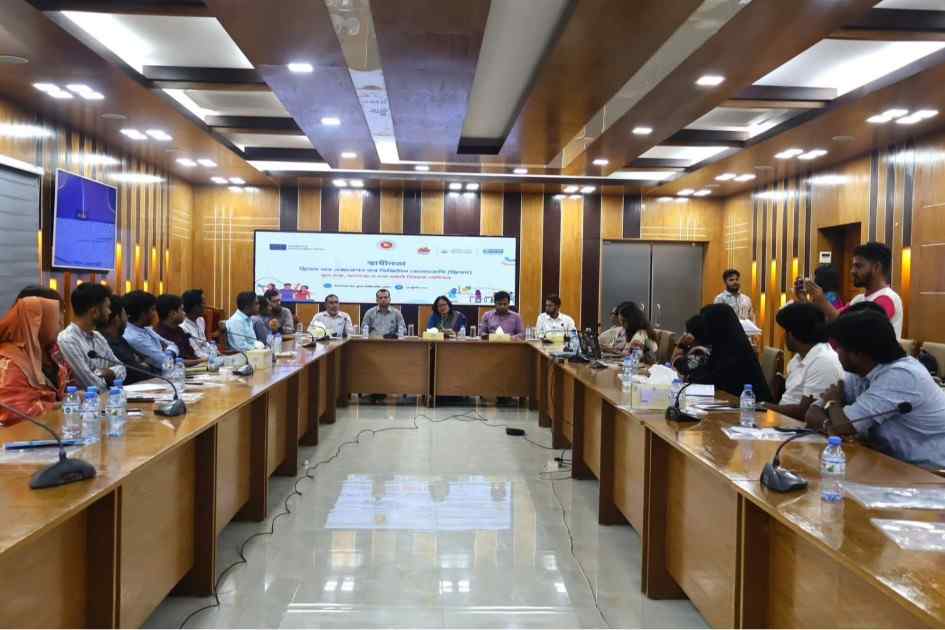

Government officials, journalists and activists called for greater public awareness, responsible online behaviour and stronger fact-checking to counter misinformation, harassment and other digital risks, particularly those affecting women.
Government representatives, journalists and civil society activists have called for stronger fact-checking and more responsible use of online platforms to combat misinformation, disinformation and digital harassment.
The call came at a seminar held at the Khulna Circuit House under the European Union-funded Swadhinata: Freedom of Expression for Digital Democracy (FREEDOM) project recently.
Organised by Badabon Sangho, the event brought together government officials, local journalists, youth activists and representatives from Manusher Jonno Foundation and Badabon Sangho to discuss digital democracy, responsible online behaviour and the safe use of digital platforms.
Hure Jannat, Deputy Commissioner and District Magistrate, Khulna, attended the seminar as Chief Guest. She said misinformation, online harassment and digital safety had become urgent public concerns, particularly for women, who often face serious risks in digital spaces.
While the government was working to address the problems, government action alone would not be sufficient, she said.
Citizens must verify information, use digital platforms responsibly and refrain from sharing harmful or unverified content, she added. Mohammad Jahidul Hasan, representative of the police administration, attended the event as a special guest.
Other participants included Md. Alimuzzaman Khan, District ICT Officer, Department of ICT, Khulna; Md. Mostak Uddin, Deputy Director, Department of Youth Development, Khulna; Sheikh Ohidul Alam, District Primary Education Officer, Khulna; S. M. Chhayedur Rahman, District Education Officer, Khulna; and Lipi Rahman, Executive Director of Badabon Sangho.
The discussion focused on the precautions people should take before recording, uploading or sharing content online.
Participants highlighted journalists’ ethical responsibilities, including verifying information, consulting reliable sources and conducting fact-checking before publishing reports.
Practical techniques for detecting misleading content were also demonstrated, including reverse image searches, methods for identifying AI-generated images and the use of fact-checking platforms.
Officials and participants discussed cases of online harassment, procedures for filing an Online GD and the responsibilities of different government units in responding to cyber-related complaints.
They recommended using parent-teacher meetings to raise parents’ awareness of online risks faced by children and young people.
Participants also proposed using uthan boithok sessions to provide women in rural communities with information about online safety, misinformation and available complaint mechanisms. The seminar was conducted by Md. Alimuzzaman Khan, District ICT Officer, Department of ICT, Khulna.
He provided practical guidance on the safe and responsible use of digital platforms and responded to questions from participants alongside other government representatives.
The Swadhinata: Freedom of Expression for Digital Democracy (FREEDOM) project is funded by the European Union, led by Plan International Bangladesh and implemented by Manusher Jonno Foundation (MJF) in partnership with eight divisional Women’s Rights Organisations, including Badabon Sangho in Khulna.




