

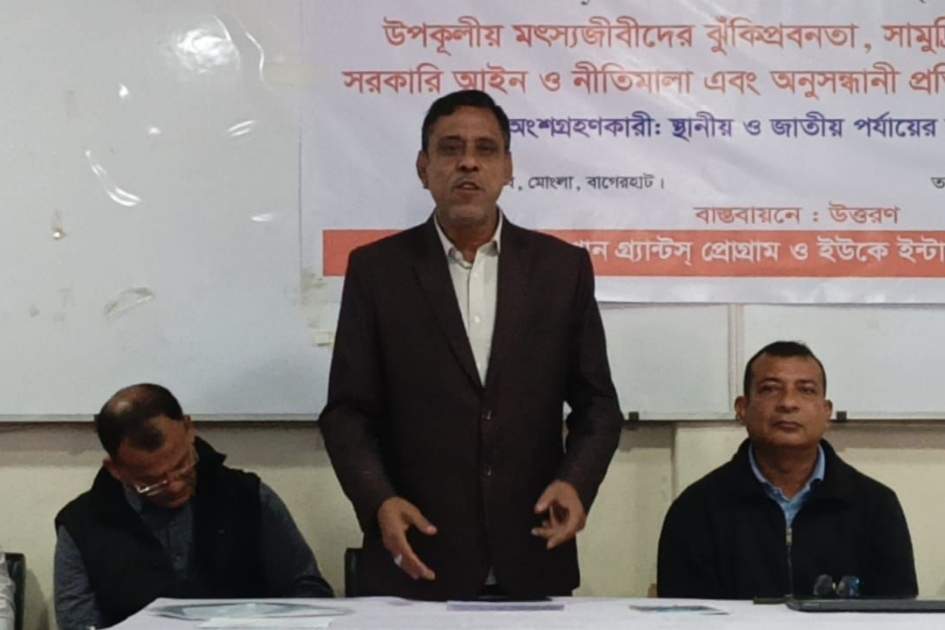



A workshop in Mongla equipped journalists with skills in investigative climate reporting, fisheries law, and marine conservation to better highlight coastal communities’ vulnerability and resilience.
As climate change increasingly threatens coastal livelihoods and marine ecosystems across the Global South, journalists in Bangladesh are being equipped with specialised skills to report more accurately on fisheries, ocean protection and climate impacts.
A day-long training workshop for local and national journalists was held on Wednesday at the Mongla Press Club, focusing on coastal fisherfolk vulnerability, marine habitat conservation, relevant government laws and policies and investigative climate reporting.
The workshop was organised by the non-governmental organisation Uttaran under the Fisherfolk Integration for Sustainable Habitat and Natural Ecosystem Transformation (FISHNET) project, with support from the Ocean Grants Programme and UK International Development.
Bangladesh’s coastal belt supports millions of people who depend directly on fisheries and marine resources for their livelihoods. However, rising sea levels, cyclones, storm surges, increasing salinity and the degradation of fish breeding grounds are placing growing pressure on these communities and the ecosystems they rely on.
The training, held from 9:00am to 2:00pm, covered the socio-economic realities of coastal fishers, the science of climate change, state initiatives for marine biodiversity protection, fisheries laws and regulations and techniques for producing investigative and human-centred environmental stories. Emphasis was placed on translating complex scientific data into accessible reporting while maintaining accuracy and ethical standards.
The session was chaired by Ahsan Habib Hasan, President of the Mongla Press Club, with Hasan Gazi, General Secretary of the Press Club, attending as a special guest. The training was facilitated by senior journalist, columnist and environmentalist Md Rafikul Islam Montu.
“Coastal fishers are among the most climate-vulnerable groups, yet their struggles are often underrepresented in mainstream reporting,” Montu said. “With proper field investigation, legal understanding and climate science knowledge, journalists can help ensure these voices are heard and policies are held to account.”
Participants also discussed best practices in source verification, investigative techniques and storytelling approaches that centre on human experiences without compromising scientific accuracy. Trainers stressed the role of the media in bridging the gap between policy, science and affected communities.
Members of the newly elected Mongla Press Club committee, along with journalists from various local media outlets, took part in the workshop. Participants called for similar capacity-building initiatives to be held regularly, noting that such training strengthens journalistic professionalism while contributing to more informed public debate on climate resilience, ocean governance and sustainable livelihoods, issues that are gaining increasing global attention ahead of international climate and ocean policy processes.




