

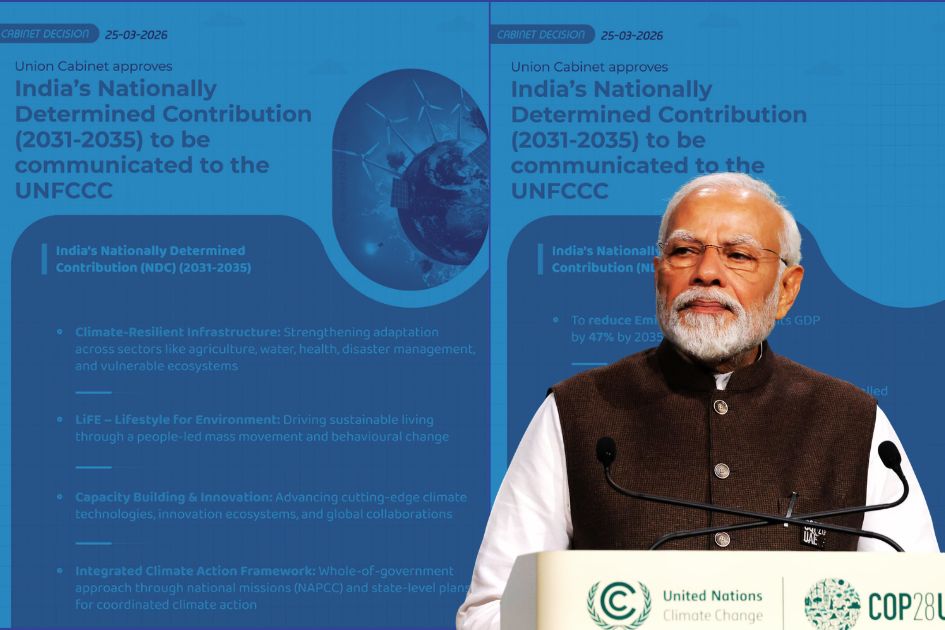



India unveils ambitious 2035 climate goals, targeting major emissions cuts and renewable expansion, while boosting adaptation efforts and reinforcing its leadership in global climate action and sustainable development.
At a time when global climate pledges are faltering, India has raised the bar. The Union Cabinet, chaired by Prime Minister Narendra Modi, approved the country’s Nationally Determined Contribution (NDC) for 2031 to 2035, marking a major step toward a low-carbon, climate-resilient future.
Under the new targets, India aims to reduce the emissions intensity of GDP by 47 percent from 2005 levels, achieve 60 percent of installed electric power capacity from non-fossil fuels and create a carbon sink of 3.5 to 4 billion tonnes of CO₂ equivalent through forest and tree cover. These commitments align with India’s long-term vision of Viksit Bharat @2047 and the nation’s goal of net-zero emissions by 2070.
India has a strong track record in climate action. It met its 2030 renewable energy and emissions targets years ahead of schedule, achieving 52.57 percent non-fossil energy capacity and cutting emissions intensity by 36 percent between 2005 and 2020. Afforestation and ecosystem restoration have created 2.29 billion tonnes of carbon sink, earning India third place globally for net forest area gain.

The NDC emphasizes both mitigation and adaptation. On mitigation, measures include large-scale renewable energy expansion, battery storage, green energy corridors, carbon capture technologies and nuclear energy. Programs such as the Green Hydrogen Mission, PM-KUSUM solar irrigation and Production Linked Incentive (PLI) schemes aim to scale renewable energy while integrating climate action across sectors.
Adaptation measures include coastal mangrove restoration, climate-resilient infrastructure, early warning systems, glacier monitoring, biodiversity conservation and Heat Action Plans. Implementation is coordinated through the National Action Plan on Climate Change (NAPCC) and State Action Plans, ensuring a whole-of-government, people-centered approach.
Commenting on the announcement, climate activist Harjeet Singh, Founding Director of Satat Sampada Climate Foundation, said, “India has set a strong example for the world. By aiming for 60 percent renewable energy and cutting emissions intensity by nearly half, the country is proving that economic growth and climate action can go hand in hand. If other nations step up, India’s success can become a global win.”
The NDC also prioritizes inclusive growth, creating opportunities for youth and women as partners in India’s green transition. The Cabinet’s approval sends a clear signal that the nation is committed to balancing economic development with environmental responsibility while strengthening its global climate leadership.




