

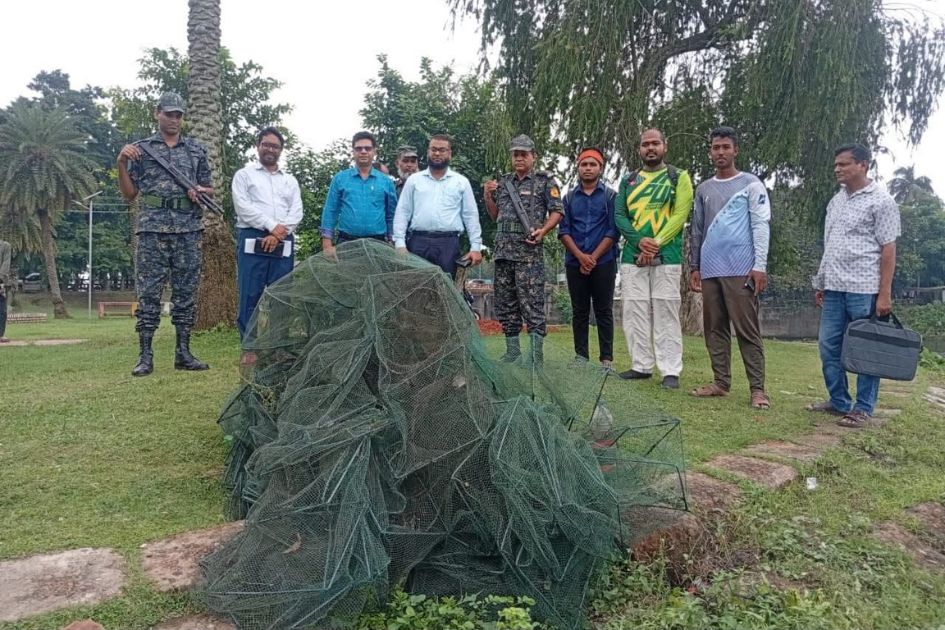



The enforcement drive underscored growing concerns over destructive fishing gear that threatens juvenile fish and freshwater biodiversity, while highlighting the need for stronger community participation, awareness and sustainable livelihood support for fishing communities.
In an effort to protect aquatic ecosystems and curb illegal fishing practices, the Magura zone of the Deep Ecology and Snake Conservation Foundation (DESCF) provided information and operational assistance to support a mobile court operation that resulted in the seizure and destruction of approximately one kilometre of illegal “Duari” fishing nets valued at around Tk 3 lakh.
The operation, led by MD Shadid Mahmud Sishir, began at 11:30 am and continued until 4:00 pm. DESCF volunteers supported the operation by identifying locations, sharing necessary information and assisting the enforcement process. A mobile court led by the relevant government authorities conducted the seizure and destruction of the prohibited fishing gear in accordance with legal procedures, while DESCF provided field-level support throughout the operation.
Duari nets, commonly used as fine-mesh fishing traps, pose a serious threat to aquatic ecosystems as they often capture juvenile fish and other non-target aquatic species. These destructive fishing devices can affect breeding grounds, disrupt natural fish reproduction, reduce native fish populations and disturb the balance of aquatic food chains in rivers and wetlands.
The scale of the operation highlighted the widespread use of these destructive fishing traps in local waterways. Volunteers assisting fisheries officials reported that the volume of nets recovered was so extensive that they became physically exhausted during the final phase of the drive, requiring the operation to be concluded for the day.
During the campaign, volunteers expressed surprise at the high market value of the confiscated fishing gear. Fisheries officials explained that the cost of these traps is largely driven by the heavy iron rings used in their construction. They also noted that many low-income fishermen become financially burdened after borrowing money to purchase such equipment, highlighting the need for awareness, sustainable fishing alternatives and livelihood support for vulnerable fishing communities.
Environmental activist Syeda Anannya Faria urged local residents to remain vigilant, report illegal fishing activities and actively participate in protecting rivers, wetlands and aquatic life. She emphasized that long-term conservation requires both effective enforcement of fisheries regulations and community-led efforts. She also highlighted the importance of combining enforcement with awareness-building and access to sustainable fishing practices to support fishing-dependent communities while ensuring responsible management of natural resources.




