

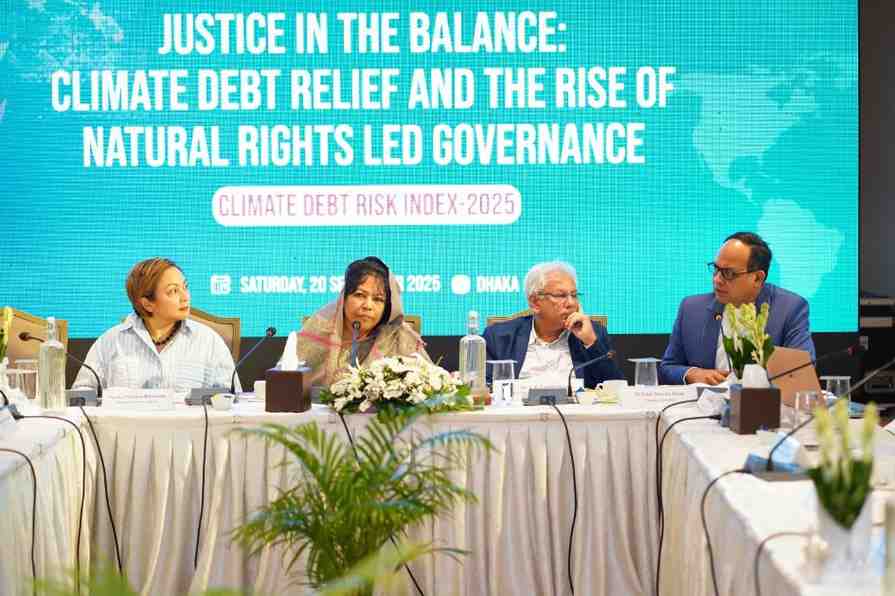

Bangladesh faces one of the world’s highest climate debts, with USD 79.6 per capita and a debt-to-grant ratio of 2.7. Loans dominate climate finance, adaptation is neglected, and fossil projects misclassified, pushing resilience, poverty, and justice to crisis.
Bangladesh has emerged as one of the world’s most climate-indebted nations, with a per-capita burden among the highest of all Least Developed Countries (LDCs). The newly released Climate Debt Risk Index 2025 (CDRI-25) by Change Initiative on Saturday in Dhaka gives Bangladesh a score of 65.37 out of 100, placing it in the “High Risk” category. The score is projected to rise to 65.63 by 2031, indicating worsening vulnerability if no reforms are made.
Although Bangladesh contributes less than 0.5 percent of global greenhouse gas emissions, its per-capita climate debt now stands at USD 79.61 — more than three times the LDC average of USD 23.12. Between 2000 and 2023, over 130 million Bangladeshis were affected or displaced by climate disasters, which caused USD 13.6 billion in economic damages. Yet, adaptation finance continues to flow slowly, in small amounts, and overwhelmingly as loans rather than grants.
The debt-to-grant ratio illustrates this imbalance starkly. For every dollar Bangladesh receives as a grant, it borrows USD 2.70. Among multilateral climate funds, the debt-to-grant ratio is 0.94, nearly five times the LDC average of 0.19. Disbursement is sluggish: only 63 percent of committed funds actually arrive, and in the case of multilateral climate finance, the figure drops to 32 percent.
Adaptation, considered vital for Bangladesh’s survival, is critically underfunded. The adaptation-to-mitigation ratio is 0.42, less than half the global average of 0.88. “Climate is science, yet Bangladesh remains deeply vulnerable,” said Dr. A.K. Enamul Haque, Director General of the Bangladesh Institute of Development Studies (BIDS). “Grants are limited, loans risky, and overreliance on the private sector heightens financial strain. Vulnerable communities face added threats like trafficking. True resilience demands local knowledge, technology, and systemic change—incremental fixes are not enough.”
Skewed sectors and fossil fuel misuse
The CDRI exposes deep distortions in the way climate finance is distributed. More than half of Bangladesh’s finance (54 percent) flows to the energy sector, dominated by debt with a loan-to-grant ratio of 11.99:1. The transport sector is almost entirely debt-driven, with a staggering 1123:1 ratio, while water supply carries a 7.78:1 ratio despite being essential for adaptation. By contrast, agriculture, disaster preparedness, health, and industry receive negligible support relative to need.
Perhaps most concerning, 18.84 percent of reported climate finance has been misattributed to fossil fuel projects, including coal and gas infrastructure such as the Matarbari power plants. These flows carry a loan-to-grant ratio of 28.8, artificially inflating Bangladesh’s debt metrics while diverting funds from embankments, mangrove restoration, and water security.
“Unless Bangladesh ensures accountability, transparency, and good governance so climate funds reach the most vulnerable, access to global finance will remain limited,” warned Shirin Lira, Cooperation Officer at the Embassy of Switzerland. “Policies alone are not enough — during disasters, local communities are the first responders, and without building their capacity, international pledges will not deliver real action.”
Human and fiscal consequences
The debt-heavy finance system has profound human and fiscal consequences. Rising debt repayments threaten to crowd out social spending in health and education. Meanwhile, households are carrying a silent but massive financial load. Rural families spend BDT 10,700 (≈USD 88) annually on self-financed adaptation, amounting to USD 1.7 billion each year.
“Adaptation finance must be grant-based and equitable, or the world risks a climate debt crisis where survival becomes unaffordable for the vulnerable and destabilizing for all,” said Dr. Fazle Rabbi Sadeque Ahmed, Deputy Managing Director of PKSF.
Call for just climate finance
The CDRI argues that Bangladesh cannot escape this debt trap without systemic reform. It proposes a Natural Rights Led Governance (NRLG) approach, which recognizes the rights of people and ecosystems to exist, recover, and thrive. Under this framework, climate finance must be treated as an obligation, not charity, and adaptation and loss-and-damage funds should be debt-free by default.
M. Zakir Hossain Khan, Chief Executive of Change Initiative, underscored the urgency: “Without firm pledges and clear governance, the $1B Climate Finance Action Fund, launched in COP29, risks remaining an ambition, not a lifeline for vulnerable nations.”
The NRLG pathway outlines bold reforms: at least 70 percent of adaptation finance and all loss & damage finance as grants; climate debt cancellations and debt-for-nature swaps tied to ecosystem restoration; direct local access windows for municipalities and communities; and transformation of the Bangladesh Climate Change Trust Fund (BCCTF) into a Bangladesh Natural Rights Fund (BNRF) with rights-based allocations. It also calls for a global Earth Solidarity Fund, capitalized by carbon pricing and transaction levies, to deliver unconditional resilience finance.
Global picture of failure
The CDRI 2025 assesses 55 countries and paints a grim global picture. By 2023, 76 percent of climate finance worldwide was debt, while less than 5 percent of LDC finance was grant-based. Thirteen countries are already classified as “Very High Risk.”
The report says this structure represents a direct violation of the Paris Agreement’s polluter-pays principle and undermines the International Court of Justice’s 2025 ruling, which declared climate reparations a legal obligation of major emitters.
“Protecting biodiversity can reduce climate impacts, yet global forums like COP often fail to deliver results, leaving communities vulnerable,” said Dr. Farhina Ahmed, Secretary of the Ministry of Environment, Forest and Climate Change. “Bangladesh must respond by addressing unequal carbon emissions, as highlighted by the ICJ judgment, while prioritizing public-private action, national adaptation plans, and NDC implementation.”
Diplomats echoed the call for fairness and accountability. “Climate finance must be accountable, just, and impactful — protecting resources and ensuring a fair transition,” said Nayoka Martinez-Bäckström, First Secretary at the Embassy of Sweden. “Beyond grants, new financing sources are vital. Tools like the Climate Vulnerability Index and inclusive budgeting can guide allocation, but what matters most is real community impact. Only projects that truly advance adaptation and mitigation, such as public transport, should be prioritized to build resilience and support vulnerable populations.”
From the civil society side, Faria Hossain Ikra of Greenpeace South East Asia warned that the challenge would only grow as Bangladesh exits LDC status: “As Bangladesh prepares to graduate from LDC status, accessing just and fair climate finance will become even harder. We must explore how the ICJ’s advisory opinion can serve as a legal tool to hold major emitters accountable and mobilize the support we are owed.”
Political voices also emphasized the justice dimension. “Bangladesh contributes little to global emissions yet suffers the greatest impacts,” said Dr. Saimun Parvez, Special Assistant to the BNP Chairperson. “Climate finance must shift from loans to equity and justice, with transparency, accountability, and real support for adaptation. From nature-based solutions and waterway restoration to renewables and climate-smart agriculture, action must be backed by expertise, national commitment, and global solidarity. The era of climate debt must end; the era of climate justice must begin.”
Finally, Dr. Kazi Shahjahan, Joint Secretary at the Economic Relations Division, stressed that climate finance cannot be divorced from governance: “Climate science is intertwined with politics, economics, and human behavior; to effectively mobilize finance, we must navigate national and international policies, learn from global development frameworks, and build local capacity to utilize data and resources strategically.”
Shamsuddin Illius, environmental journalist and Chittagong Bureau Chief at The Business Standard, emphasized the need to explore alternative sources of funding to reduce dependency on foreign loans. He suggested that the government could introduce a carbon tax on high-emitting industries to generate resources for climate-related mitigation and adaptation efforts. He also underscored the importance of ensuring data transparency.
A crossroads ahead
Bangladesh’s case is now a stark example of a global climate finance system gone wrong: debt-heavy, slow to deliver, and misaligned with the needs of the most vulnerable. At COP30 in Belém, Dhaka is expected to push for reforms under the NRLG framework, demanding a grant-first, justice-driven approach that prioritizes adaptation and loss-and-damage finance.
Whether the international community listens will determine if Bangladesh escapes the climate debt trap — or sinks deeper into poverty and insecurity as disasters intensify.




