

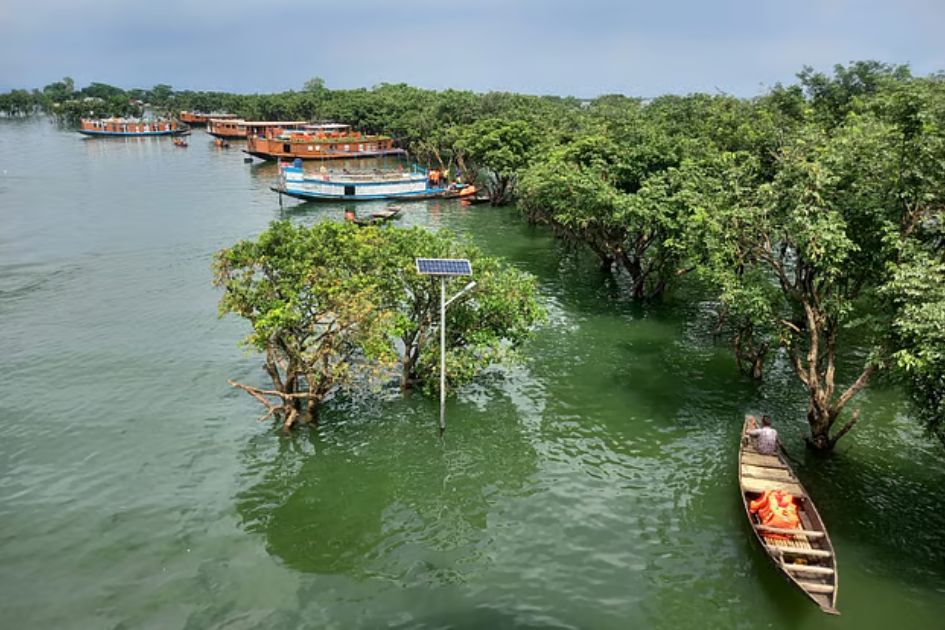

The FY2026–27 budget prioritises Bangladesh’s haor region with increased climate adaptation funding, resilient infrastructure, water management projects and ecosystem-based measures to strengthen livelihoods, disaster preparedness and long-term resilience.
The Bangladesh government has outlined a significant increase in climate adaptation investments for the haor (wetland) region in the proposed FY2026-27 national budget, with a strong emphasis on ecosystem-based adaptation and resilience-building measures alongside expanded mobilisation of international climate finance, according to documents released by the Ministry of Finance.
A key highlight of the allocation is the continuation and expansion of the co-management initiative for the Tanguar Haor wetland ecosystem. Under the “Community-Based Management of Tanguar Haor Wetland Ecosystem” project, a total of BDT 259.25 crore has been earmarked, including BDT 49.78 crore from the Global Environment Facility (GEF) and BDT 209.40 crore in co-financing.
The largest allocation under the climate portfolio has been directed to the “Ecosystem-Based Approaches to Adaptation (EbA)” project, designed to address drought, flooding and waterlogging challenges in the haor and Barind regions. The project has been allocated BDT 734.81 crore, including BDT 63.91 crore from GEF and BDT 667.16 crore in co-financing support.
Another intervention in the pipeline under the Adaptation Fund is expected to secure BDT 61.46 crore in grant financing. The proposed project, “Strengthening Climate Resilience through Locally Led Housing Solutions in the Haor Region,” aims to provide climate-resilient housing for communities in flash flood-prone areas.
Beyond donor-supported initiatives, the government is also increasing domestic investment in water governance and river management in the northeastern region.
In the Surma-Kushiyara River Basin, BDT 100 crore has been allocated in the first phase for flood control and integrated water resource management. In addition, BDT 30.63 crore has been set aside for minor irrigation development in the haor areas of Kishoreganj and Netrokona. Another BDT 20 crore has been committed for the rejuvenation and pollution control of the Sutang River in Habiganj while BDT 22.80 crore has been earmarked for riverbank protection along the Kushiyara River.
In addition to these water governance interventions, a significant share of the budget has been directed toward climate-resilient infrastructure aimed at improving connectivity and disaster preparedness in the haor belt. The Haor Elevated Road Project (HERRIP-II) has been allocated BDT 285 crore in the current fiscal year to ensure year-round mobility during seasonal flooding.
Education infrastructure is also being integrated into disaster resilience planning, with schools serving as emergency shelters during floods and cyclones. Under this approach, BDT 300 crore has been allocated for upgrading selected educational institutions in the haor region along with an additional BDT 130 crore for schools in Kishoreganj’s haor areas.
On livelihoods and social protection, the finance minister emphasized a diversified development strategy focusing on fisheries, duck farming, eco-tourism and biodiversity conservation. Vulnerable fisher households are being brought under the Vulnerable Group Feeding (VGF) programme, covering an estimated 1.5 million families nationwide.
In addition, BDT 50 crore has been earmarked as special grants for char, haor and other underserved regions. Under the “Improving Livelihoods of Disadvantaged Populations” programme, BDT 234.62 crore will be invested in food security, employment generation and healthcare services for haor communities.
Officials said the expanded allocation reflects a broader policy shift toward ecosystem-based adaptation and locally led resilience planning, positioning the haor region as a priority zone in Bangladesh’s climate response strategy.




