

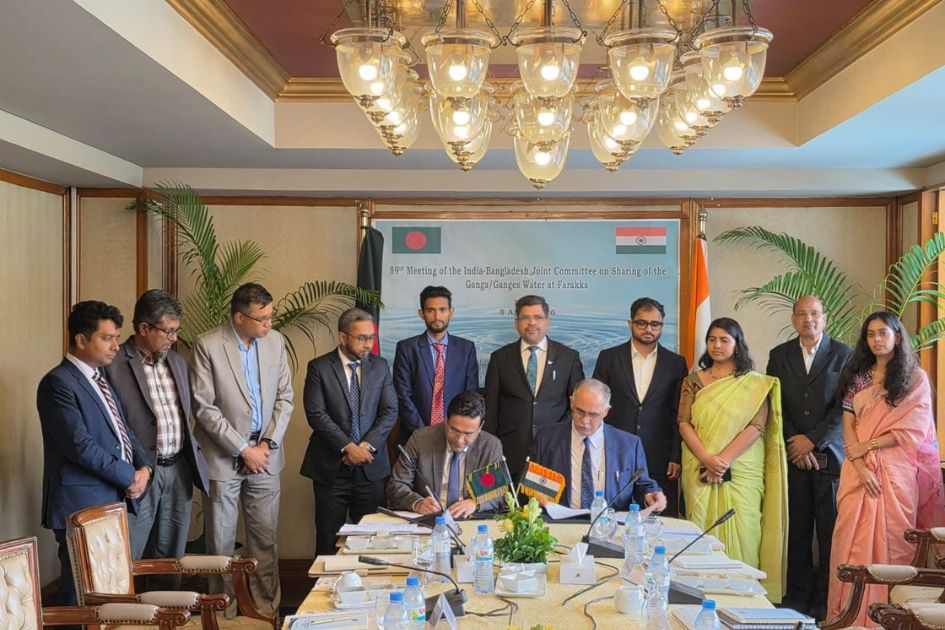



Bangladesh and India review Ganges water-sharing treaty in Dhaka, addressing dry-season shortages, data gaps, and climate pressures ahead of a critical 2026 renewal deadline.
Bangladesh and India held the 89th meeting of the Joint Committee on the implementation of the 1996 Ganges Water Sharing Treaty in Dhaka on Tuesday, focusing on ensuring equitable water distribution during the dry season and strengthening cooperation over shared rivers.
Signed in 1996, the treaty remains a cornerstone of water diplomacy between the two countries, governing the sharing of Ganges waters during the critical lean period when river flows decline significantly.
In the broader diplomatic context, Bangladesh and India are expected to engage further at higher levels to address water-sharing issues. According to diplomatic sources, Bangladesh’s Foreign Minister is visiting New Delhi for discussions with his counterpart Subrahmanyam Jaishankar, where transboundary river management is likely to feature prominently.
Ahead of the meeting, on April 7, officials from both sides conducted a joint field visit and carried out flow measurement activities at the Hardinge Bridge on the Padma River. The exercise aimed at joint verification of river flow data and enhancing transparency in implementation.
The Bangladesh delegation was led by Md Anwar Kadir of the Joint Rivers Commission under the Ministry of Water Resources, while the Indian side was headed by Sharad Chandra, Commissioner for Flood Management under India’s Ministry of Jal Shakti.
Officials described the meeting as constructive, emphasizing the importance of continued data sharing, technical cooperation and mutual trust to ensure smooth implementation of the treaty.
They also underscored that sustained collaboration is crucial as both countries face increasing pressure on river systems due to climate variability, upstream challenges and growing water demand, making effective regional water governance more important than ever.
With the current agreement set to expire in 2026, both countries are expected to intensify discussions on its renewal in the coming months. Experts say the renewal process will be critical, as changing hydrological patterns and rising demand require a more adaptive and forward-looking framework.
Over the last two decades, empirical evidence has pointed to discrepancies between expected and actual water flows downstream in Bangladesh. In many cases, water flow recorded at Hardinge Bridge during the dry season has been lower than the amounts allocated under the treaty, based on releases from the Farakka Barrage.
A study comparing yearly releases from Farakka and corresponding downstream flows between 1997 and 2016 found that in around 31 percent of cases, Bangladesh received less water than expected. Such gaps have significant implications for agriculture, fisheries and ecosystems, where downstream flow is critical.
Experts note that one of the key limitations of the treaty is the absence of a robust dispute resolution mechanism, as well as limited provisions for independent verification of water releases. As a result, disagreements are often prolonged through negotiations without definitive resolution.
Climate change is further intensifying these challenges. Reduced snow persistence in the Himalayas and shifting rainfall patterns have contributed to increased variability in river flows, with some research indicating a decline in dry-season water availability over time.
Analysts suggest that future negotiations should prioritize improved data transparency, revised allocation methods that reflect climate variability and guarantees of downstream flow at key monitoring points such as Hardinge Bridge.
While the current treaty is bilateral, some experts have suggested that broader regional cooperation, including with upstream countries, could help improve dry-season flow management. However, such approaches would require significant investment and political coordination.
Observers warn that allowing the treaty to expire without a new agreement could weaken existing monitoring mechanisms and increase uncertainty. At the same time, a simple renewal without reforms risks perpetuating existing shortcomings.
They say the way forward lies in balancing continuity with necessary reforms, ensuring that any renewed agreement reflects current realities while safeguarding the interests of both countries.
Analysts believe that prioritizing people-centric issues such as fair water-sharing could play a key role in strengthening bilateral relations. Renewing the Ganges treaty, alongside progress on other shared rivers like the Teesta, could help build trust and improve public perception in both countries.
“Sustainable and equitable water sharing is not just a diplomatic issue, it is a matter of climate justice for millions of people in downstream communities,” said Sohanur Rahman, Executive Coordinator of YouthNet Global. “The renewal of the Ganges treaty must incorporate transparency, accountability and climate resilience to ensure that vulnerable populations are not left behind.”




