

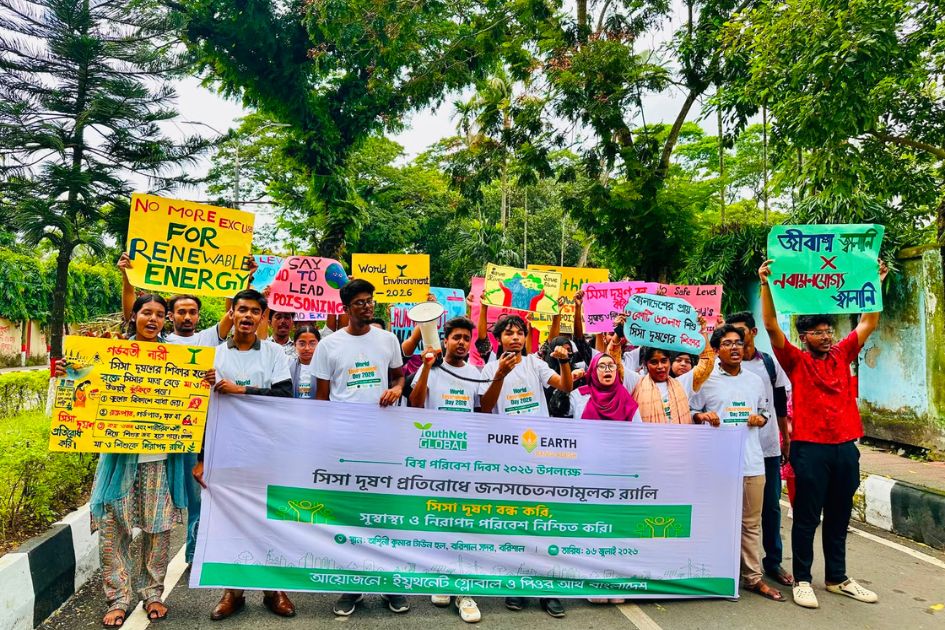



Youth-led rallies in Rangpur and Barishal have renewed calls for stronger regulation of lead pollution as Bangladesh prepares to expand cleaner battery manufacturing under new government policy.
Barishal and Rangpur youth rallies demand action on childhood lead poisoning as experts call for responsible battery future.
As Bangladesh struggles with the health and environmental impacts of unsafe lead-acid battery recycling, environmental activists, experts and young leaders are calling for stronger safeguards while the country moves towards newer battery technologies for clean energy and electric transport.
Speaking at a World Environment Day event on 9 July, Minister of Environment, Forest and Climate Change of Bangladesh, Abdul Awal Mintoo said the government had finalised a national strategy to address the public health crisis caused by lead pollution.
Environmental activists, students, teachers and community members in Rangpur and Barishal recently demanded urgent government action to control lead pollution, warning that informal lead-acid battery recycling is exposing children, workers and vulnerable communities to toxic substances.
The rallies were organised by YouthNet Global with support from Pure Earth as part of a week-long nationwide campaign across all eight divisions under the theme “Stop Lead Pollution, Ensure Healthy Lives and a Safe Environment.”
Participants placed a five-point demand agenda, including development of a national strategy to tackle lead pollution, regular blood lead monitoring for children and vulnerable communities, stronger regulation of lead-acid battery producers, safe collection and environmentally sound recycling of used batteries and increased research and institutional capacity.
Activists said the burden of lead exposure often falls disproportionately on low-income communities, where informal recycling activities frequently operate with limited safety protections.
Experts said Bangladesh’s transition towards lithium-ion and sodium-ion batteries presents both an economic opportunity and an environmental responsibility. They warned that cleaner technologies must be supported by responsible production, recycling and disposal systems to avoid creating new waste challenges in the future.
Unsafe recycling remains a major source of lead contamination
Speakers at the rallies said informal lead-acid battery recycling remains one of the major sources of lead contamination in Bangladesh. Unsafe dismantling and recycling activities release toxic substances into soil, water and air, putting workers, children and nearby communities at risk.
UNICEF estimates that Bangladesh carries one of the world’s highest burdens of childhood lead exposure, with more than 3.5 crore children estimated to have elevated blood lead levels. Preliminary findings from the Bangladesh Multiple Indicator Cluster Survey (MICS) 2025 show that 38.3 percent of children aged 12 to 59 months have blood lead levels at or above 5 micrograms per decilitre (\mu g/dL). It is important to note that this is not a ‘safe’ limit, as there is no known safe level of lead in the blood; rather, this is the reference threshold at which the World Health Organization recommends identifying and removing sources of exposure.
Experts said children are particularly vulnerable to lead poisoning because their brains and bodies are still developing. Even low levels of lead exposure can reduce cognitive ability, affect learning and behaviour and cause long-term neurological damage.
Experts said lead exposure is not limited to battery recycling. The Bangladesh Food Safety Authority’s 2024-25 report also raised concerns over heavy metal contamination detected in some food products, including baby food samples.
Health professionals warned that infants and young children are especially vulnerable because exposure during early development can affect cognitive growth, learning ability and neurological development.
Experts stressed that preventing lead poisoning requires action across multiple sectors, including environmental regulation, industrial safety, food monitoring and public awareness.
Rangpur rally highlights child health risks
In Rangpur, the awareness rally began at Chandra Mor, passed through major roads including Abu Sayed Chattar and concluded at the main entrance of Begum Rokeya University, a public university in northern Bangladesh.
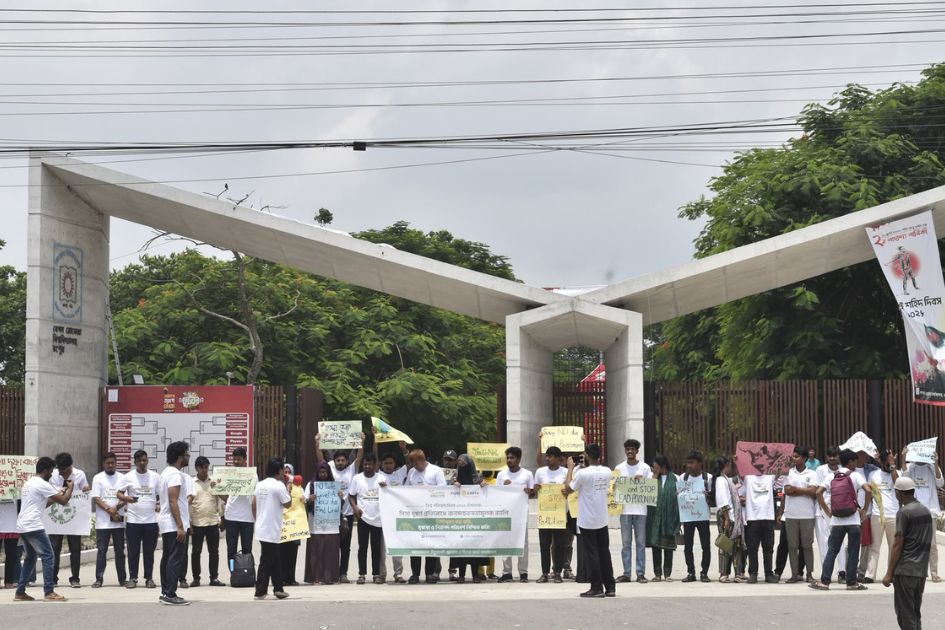
Students, teachers, young activists and community members joined the procession carrying banners and placards demanding stronger government measures to control lead contamination.
Zilhazz Sarkar, divisional coordinator of YouthNet Global in Rangpur, said protecting children from lead poisoning requires stronger community-level monitoring and awareness.
“Lead pollution is a question of children’s rights, public health and justice,” he said.
Sohag Kumar, Rangpur representative of YouthNet Global and member of Solution Bangladesh, described lead as a “silent killer” threatening future generations.
“We need urgent action from the government, industries and all stakeholders to control the sources of lead pollution,” he said.
“No child’s future should be held hostage by toxic pollution. Everyone must come forward to build a safe environment, healthy lives and a lead-free Bangladesh,” he added.
Professor Dr Abu Reza Md Toufikul Islam, head of the Department of Disaster Science and Management at Begum Rokeya University, said lead pollution gradually damages human health and the environment.
“Awareness and preventive measures are the ways to protect our environment and future generations from this invisible threat,” he said.
Sohanur Rahman, executive coordinator of YouthNet Global, said unsafe lead-acid battery recycling is harming workers and communities living near recycling sites.
“Lead pollution is a preventable public health crisis. Bangladesh urgently needs stronger regulation, public awareness and youth-led action to address this health emergency,” he said.
He added that many informal recycling workers operate without adequate protective equipment, increasing risks for themselves, their families and surrounding communities.
Sohanur Rahman said lead pollution is also an environmental justice issue, as low-income and vulnerable communities often face the greatest burden of toxic exposure.
Barishal rally calls for stronger safeguards
Similar demands echoed in Barishal, where another awareness rally was organised as part of the nationwide campaign.
The rally began at Aswani Kumar Hall premises, moved through major streets of the city and ended at the Central Shaheed Minar.
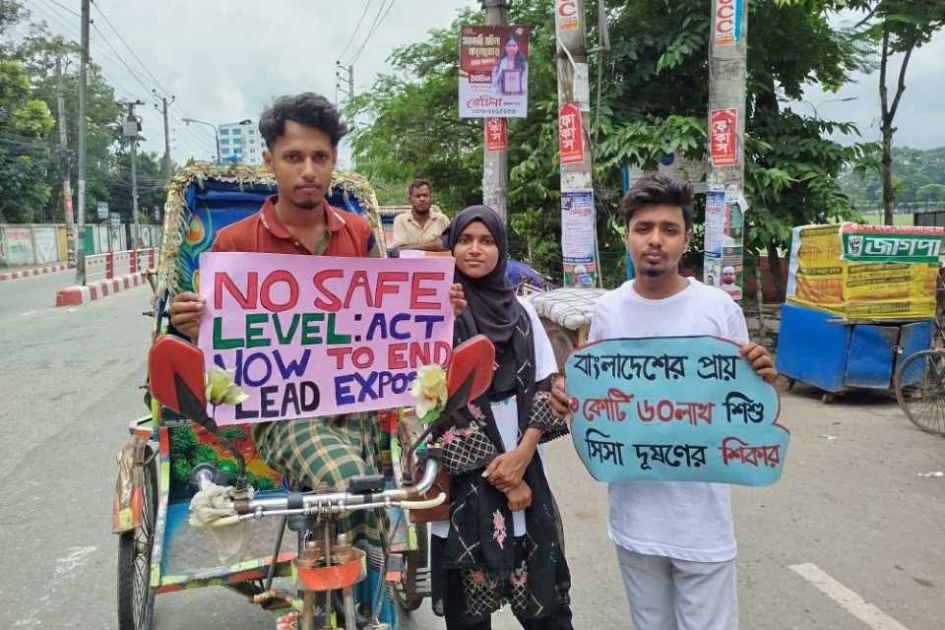
Students, teachers, environmental activists, government representatives and young people from different communities participated in the programme, carrying banners and placards calling for stronger action against lead pollution.
Sazid Mahmud, Barishal divisional coordinator of YouthNet Global, said preventing lead poisoning requires stronger local engagement and accountability.
“Lead pollution is not only an environmental issue; it is a question of children’s rights, public health and environmental justice. Ensuring a safe childhood requires stronger local awareness, accountability and collective action,” he said.
Kazi Saifuddin, assistant director of the Department of Environment’s Barishal office, said government agencies are working with NGOs, communities and industries to strengthen implementation of regulations and promote safer practices to reduce lead exposure.
Battery transition brings new opportunities and challenges
While Bangladesh faces the immediate challenge of lead pollution, policymakers and industries are also seeking to accelerate a shift towards modern battery technologies.
Under the fiscal measures announced in the 2026-27 national budget, the government has provided customs and import duty exemptions on raw materials used for manufacturing lithium-ion and sodium-ion batteries until June 30, 2030.
Industry stakeholders said the move could reduce production costs, attract new investment and strengthen domestic manufacturing capacity.
Demand for advanced batteries is increasing due to the expansion of electric three-wheelers, solar energy systems and industrial applications. However, wider adoption has previously been limited by high prices, dependence on imported finished products and limited local production capacity.
Environmentalist Syed Chowdhury said encouraging local battery production could support renewable energy expansion while reducing environmental risks linked to unsafe recycling.
“This is an important step towards a sustainable energy future. By encouraging local production of lithium-ion batteries, Bangladesh can support renewable energy growth while reducing environmental risks associated with unsafe lead-acid battery recycling,” he said.
Experts noted that lithium-ion and sodium-ion batteries are not automatically free from environmental challenges. Responsible mineral sourcing, safe manufacturing practices and effective end-of-life management will be essential to ensure their long-term benefits.
Need for responsible battery management
Industry players, particularly manufacturers operating from Kaliakoir Hi-Tech Park in Gazipur, welcomed the government initiative but urged authorities to simplify implementation procedures.
Mohammad Mahmudul Haque, a director at Leo ICT Cables PLC, said the tax relief is a significant step but administrative requirements need to be streamlined to help local manufacturers expand production.
He said processes involving technical committees, VAT officials, SRO approval and CPC codes should be simplified to support faster implementation.
“If the government ensures a smooth implementation process and facilitates necessary approvals, local battery production could expand rapidly and contribute to strengthening the country’s energy sector,” Haque said.
Energy analysts said Bangladesh has the potential to develop a competitive battery manufacturing sector, but success will depend on technology transfer, skilled workforce development, responsible supply chains and effective recycling systems.
They said sodium-ion batteries may reduce dependence on some critical minerals used in conventional battery production, but all battery technologies require responsible end-of-life management.
Environmental groups urged policymakers to introduce battery recycling regulations alongside production incentives to ensure that Bangladesh’s battery transition remains environmentally responsible.
Analysts said the country’s emerging battery industry could support economic growth and clean energy expansion, but long-term success will depend on whether production growth is matched with strong environmental safeguards, worker protection and responsible recycling systems.
Environmental justice advocates said the transition towards newer battery technologies provides an opportunity to reduce reliance on traditional lead-acid batteries, but the country must develop safe collection, recycling and disposal systems.
“Promoting lithium-ion and sodium-ion battery production is an important step for Bangladesh’s clean energy transition, but the country must also develop safe collection, recycling and disposal systems and a just transition,” said Sohanur Rahman, executive coordinator of YouthNet Global.
“Without responsible battery management, we risk replacing one environmental challenge with another,” he added.
He said Bangladesh needs a comprehensive battery management framework and just transition covering both existing lead-acid batteries and emerging technologies.
“Strong environmental safeguards, worker protection and environmentally sound recycling systems must be developed alongside battery manufacturing incentives to ensure a truly sustainable transition,” he said.




