

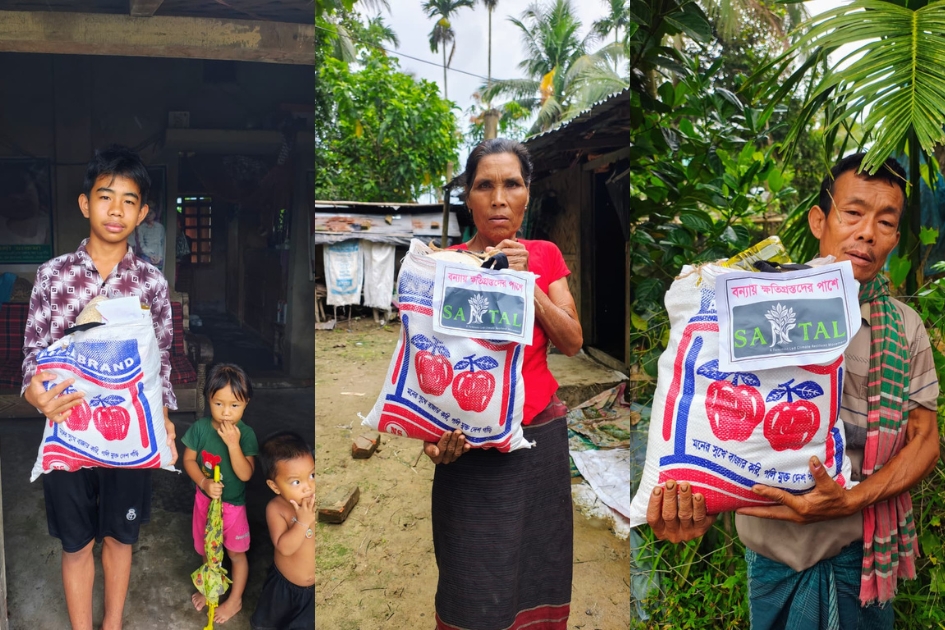

Emergency food assistance reached 25 Indigenous families in Khalkul Para through a public fundraising campaign, while SANTAL urged greater long-term investment in Indigenous rights, climate resilience and locally led adaptation.
A feminist-led climate resilience movement has provided emergency food assistance to 25 Indigenous families affected by recent flooding in southeastern Bangladesh’s Khagrachhari district and called for greater support for communities facing climate-induced disasters.
On 17 July, SANTAL distributed emergency food packages to 25 Indigenous families in Khalkul Para of Kobakhali Union in Dighinala Upazila, one of the communities affected by the recent flooding, according to the organization.
The relief effort was funded through an emergency public fundraising campaign supported by individuals and contributors who responded to SANTAL’s appeal for solidarity with affected communities.
The distribution took place in the presence of community members and local media representative Md. Al Amin, former president of the Dighinala Press Club.
Speaking about the initiative, SANTAL founder Javed Ziauddin said Indigenous communities, particularly women and girls, were among those who bore the greatest burden of climate-induced disasters while receiving the least attention in humanitarian responses.
“We call upon the Government of Bangladesh, humanitarian agencies, development partners, donors and all relevant stakeholders to scale up support for Indigenous communities affected by climate-induced disasters.
Beyond emergency relief, there is an urgent need for long-term investment in climate resilience, Indigenous rights, sustainable livelihoods and locally led adaptation initiatives. Climate justice will remain incomplete unless Indigenous communities are recognized as rights holders and active partners in shaping solutions,” he said.
SANTAL also thanked those who contributed to the fundraising campaign.
“We are deeply grateful to every individual who stood with us. Every contribution, regardless of its size, became a source of hope for families facing immense hardship. This initiative reflects the strength of collective action and reminds us that solidarity can bridge distances and save lives,” the organization said.
While the emergency response reached 25 families in Khalkul Para, SANTAL said many more Indigenous households across the Chittagong Hill Tracts in southeastern Bangladesh continued to face the impacts of recurrent climate-induced disasters.
The organization said humanitarian assistance should be inclusive, culturally responsive and grounded in the rights and priorities of Indigenous communities.
SANTAL describes itself as a feminist-led climate resilience movement that works alongside coastal and Indigenous women to advance climate justice, environmental sustainability, gender equality and community-led solutions through advocacy, grassroots organizing, humanitarian response and research.




