

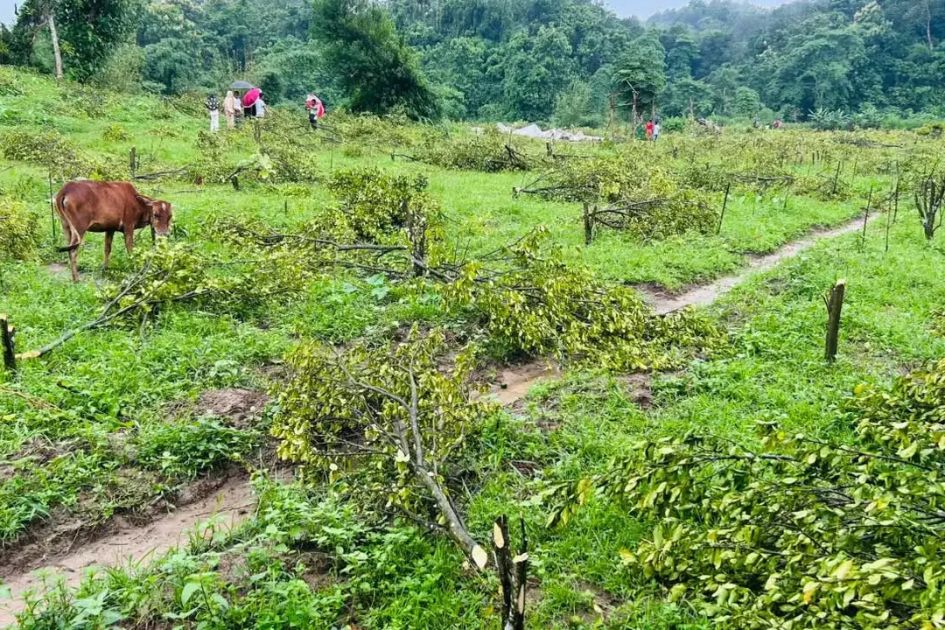



The disputed eviction has intensified scrutiny of forest governance, with authorities ordering a high level investigation into allegations of corruption, selective enforcement and the destruction of a long-established orchard inside protected forest land.
Bangladesh has launched a high-level investigation after a controversial forest eviction operation in Moulvibazar district left around 1,200 mature orange trees cut down, with the affected family alleging the action was retaliatory after they stopped making illegal payments to local forest officials. The Bangladesh Forest Department rejects the allegations, insisting the operation was a lawful effort to recover protected forest land from illegal occupation.
The incident took place in Kalinji area under the Adampur Forest Beat of Rajkandi Forest Range in Kamalganj upazila, where the Forest Department, the local administration and police conducted a joint eviction drive on July 16 in the presence of the Assistant Commissioner (Land).
According to the Forest Department, approximately five acres of land classified as protected forest under Section 20 of the Forest Act were recovered from illegal occupation during the four-hour operation.
The affected family, however, claims they had spent the past eight years developing the orchard after investing between Tk 1.5 million and Tk 2 million through high-interest loans obtained from non-governmental organisations.
The orchard, consisting mainly of orange trees alongside papaya and bottle gourd cultivation, was reportedly only three months away from harvesting. The family estimated it would have generated between Tk 2.5 million and Tk 2.6 million in income, allowing them to repay a significant portion of their outstanding loans.
“We borrowed heavily believing we could repay the loans after selling the oranges this season,” orchard owner Salma Begum said.
“Everything we built over the past eight years has been destroyed. We no longer know how we will repay the loans or support our family.”
Her husband, Alim Ullah, said the family had invested years of labour and borrowed money into transforming the land into a productive orchard.
The family alleges they had regularly made unofficial monthly payments to certain local forest officials to continue cultivating the land. According to them, after financial hardship prevented them from making further payments, the orchard became the target of the eviction drive.
Salma Begum’s mother-in-law also alleged that officials demanded higher payments shortly before the operation.
The family’s allegations of unofficial payments and retaliatory enforcement could not be independently verified.
Residents questioned why authorities waited eight years before taking action if the orchard had been illegal from the outset.
“If the plantation violated the law, why was it allowed to grow until the trees became productive?” one local resident asked.
Several residents also claimed the family had previously shared information with journalists regarding alleged irregularities involving unofficial leasing of forest land and illegal collection of money by some local officials. They believe this may have contributed to the decision to target the orchard, although no independent evidence has confirmed the allegation.
Residents further alleged that while the orange orchard was cleared, cultivation by other occupants on nearby forest land, including betel leaf and shifting cultivation, remained untouched. The family also claimed their irrigation equipment was damaged during the operation.
Responding to the allegations, Rajkandi Range Officer Pritam Barua denied any selective enforcement.
He said any occupation inside protected forest land is illegal regardless of whether the land is used for oranges, pineapples, betel leaf or any other crop.
“Our eviction operations are conducted regularly to recover illegally occupied forest land,” he said.
“Whether the occupation continued for eight years or 10 years, it remains illegal under the law.”
When asked why the orchard remained untouched for years if it had been illegal from the beginning, he did not directly respond.
Sylhet Divisional Forest Officer Mohammad Abdur Rahman said Bangladesh’s forest regulations do not permit commercial fruit orchards on hills or elevated areas within protected forests.
He explained that under the historical village settlement system introduced in the early twentieth century, cultivation rights were limited to low-lying agricultural land for rice farming and did not extend to commercial orchards on forested hills.
“The policy is to restore natural forest vegetation inside protected forests rather than allow fruit plantations,” he said.
He added that if credible evidence emerges that any Forest Department officials were involved in corruption or illegal financial transactions, appropriate disciplinary and legal action would be taken.
The incident has drawn widespread attention following media reports, prompting authorities to establish a high-level investigation committee.
According to Kamalganj Upazila Nirbahi Officer, the committee is headed by the Additional Divisional Commissioner and includes representatives from the Forest Department and the district administration.
The committee has been tasked with conducting an on-site investigation, determining the facts surrounding the operation and recommending any necessary legal or administrative measures.
Environmental experts note that recovering illegally occupied protected forests remains essential for biodiversity conservation, watershed protection and Bangladesh’s climate resilience efforts. At the same time, they say enforcement actions should be transparent, proportionate and consistent, while any credible allegations of corruption, bribery or abuse of authority should be thoroughly investigated.
The controversy has reignited broader debate over how Bangladesh can balance forest conservation with the livelihoods of vulnerable communities. Observers say restoring degraded forests is critical to meeting the country’s environmental commitments, but public confidence in conservation efforts also depends on transparent governance, accountability and the fair application of environmental laws.




