

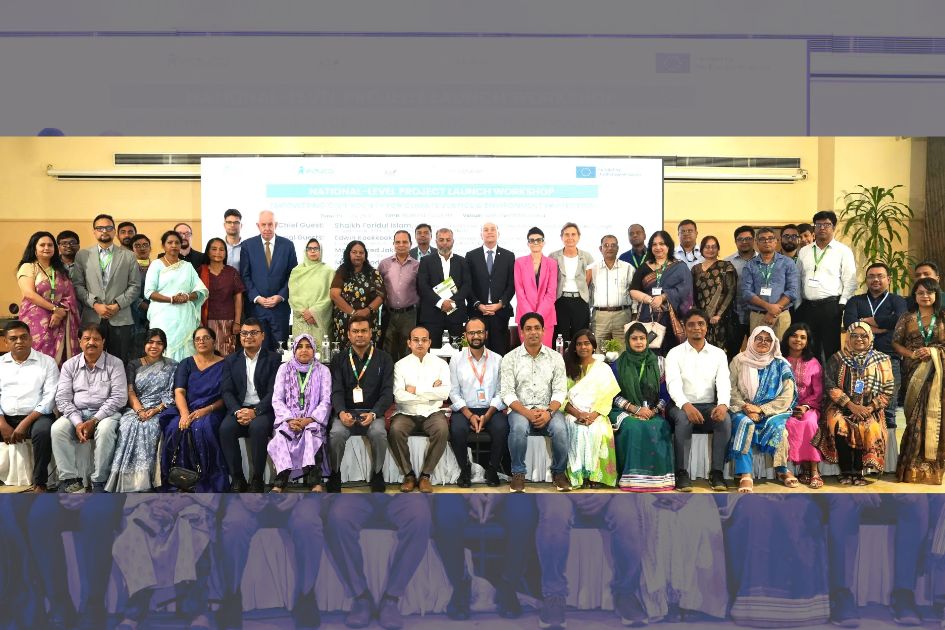



The project will support 18 grassroots groups, including women-led, Indigenous Peoples’, Dalit and youth organisations, to engage in advocacy, evidence generation, environmental governance and monitoring climate-related human rights issues.
A European Union-funded initiative has been launched to strengthen grassroots civil society organisations across Bangladesh and advance climate justice, environmental protection and the rights of climate-vulnerable communities.
The project, “Empowering Civil Society for Climate Justice and Environment Protection”, was officially launched on Sunday at a national workshop held at Hotel Lakeshore Grand in Dhaka.
Welthungerhilfe (WHH) is implementing the initiative in partnership with Educo, Manusher Jonno Foundation and Uttaran.
The project aims to strengthen the institutional capacity, advocacy skills and collaborative networks of grassroots civil society organisations while promoting locally led climate action and better environmental governance.
Senior government officials, European Union representatives, development partners, civil society organisations, academics, youth leaders, environmental experts and representatives of climate-affected communities attended the launch workshop to discuss responses to the growing impacts of climate change in Bangladesh.
Bangladesh’s State Minister for Environment, Forest and Climate Change Shaikh Faridul Islam attended as the chief guest and called for climate initiatives to deliver tangible results.
“We have to focus more on results. This project is funded by the European Union. I admire them for their continuous support. Our Prime Minister is a result-oriented person who has a keen interest in and a strong focus on climate justice issues. We will support any initiative that brings positive change to our people and our country,” he said.
Edwin Koekkoek, representing the Delegation of the European Union to Bangladesh, reaffirmed the bloc’s commitment to helping Bangladesh address climate change while advancing human rights and inclusive development.
“The EU remains fully committed to working with Bangladesh to address climate change, promote human rights and strengthen civil participation to ensure inclusive development. As we launch the project today, the EU expresses its shared commitment to ensuring that climate action reaches those who need it most and helps shape a better future,” he said.
Welthungerhilfe Bangladesh Country Director Jonas Wiahl said collaboration and mutual trust among stakeholders would be crucial to the project’s success.
“By working together, learning from one another and building shared strength, we will create long-lasting transformative change. The success of the project cannot be measured only by the activities, but also by the partnerships, the trust in each other and the positive changes we achieve together,” he said.
Shaheen Anam, Executive Director of Manusher Jonno Foundation, said meaningful progress on climate justice would require close cooperation among civil society, public institutions and local communities.
“The outcome of the project cannot be achieved by any donor, partner or other stakeholder alone. It needs a high level of collaboration among civil society, local authorities and citizens’ groups,” she said.
Afsari Begum, Head of Project at Welthungerhilfe Bangladesh, presented an overview of the initiative during the workshop.
Representatives of climate-affected communities also shared their experiences in a session moderated by Tazeen Hossain, Head of Programme at Educo Bangladesh.
Special guests included officials from Bangladesh’s Ministry of Environment, Forest and Climate Change, the NGO Affairs Bureau, the Department of Disaster Management and the Ministry of Chittagong Hill Tracts Affairs.
A high-level panel discussion examined the role of civil society organisations in advancing climate justice, strengthening environmental governance, protecting human rights and promoting community-led climate resilience.
Speakers called for stronger collaboration among government institutions, development partners, civil society and local communities to deliver sustainable and inclusive climate solutions.
Under the project, 18 grassroots civil society organisations will receive Financial Support to Third Parties (FSTP). Beneficiaries will include women-led organisations, Indigenous Peoples’ organisations, Dalit organisations and youth groups.
The initiative will strengthen their organisational capacity, advocacy and networking skills, evidence generation and monitoring of climate-related human rights issues, allowing them to participate more effectively in policymaking and environmental governance.
Speakers at the event said climate change was not only an environmental challenge but also an issue of justice, equity and human rights.
They stressed the need to empower local organisations and frontline communities so that people most affected by climate change could play a greater role in shaping the policies and decisions affecting their lives.
Organisers said the initiative reflected the European Union’s continued commitment to supporting democratic participation, inclusive climate resilience and stronger civil society in Bangladesh.
They said the project would place localisation, gender equality, social inclusion and community leadership at the centre of climate action.




