

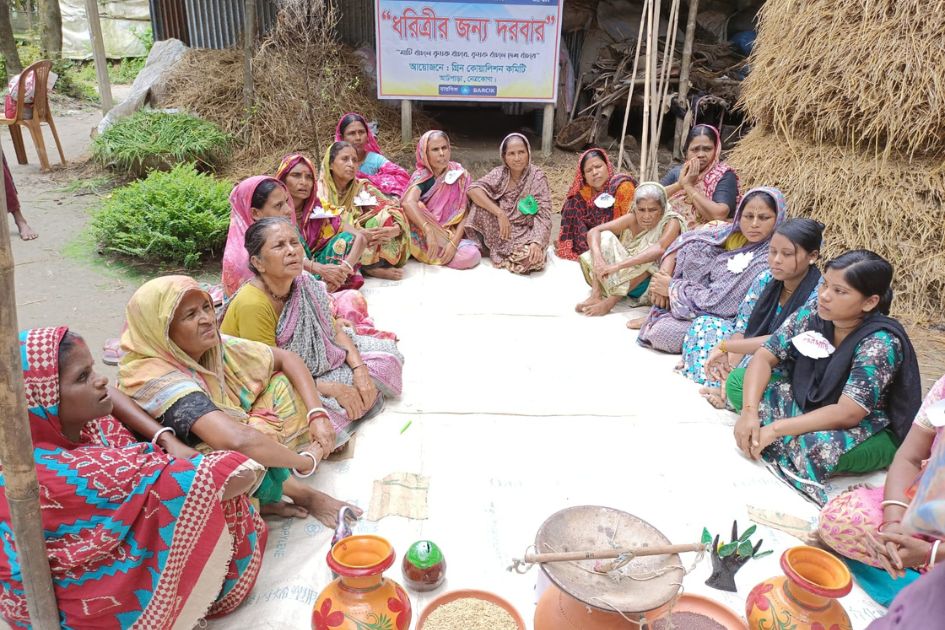



Community members used interactive discussions to examine how environmental damage is affecting local livelihoods, highlighting traditional knowledge, shared responsibility and the importance of protecting soil, trees and natural resources.
Farmers, fishers, potters, blacksmiths, young people, women and elderly residents gathered in Bakharpur village of Atpara upazila in Bangladesh’s Netrokona district for an event titled “Dialogue for the Earth”, where participants discussed environmental degradation and the need to protect natural resources.
The event, organised by the Green Coalition Committee of the private research organisation BARCIK under the theme “Our Earth, Our Strength”, was held on Tuesday at the Mati Jibon Kumar Women’s Organisation.
BARCIK’s Parbati Rani Singha opened the programme with welcoming remarks, saying people were being forced to struggle against nature in order to survive.
“Human activities that destroy the environment are heating the planet. Climate change is taking place. As a result, rising global temperatures, reduced rainfall, hot and dry weather, the impact of El Niño and natural disasters such as soil erosion are occurring,” she said.
She added that population growth, excessive use of chemicals in agriculture, deforestation, over-extraction of groundwater, politics surrounding water, and the disappearance of wetlands were increasing natural disasters and desertification. “People in this country have fought and adapted to these disasters for generations. We have only one Earth. It cannot be destroyed through excessive consumption and luxury,” she said.
Speaking as the chief guest, farmer organiser Sayed Ahmed Khan Bachchu said, “If the Earth could speak, what would it tell us about our actions?”
He said that thought inspired the organisation of “Dialogue for the Earth” in Bakharpur village of Atpara upazila.
According to Bachchu, two of the programme’s most distinctive segments were the “Parliament of the Soil” and the “Scales of Justice”.
During the “Parliament of the Soil”, farmers shared their views, describing the soil as “our mother”. Some participants said species including turtles, porcupines, baghailla, ghoil snakes, henja and crows that were once common in the area were no longer seen. Others said, “Trees and soil are our money-making machines. Our families survive only if they remain healthy. That is why it is our responsibility to protect trees and soil.”
In the “Scales of Justice” session, participants divided human activities into two categories: “The Earth Smiles” and “The Earth Cries”. Farmers assessed which actions benefit nature and which cause environmental harm.
At the conclusion of the programme, organisers said the discussions showed that people’s own life experiences could teach more about environmental protection than broad public statements.
“Soil must survive for farmers to survive and if farmers survive, the country will survive,” the organisers said at the close of the event.




