

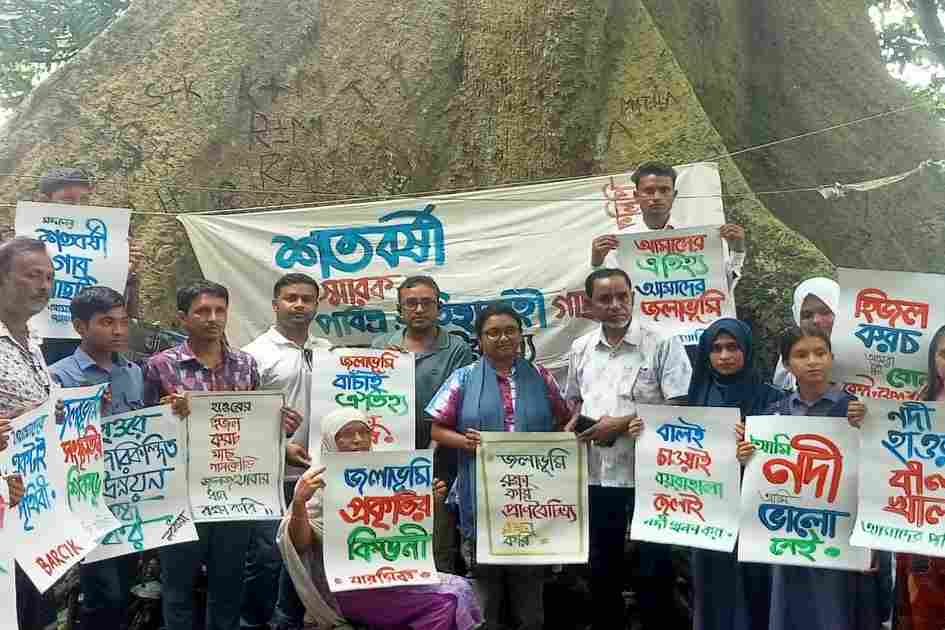

Villagers, environmental activists and BARCIK urged authorities to protect Netrakona’s century-old heritage trees, wetlands and aquatic biodiversity, warning that tree felling and water pollution threaten local ecosystems.
A climate march and village discussion were held in Netrakona on today, demanding protection for century-old heritage trees and aquatic life in the district, with organisers later submitting a memorandum to local authorities seeking state conservation and legal action.
The programme was organised by the private research organisation BARCIK and the Green Coalition Committee at 11:00 am in Monohorpur village of Madan upazila under a 300-year-old memorial silk cotton tree regarded as a historic landmark. Members of the Green Coalition Committee, leaders of local environmental groups, teachers, students, farmers and representatives of civil society took part.
Opening the event, Md. Nur-e-Alam Siddiqui, general secretary of the Green Coalition Committee in Madan upazila, said the district’s rural landscape still holds green croplands, village legends, hundreds of ponds, rivers, century-old trees and many species of birds and fish. But he said natural resources were declining steadily as wetlands were being grabbed, rivers, canals and marshes were drying up and fish sanctuaries, breeding grounds, endangered native fish species and the traditional livelihoods of fishers were disappearing.
He said urgent steps were needed to protect 13 century-old trees in the upazila, including the 300-year-old silk cotton tree in Monohorpur village, the banyan tree at Joybangla Bazar, the banyan tree in Keshjani village, the hijal tree in Khaliajuri haor, the gab tree in Barati village, the hijal tree at Balai Par and the banyan tree at Uchitpur Bazar. He also called for excavation and protection of the rivers, canals, wetlands, haors and ponds in Madan upazila and for action to conserve aquatic biodiversity in the haor region.
The programme began with an open village discussion under the historic 300-year-old silk cotton tree in Monohorpur village. Speakers said the century-old trees were not only part of nature’s beauty but also living witnesses to local history and vital to the area’s ecosystem. At the same time, they said aquatic life in this haor and wetland-rich region was facing severe threat.
They warned that indiscriminate tree felling and water pollution were pushing native fish and aquatic plants toward extinction. At a time of worsening climate crisis, they said protecting these natural resources had become urgent. “If we fail to protect the century-old trees around us and the aquatic life of the haors, the environment and the lives of people in this region will face an extreme threat. So we must build collective resistance now,” the speakers said.
After the discussion, a climate march was held with the participation of environmental activists, local volunteers and villagers. The procession moved through different roads in Monohorpur village and ended beneath the century-old silk cotton tree with remarks by Green Coalition Committee president Imam Hossain Mehedi.
Later, representatives of the Green Coalition and BARCIK submitted a memorandum to the Madan upazila administration. In the memorandum, they strongly demanded that all century-old, religiously significant, historically sacred and memorial trees in Madan upazila and across Netrakona district be listed and preserved by the state. They also called for effective legal measures to protect aquatic life in the haor region.




