

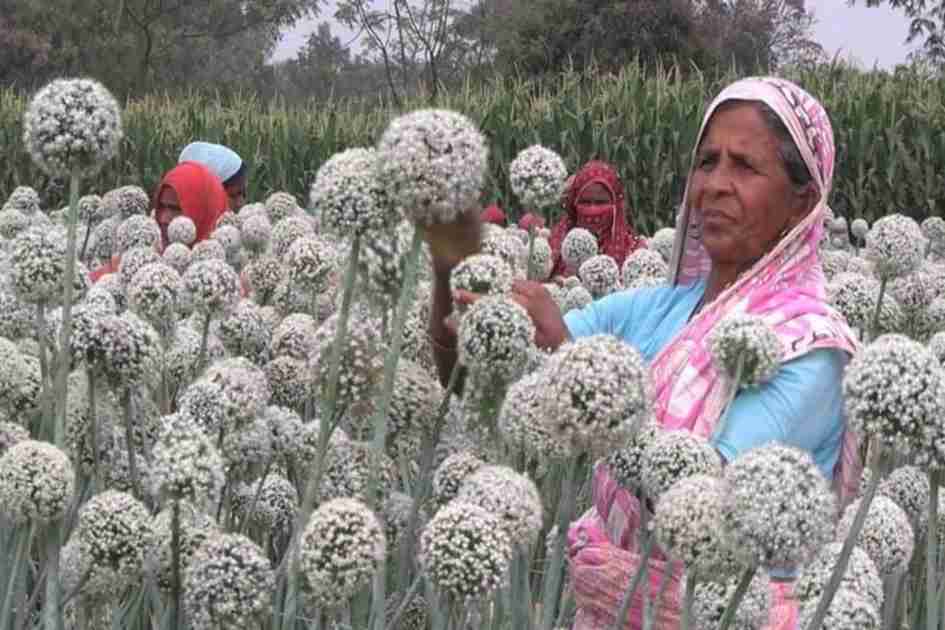

In northern Bangladesh, disappearing bees are forcing farmers into manual pollination, exposing pesticide-driven ecological imbalance and raising concerns over food security, rural livelihoods and the sustainability of agriculture systems.
At sunrise in northern Bangladesh, fields of onion flowers bloom in soft white clusters. But instead of the familiar hum of bees, it is people, mostly women, moving carefully from plant to plant and transferring pollen by hand.
In Thakurgaon district, the disappearance of pollinating bees is forcing farmers into labor-intensive hand pollination, revealing a deeper ecological crisis driven largely by the excessive use of chemical pesticides.
Farmers say that without bees, onion flowers fail to produce viable seeds unless pollinated manually. What was once a natural process is now dependent on human labor.
“We did not have to do this before,” said farmer Shafiqul Islam from Baliadangi, where onion seed cultivation is most concentrated. “Now, without bees, we have no choice.”
While farmers in Thakurgaon have adapted with resilience, their experience reflects a broader global trend. The decline of pollinators is increasingly threatening agricultural systems worldwide.
In Bangladesh, the response has been immediate and visible, with human hands replacing bees. For now, the fields remain productive, sustained by the careful work of hundreds of workers. But farmers and experts alike agree that this is not a long-term solution.
Without urgent action to restore pollinator populations and protect ecosystems, the cost of food production will continue to rise, and the balance between nature and agriculture will become even more fragile.
A booming crop built on a fragile system
Onion seed, locally known as black gold, has become one of the most profitable crops in the region. Within just five to six months, farmers can earn substantial returns, driving a rapid expansion in cultivation.
According to the Department of Agricultural Extension, onion seed farming in Thakurgaon has grown from just 40 hectares in 2020 to more than 1,125 hectares in the 2025 to 2026 season.
On average, one unit of land, locally known as a bigha, approximately 0.13 hectares, produces 150 to 160 kilograms of seeds. With market prices reaching about 2,000 taka per kilogram, farmers can generate up to 300,000 taka in revenue, with profits ranging between 100,000 and 150,000 taka.
Yet this success story is increasingly dependent on a fragile workaround, human pollination.
Women step in where bees have disappeared
The shift has created new employment opportunities, particularly for rural women who often struggle to find consistent work.
Roksana Bibi, a local worker, now earns around 400 taka a day pollinating onion flowers.
“Before this, there were days with no work,” she said. “Now I can support my family and pay for my children’s education.”
Hundreds of workers, including teenagers, are engaged in this delicate process, transforming pollination into a labor-driven rural industry.
A warning sign of ecological imbalance
Experts warn that the decline of bees is not an isolated issue but part of a wider environmental crisis. The overuse of pesticides, habitat loss and changing climate patterns are all contributing to the disappearance of pollinators.
“Bangladesh is witnessing a silent ecological crisis where the loss of pollinators like bees is disrupting entire ecosystems and threatening food security,” said Sohanur Rahman, Executive Coordinator of YouthNet Global. “Hand pollination may offer a temporary solution, but it is not sustainable. We must urgently protect our ecosystems, reduce harmful pesticide use and restore habitats to bring pollinators back.”
Globally, pollinator decline has raised alarms among scientists and policymakers. In Bangladesh, however, the consequences are already visible in farmers’ fields.
Market uncertainty and policy gaps
Despite rising production, farmers face challenges in accessing stable markets. Many report that they cannot sell seeds through formal government channels, leaving them exposed to fluctuating prices.
“If the government ensured seed procurement and provided agricultural loans, more farmers would invest in this sector,” said farmer Jamal Uddin.
Some farmers also say they are not receiving adequate subsidies or financial support to expand production sustainably.
Local agricultural officials have acknowledged these concerns, noting that efforts are underway to provide technical assistance and explore mechanisms for credit support and seed procurement.




