

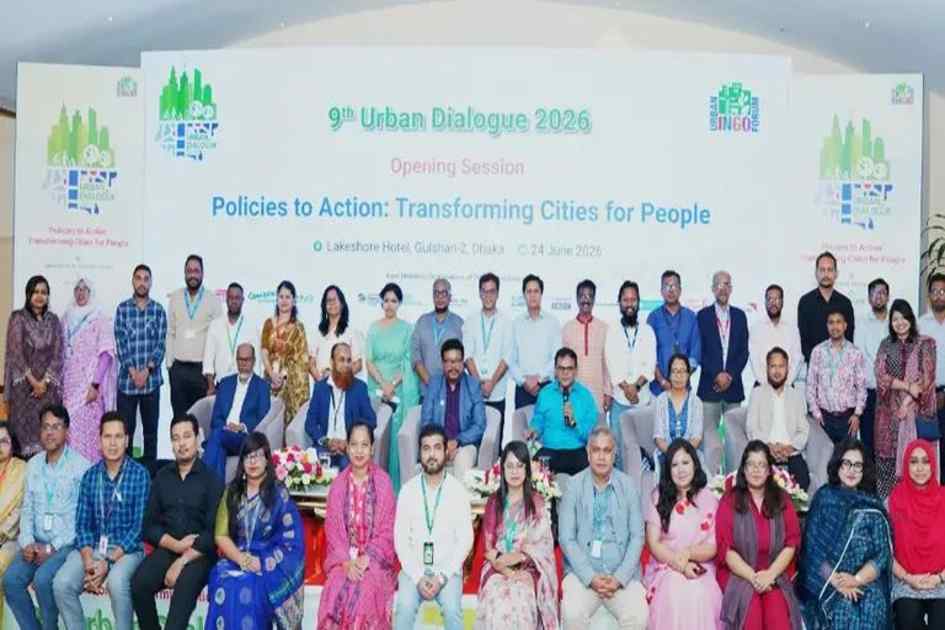

The 9th Urban Dialogue 2026 concluded in Dhaka on Wednesday with a renewed call for the urgent implementation of major national urban policy frameworks to address escalating climate risks, housing shortages and livelihood pressures driven by rapid urbanisation.
Organised by the Urban INGO Forum Bangladesh, the day-long dialogue brought together government officials, urban planners, development partners and community representatives, highlighting the need for stronger coordination between state and non-state actors to translate policies into practical urban solutions.
The Urban INGO Forum Bangladesh, a platform of more than 20 international development organisations, said its work focuses on strengthening policy coherence, reducing urban inequality and supporting sustainable urban governance through shared national and global expertise.
The discussions centred on the swift implementation of three key national frameworks: the National Urban Policy 2025, the Spatial Planning Act 2026 and the National Adaptation Plan (2023-2050). Participants stressed that these frameworks must move beyond policy design into effective implementation to address Bangladesh’s rapidly changing urban challenges.
Delivering the keynote presentation, Professor Dr. Adil Muhammad Khan of Jahangirnagar University and Executive Director of the Institute for Planning and Development said Bangladesh’s urban transition demands urgent structural reform.
“Given infrastructural deficits and deep socio-economic inequality, inclusive urban governance is now a critical necessity,” he said, linking the issue to Bangladesh’s upcoming LDC graduation and increasing global competitiveness pressures.
A 16-point declaration adopted at the dialogue called for recognising access to safe water, electricity and sanitation as basic urban rights for all citizens, including slum dwellers, regardless of land tenure status.
The declaration also urged the formulation of a National Heat Action Plan to respond to rising urban temperatures, reflecting growing climate stress in densely populated cities. It further recommended the establishment of community-based childcare hubs for working mothers and the formal integration of waste management and sanitation workers into municipal systems, ensuring fair wages, occupational safety and social protection.
Participants also called for scaling up green and blue infrastructure to strengthen urban resilience against flooding, heatwaves and other climate-induced shocks, particularly for low-income and vulnerable communities.
Three technical sessions focused on affordable housing, urban livelihoods and climate-resilient development pathways. Organisers said the sessions aimed to translate policy discussions into actionable recommendations while community representatives shared their lived experiences of heat stress, waterlogging and inadequate access to essential services.
In the closing session, Director General of the Department of Disaster Management, Rezwanur Rahman, attended as chief guest and expressed optimism about implementing the recommendations.
At the opening session, Secretary of the Ministry of Disaster Management and Relief, Md. Saidur Rahman Khan, emphasised the importance of integrating disaster risk reduction into broader development planning.
“Without integrating disaster management into development programmes, sustainable progress is not possible,” he said, noting that Bangladesh has made globally recognised progress in disaster preparedness while warning that rapid urbanisation now requires stronger urban resilience systems.
He added that the government is working to build around 100,000 urban volunteers for earthquake preparedness, with nearly 50,000 already trained. Coordination among the Fire Service, the Meteorological Department and other agencies is also being strengthened alongside efforts to improve preparedness infrastructure, public awareness and early warning systems.
Experts including urban planner Dr. K M Nuruzzaman, climate researcher Prof. Dr. Naznin Ahmed and sociologist Dr. M A Kashem joined panel discussions alongside representatives of international development organisations and urban practitioners.
Speaking to The Climate Watch on the sidelines of the dialogue, Sohanur Rahman said urban justice must be placed at the centre of national planning.
“Housing justice, climate resilience and equitable transport systems are not separate agendas. They are deeply interconnected with the future of young people in rapidly growing cities. Without investing in inclusive housing, safe mobility and youth participation in decision-making, urban transition will remain incomplete and unequal,” he said.




