




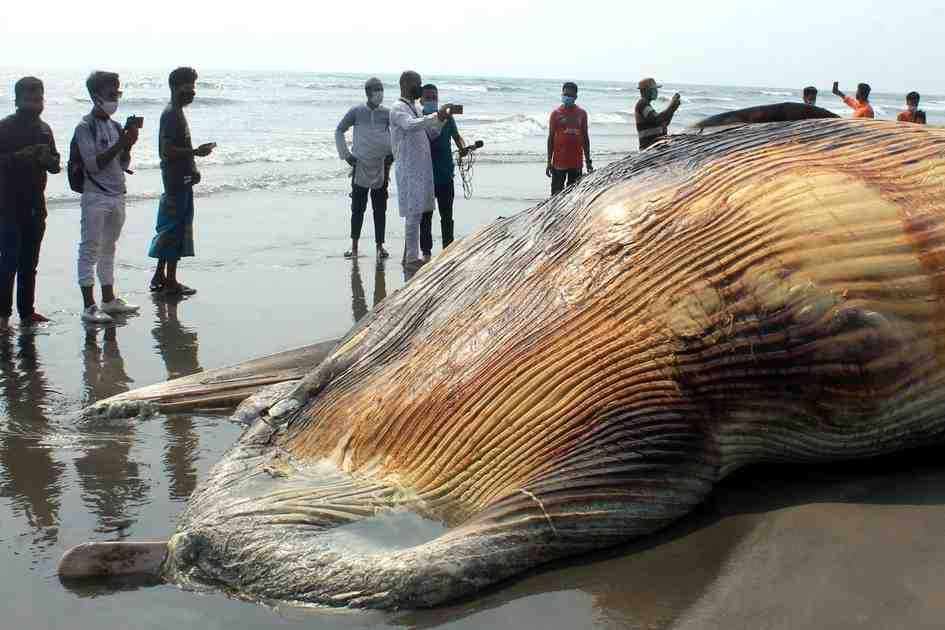
A decomposing whale washed ashore in Kutubdia, alarming residents and highlighting growing threats to marine mammals from fishing nets, pollution and vessel collisions in Bangladesh’s coastal waters.
A large dead whale has washed ashore on the coast of Kutubdia in Cox’s Bazar, raising concerns about the rising deaths of marine mammals along Bangladesh’s coastline.
The carcass was discovered late Saturday night around 9:00 pm on the western beach of South Dhurung union in Kutubdia upazila. Local residents later buried the whale in a sand dune to prevent the spread of a strong foul smell and potential health risks.
According to local sources, fishermen first spotted the massive whale while fishing in the Bay of Bengal. Several trawlers then worked together to tow the animal closer to the Kutubdia coast using ropes. By the time they approached the shore the whale was already dead and its decomposing body had begun emitting a strong odor.
After the fishermen left the carcass floating at sea, tidal currents later carried it toward the shore where it became stranded in the sand dunes along Kutubdia’s western beach.
Local fisherman Mujibur Rahman said the whale’s body had started swelling as decomposition progressed. During this process gases including hydrogen accumulate inside the carcass, producing a strong smell and posing potential health risks for nearby residents.
Considering the situation local authorities quickly arranged to remove the carcass. Using an excavator workers dug a pit in the sand dunes and buried the whale after nearly an hour of effort.
Union Parishad Chairman Alauddin Al Azad said fishermen first noticed the dead whale while fishing in the Bay of Bengal and several trawlers later brought it near the coast. As the odor intensified the fishermen left it at sea before tidal waters eventually pushed the carcass onto the beach where it became trapped in the sand dunes.
Residents estimate the whale measured roughly five to six meters in length and weighed more than two to three tonnes. In such incidents local administration or the Department of Environment usually manages the response. However officials were not present in the area at the time prompting local authorities to take immediate action and bury the whale.
Data from the New York based Wildlife Conservation Society (WCS) show that at least 67 dolphins and whales have died in Bangladesh between January 2019 and September this year. Among them 61 were dolphins and six were whales.
The data indicate that about 83 percent of these deaths occurred after animals became entangled in fishing nets while 17 percent were caused by collisions with trawlers or ships. Of the animals trapped in nets around 78 percent were caught in gill nets.
Researchers say whale deaths generally occur due to five main causes including natural death entanglement in fishing nets collisions with large vessels ingestion of plastic waste and the effects of chemical pollution.
Whales typically feed by taking in mouthfuls of seawater and filtering out microorganisms small fish and shrimp like creatures. During this process floating plastic in the ocean can also enter their stomachs which can obstruct digestion and gradually lead to death researchers said.
Bangladesh has recorded similar incidents in recent years. In 2021 two dead whales washed ashore along the country’s coast within two days including one measuring about 16 meters in length. Officials at the time suspected marine pollution could have contributed to the deaths.
Another dead whale measuring about 35 feet long was found floating in the Payra River in Patuakhali on July 2 2024.
Researchers note that whales can travel up to around 1,600 kilometers in a year. Strong tidal currents may bring them close to the coast where they can become stranded during low tide leading to death.
Scientists warn that marine pollution entanglement in fishing nets and collisions with vessels are increasing the risk of deaths among whales and dolphins in coastal waters.




